Welcome back. In our previous lesson, we examined the Accident Fallacy, where a general rule is incorrectly applied to a specific, exceptional case. We saw how context is key to dismantling this error. Today, we'll explore a related error in reasoning: the False Analogy.
This lesson will teach you to deconstruct and counter arguments that rely on misleading comparisons. A false analogy attempts to discredit a choice by comparing it to something else that is superficially similar but fundamentally different and usually negative. This is a common rhetorical trick used to pass judgment without making a direct, logical argument. By the end of this lesson, you will be able to spot these flawed comparisons and dismantle them with sharp, precise rebuttals tailored to our two key scenarios.
The Logic of Analogy: Valid vs. False
An argument from analogy is not inherently fallacious. It's a powerful tool for reasoning and explanation. A valid analogy follows this structure:
- Object A and Object B share several relevant properties (P, Q, R).
- Object A has an additional property, Z.
- Therefore, it is probable that Object B also has property Z.
The strength of this argument depends entirely on the relevance of the shared properties (P, Q, R) to the inferred property (Z). The False Analogy fallacy occurs when the shared properties are not relevant, or when there are critical, unstated differences between A and B that undermine the comparison.
As a statistician, you can think of this in terms of predictive modeling. A good analogy is like a model where the features (shared properties) have strong predictive power for the outcome (the inferred property). A false analogy is like a model built on irrelevant features or one that ignores a crucial confounding variable that invalidates the entire prediction. It creates an illusion of a logical connection where none exists.
The flowchart below illustrates the flawed process of drawing an incorrect analogy.
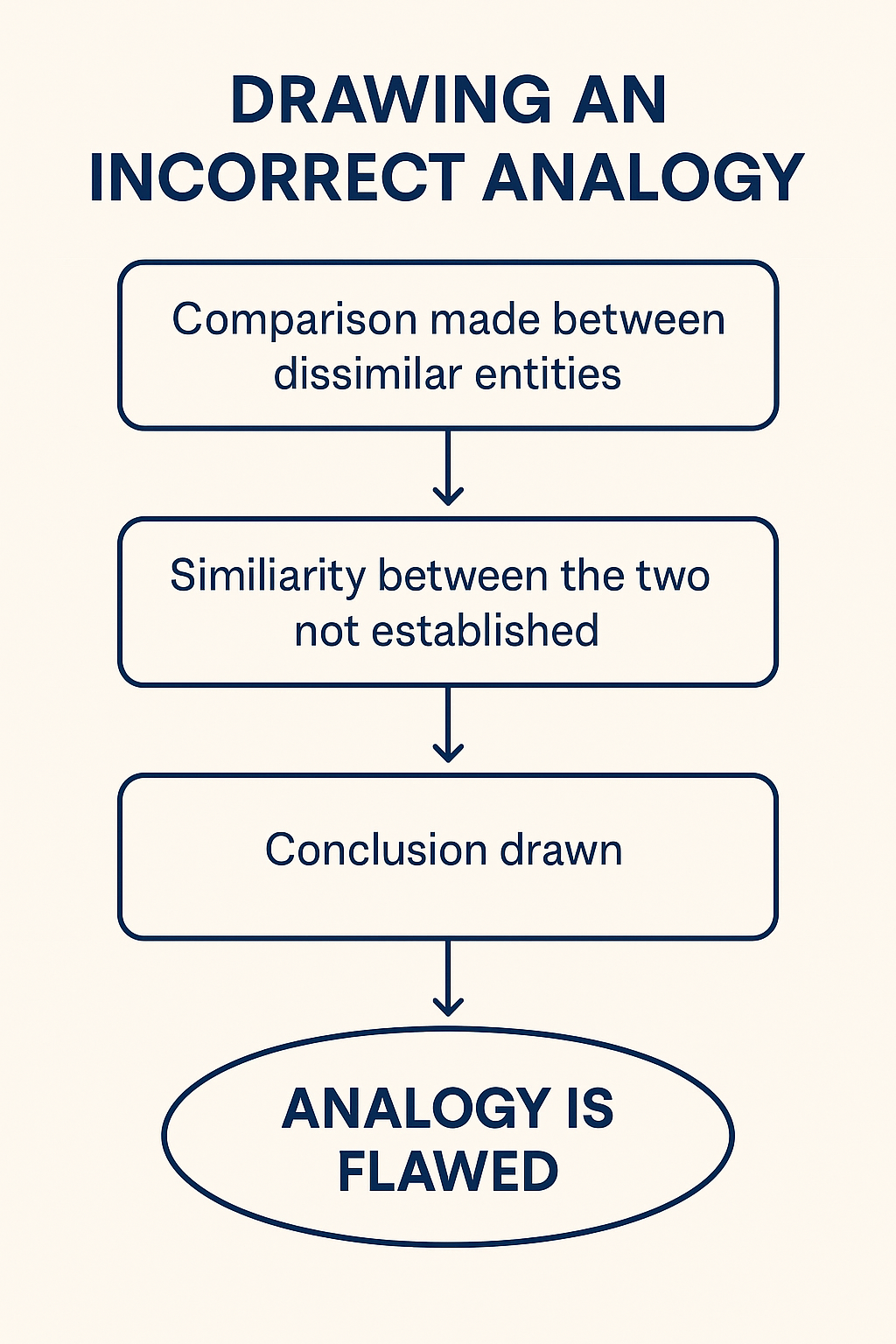
Deconstructing the False Analogy
Your strategy for countering a false analogy has two primary routes:
- Highlight the Critical Differences: Pinpoint the fundamental ways in which the two things being compared are not alike, especially in ways relevant to the conclusion.
- Provide a Counter-Analogy: Turn the tables by offering a different, more accurate analogy that leads to the opposite conclusion, thereby exposing the arbitrary nature of the original.
Let's apply this to our scenarios.
Application 1: Attire and the Analogy of Negligence
- Fallacious Argument: Someone sees you in a stylish, low-cut outfit and remarks, "Dressing like that is like leaving your front door wide open in a bad neighborhood. You can't act surprised if someone decides to walk in and help themselves."
- Deconstruction: This analogy attempts to equate a woman's clothing choice with negligence and to reframe potential harassment or assault as a predictable consequence akin to theft.
- The Comparison:
- Woman's body/clothing ↔ A house with goods inside.
- Choosing an outfit ↔ Leaving a door unlocked.
- Unwanted sexual attention/assault ↔ Theft.
- The Flaw (Critical Differences):
- Agency vs. Object: A person is a sentient being with autonomy and rights. A house is inanimate property. The comparison dehumanizes the person into an object to be secured.
- Intent: The purpose of dressing is often self-expression, confidence, or comfort. The sole purpose of locking a door is security. Their functions are entirely different.
- Responsibility: The analogy's goal is to shift blame from the perpetrator to the victim. However, in both scenarios, the moral and legal responsibility for the crime (theft or assault) lies 100% with the person committing the act.
- The Comparison:
- Witty, Sharp Rebuttal (Highlighting the critical difference): "Are you seriously comparing a human being to a piece of real estate? I'm a person, not a house. Your analogy is flawed because it treats people like property."
- Alternative Rebuttal (Attacking the shifted blame): "That's an interesting comparison, because in both cases—a break-in and an assault—the only one responsible is the criminal. I'm glad we agree that the blame lies with the one who 'helps themselves,' not with the homeowner or the person in the outfit."
Application 2: Relationships and the "Lock and Key" Analogy
This is perhaps one of the most widespread and pernicious false analogies used to enforce sexual double standards, making it a crucial one to master.
- Fallacious Argument: A friend learns about your open relationship and says, "Well, you know what they say: a key that can open many locks is a master key, but a lock that can be opened by many keys is a shitty lock."
- Deconstruction: This analogy assigns gendered, unequal roles to inanimate objects to justify a double standard for sexual activity.
- The Comparison: Man ↔ Key. Woman ↔ Lock. Sexual activity ↔ Unlocking.
- The Flaw: This analogy is rotten to the core. It fails on multiple logical levels. To prepare your rebuttals, let's examine two excellent takedowns of this argument.
First, let's look at a logical deconstruction of the analogy's very premise.
The Problem with the Lock & Key Analogy... - Tumblr
This post provides a concise logical takedown of the "lock and key" analogy. It's a great starting point for understanding how to dismantle a false analogy from its very foundations.
Read the entire short post. Pay close attention to the three numbered points. Point 1, The first problem, challenges the analogy on its own terms. More importantly, points 2 and 3, the core logical flaw, expose how the analogy sneakily assumes the very conclusion it's trying to prove.
As the author of "The Problem with the Lock & Key Analogy..." points out, the analogy is a form of circular reasoning. It only works if you already accept its conclusion: that men and women have fundamentally different, unequal roles regarding sex. By assigning the active role to the "key" (man) and the passive, conquered role to the "lock" (woman), the analogy bakes in the very sexism it purports to illustrate.
Now, let's arm ourselves with some practical counter-moves.
"'A key that can open many locks is called a master key, but a lock ...
Now let's look at a more passionate and practical refutation from the blog "A Division by Zer0". This piece is less about formal logic and more about providing immediate, effective counter-arguments.
First, read the brief introduction. Then, focus on the large quoted section from "Ricecake". This section is a masterclass in fighting a bad analogy with better ones. It demonstrates how to flip the script by proposing alternative comparisons that lead to the opposite conclusion. Also, note the suggested witty retort at the end of the section.
Armed with this knowledge, you can craft devastating rebuttals.
- Witty, Sharp Rebuttal (Using a counter-analogy): "That analogy is so tired. Let's try a better one: a horse that anyone can ride is a good horse, but a man who can ride any horse is a cowboy. Or how about this: a woman who'll dance with anyone is fun at a party, and a man who'll dance with anyone is also fun at a party. The problem isn't my choices; it's your sexist comparison."
- Alternative Rebuttal (Exposing the flawed premise): "So in your metaphor, women are passive objects waiting to be opened? That's the problem. People aren't keys and locks. We are agents who make consensual choices. The moment you compare a person to an inanimate object, your argument loses all validity."
- Sharp, Dismissive Rebuttal (Turning the objectification back): "So you identify as a small metal object that spends most of its time in a man's pocket? That explains a lot."
Conclusion
Today we've dismantled the False Analogy, a fallacy that uses faulty comparisons to attack personal choices. It thrives on superficial similarities while ignoring fundamental, relevant differences.
Here are your key takeaways:
- A False Analogy compares two things based on irrelevant similarities or ignores crucial differences to force a misleading conclusion.
- The core weakness of these analogies, especially in our scenarios, is the dehumanizing comparison of a person with agency to an inanimate object or piece of property.
- Your primary counter-strategies are to expose the critical differences, challenge the comparison's relevance, or deploy a more fitting counter-analogy to reveal the original's absurdity.
In our next lesson, we will move on to the False Dichotomy. Where the false analogy presents a flawed comparison, the false dichotomy presents a flawed choice, forcing a complex reality into a simplistic and misleading "either/or" box.