In our previous lesson, we explored unfalsifiable claims—assertions so insulated from reality that no evidence could ever disprove them. We saw how these arguments are often used to make untestable pronouncements about a person's inner motives. Today, we will examine a more complex and pernicious structure built from this flawed foundation: the Self-Sealing Argument.
Your learning outcome for this session is to deconstruct and counter self-sealing arguments that twist any evidence to confirm a pre-existing bias against a lifestyle choice. While an unfalsifiable claim is a single statement that avoids refutation, a self-sealing argument is a complete, closed-loop system of belief. It's an ideological fortress designed not just to repel contradictory evidence, but to absorb it and use it as mortar for its own walls.
The Anatomy of a Closed Loop
A self-sealing argument is a position that is protected from criticism or refutation by its very structure. Any potential piece of counter-evidence is ingeniously reinterpreted as confirmation of the original claim. This creates a closed logical loop from which there is no escape. The arguer isn't seeking truth; they are defending certainty.
This flowchart illustrates the fundamental difference between genuine reasoning and the rationalization that fuels self-sealing arguments.
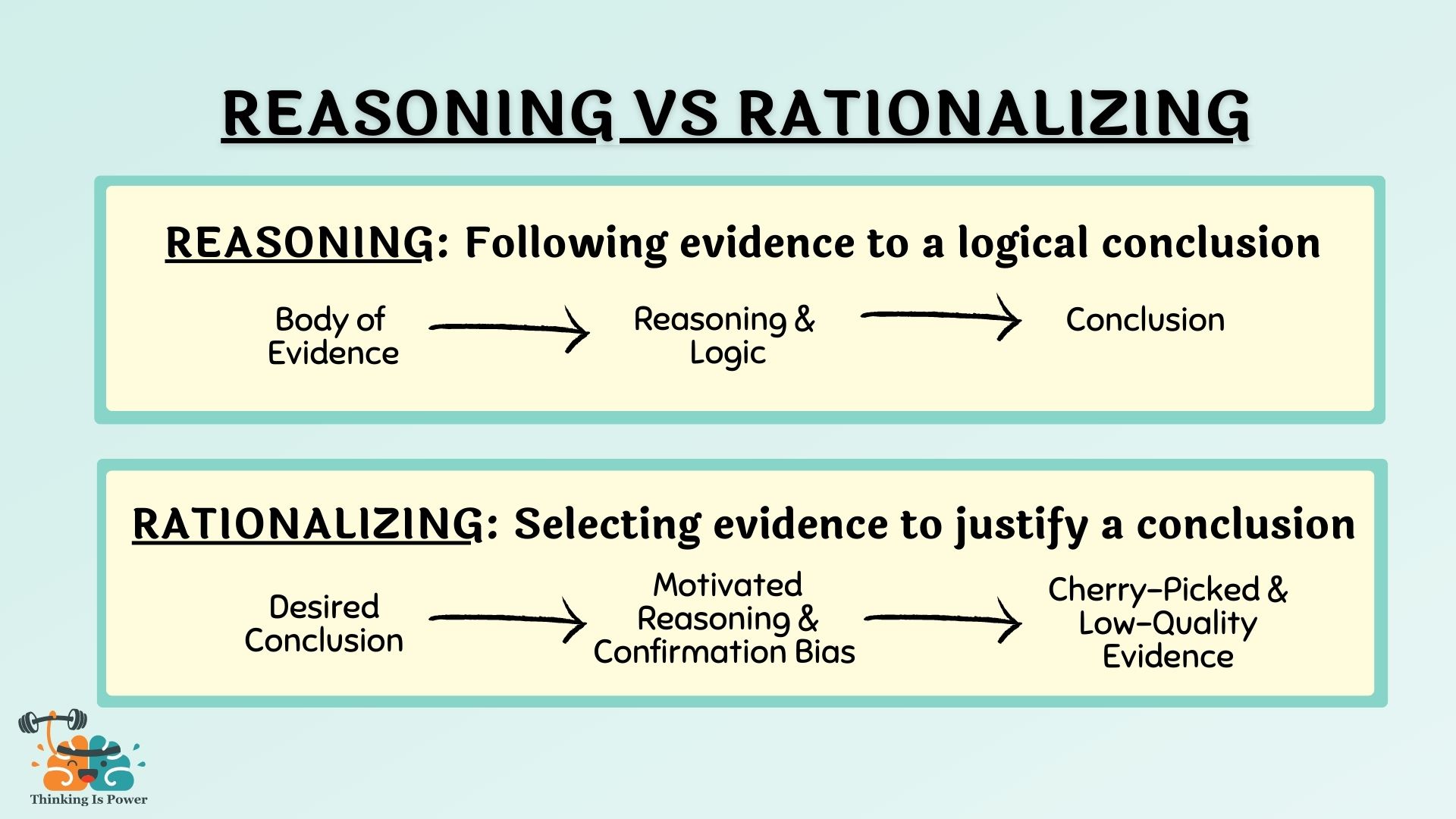
An individual employing a self-sealing argument starts with a "Desired Conclusion" and works backward, twisting all incoming data to fit it.
Let's explore the mechanics of this fallacy with some clear examples.
Self-Sealing Arguments and Learning to Fight Fair
This article from Gagné Legal Services provides a concise and practical introduction to self-sealing arguments, using clear dialogues to demonstrate how they function.
Please read the first two sections of the article. Start with the <span data-type="resource_reading_textrange" data-resource-subitem-id="7f413679" data-range-start="A reasoning fallacy particularly potent" data-range-end="useless and potentially damaging">definition of a self-sealing argument. 2. Pay close attention to the dialogue between John and Mike about dysfunctional families. Notice how Mike's denial is not accepted as counter-evidence, but is immediately re-framed as proof of John's original point ("You're in denial"). 3. Next, read the story of <span data-type="resource_reading_textrange" data-resource-subitem-id="d8c0eba8" data-range-start="Carolyn, her mother, and two sisters" data-range-end="nothing can be done today to make it better">Carolyn. Her core belief—"They don't really love me"—is so sealed-in that even an act of reconciliation on live television is interpreted as further proof of her family's insincerity.
As these examples show, the user of a self-sealing argument has appointed themselves the sole arbiter of reality. They are not merely disagreeing with you; they are invalidating your experience, your perception, and your testimony, re-casting it all as evidence for their pre-existing conclusion.
Ideological Fortresses: Cults, Politics, and Pseudoscience
Self-sealing systems are the hallmark of ideologies that prioritize certainty over truth. They are common in high-control groups, political extremism, and pseudoscience because they provide a powerful defense against inconvenient facts.
The following article by Dr. Linda Riebel provides a fascinating deep-dive into how these doctrines operate in various real-world contexts.
Dr. Linda Riebel talks self-sealing doctrine, cults affecting religion ...
This article from Saybrook University explores the dangerous appeal of self-sealing doctrines, from political rhetoric to the inner workings of cults and Freudian psychoanalysis.
Focus on these two sections that illustrate the fallacy in extreme forms: First, read the section on how cults operate. Observe how the failure of a doomsday prophecy is not seen as evidence the belief is wrong. Instead, it's rationalized away: the date was just an "alert," or the group's faith actually prevented the apocalypse. The belief system adapts to protect itself. Next, review the section on psychoanalysis. This is particularly relevant. Note how Freud handles disagreement: if a patient disputes the Oedipus complex, it's dismissed as "repression," which is seen as proof of the complex. If women disagree with his theories about them, it's because they "are themselves the problem." The critic's argument is never engaged; it's pathologized.
This dynamic—where disagreement is re-framed as a symptom that proves the original diagnosis—is the core mechanism you will encounter when your personal choices are attacked with self-sealing logic.
A stark, modern example can be found in online communities like the one depicted below.

Application: Dismantling the Loop
Your goal in a rebuttal is not to provide more evidence, as you know it will simply be twisted. Instead, you must expose the faulty mechanism of the argument itself. You are not a participant in their "game"; you are the analyst pointing out that the game is rigged.
Scenario 1: A woman wearing a low-cut outfit for personal style/confidence.
Your background in fashion design gives you a nuanced understanding of intent, aesthetics, and expression that this fallacy crudely overwrites.
- Fallacious Argument: "A woman who dresses like that is either deeply insecure and desperate for attention, or she's an arrogant narcissist who thinks she's better than everyone. Either way, it shows she has a serious character flaw."
- Deconstruction: This argument presents a false choice (insecure vs. arrogant) that functions as a self-sealing trap. No matter how the woman behaves, her actions will be interpreted as evidence for one of these two negative traits. If she is shy, she's "insecure." If she is confident, she's "arrogant." The conclusion—"she has a character flaw"—is fixed from the start. Any and all data will be bent to confirm it.
- Witty, Sharp Rebuttal: "That's a tidy little system you've built there. It seems my options are 'insecure' or 'arrogant.' This means any behavior I exhibit can be conveniently sorted into one of your two boxes to prove your point. An argument that explains everything, no matter how contradictory the evidence, ultimately explains nothing. It's a textbook self-sealing argument, designed to make you feel certain rather than to be right."
Scenario 2: A wife in a consensual "open vee" relationship engaging with a lover.
Your work as a social researcher has exposed you to the diverse architectures of functional relationships, a reality this fallacy ignores.
- Fallacious Argument: "If you were truly happy and secure in your marriage, you wouldn't need to see other men. The fact that you do proves the marriage is broken. And if you claim to be happy, you're just in deep denial, which only proves how bad things really are."
- Deconstruction: This is a classic self-sealing argument. The arguer's unstated premise is "monogamy is the only form of a 'happy' marriage." The wife's relationship structure is therefore, by definition, proof of unhappiness. Her own testimony—the most direct evidence of her emotional state—is not treated as a refutation. It is pathologized as "denial," which is then used as even stronger proof for the original claim. The loop is complete.
- Witty, Sharp Rebuttal: "You're presenting my happiness not as evidence, but as a symptom. Your reasoning is perfectly circular: you've decided my relationship is 'broken,' so my happiness must be 'denial,' which in turn proves it's broken. This argument is hermetically sealed against my actual life experience. Since you've already decided what the evidence means regardless of what it is, what's the point of this discussion?"
Conclusion
Self-sealing arguments are intellectually dishonest because they masquerade as reasoning while being completely immune to it. By learning to recognize their closed-loop structure, you can refuse to get trapped inside.
Here are your key takeaways:
- Identify the Closed Loop: A self-sealing argument is a system where all evidence, especially contradictory evidence, is reinterpreted to confirm the initial belief.
- Expose the Mechanism: Do not waste time providing counter-evidence. Your rebuttal should meta-analyze the argument itself. Point out that it's designed to be irrefutable and is therefore logically vacuous.
- Shift the Burden: By exposing the structure, you shift the focus from defending your choice to them defending their flawed logic. Often, the best response is to name the fallacy and disengage, as "winning" means refusing to play a rigged game.
The self-sealing argument stems from a desire for absolute certainty. In our next lesson, we will look at a related fallacy, the Argument from Incredulity, which arises from a similar place: the arguer's personal inability to believe something is treated as proof that it cannot be true.