Welcome back. In our last lesson, we explored the Conjunction Fallacy, seeing how our minds can be tricked into believing a detailed, specific story is more probable than a simple, general fact. This happens when we substitute narrative plausibility for mathematical probability.
Today, we delve into another common error in probabilistic reasoning: the Gambler's Fallacy. This fallacy arises from the mistaken belief that past random events can influence future outcomes. As someone with a background in statistics and probability theory, you are already intimately familiar with the concept of independent events, which is the central principle this fallacy violates. Our goal is to deconstruct this error and craft precise rebuttals for when it's misapplied to complex personal choices, suggesting a "turn of luck" or a "correction" is inevitable.
The Myth of the Overdue Outcome
The Gambler's Fallacy is the irrational belief that if a particular outcome in a series of independent random events has occurred less frequently than its probability would suggest, it is then "due" to occur. Conversely, if an outcome has occurred more frequently, it is "due" for a correction.
The classic example is a coin toss.

The coin has no memory. The probability of landing on heads is on every single toss, regardless of what came before. A run of ten heads in a row does not make tails any more likely on the eleventh toss. The probability remains fixed.
This faulty thinking stems from a misunderstanding of the law of large numbers. While a very long sequence of coin tosses will almost certainly approach a 50/50 split, there is no "law of small numbers" that forces short sequences to mirror this long-term average. People fall victim to the representativeness heuristic, expecting even a small sample of random events to be representative of the long-run distribution.
This flawed logic creates a psychological trap, particularly in situations involving risk and chance.
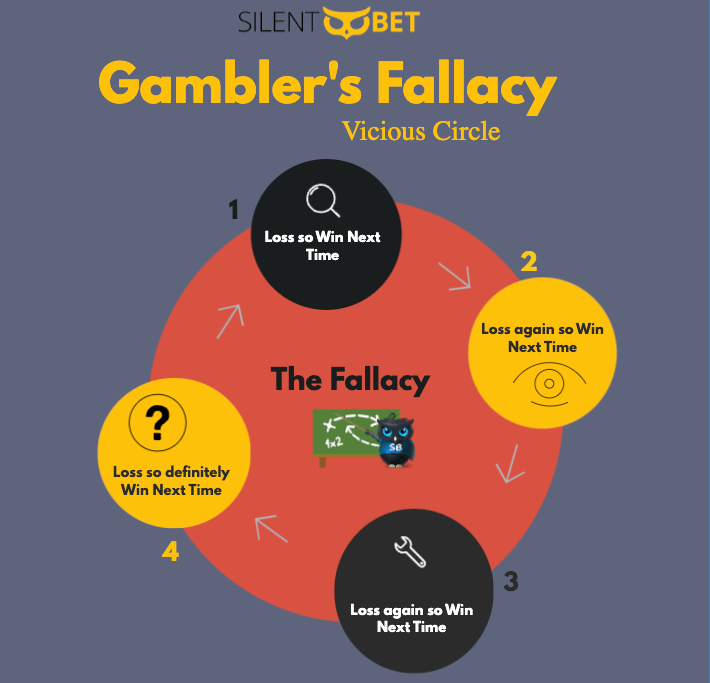
This cycle isn't just about gambling. People apply this same flawed logic to many aspects of life, wrongly imposing the mathematics of independent random trials onto situations driven by human agency and complex factors. This is where your rebuttals will find their power.
Application 1: Judging Fashion Choices
Scenario: You've been feeling particularly creative and confident lately, and for several weekends in a row, you've worn some of your more daring, self-designed low-cut tops when going out. A friend comments, "You've been on quite a streak with these revealing outfits. You're bound to switch it up and wear something more conservative next weekend. The law of averages has to kick in eventually."
-
Fallacy Deconstruction:
- The Flawed Assumption: Your friend is treating your fashion choices as if they are a series of independent random events, like spins on a roulette wheel that must eventually land on a different number.
- The "Correction" Myth: They believe that a "streak" of one type of choice ("daring") creates a probabilistic pressure for an opposing choice ("conservative") to occur, in order to "balance the books."
- The Reality: Your choice of attire is not a random event. It's a conscious decision based on your mood, the occasion, your personal style, and how you wish to express yourself. Past choices don't use up a finite resource of "daringness," nor do they create a debt that must be paid back with "modesty." The events are not independent in a probabilistic sense; they are expressions of your agency.
-
Witty, Sharp Rebuttal:
"That's an interesting application of the Gambler's Fallacy to my closet. My style isn't a coin flip that needs to correct itself. I wear what expresses my confidence and creativity at that moment. There's no 'law of averages' for self-expression, only personal choice."- Why it works: It immediately names the fallacy, demonstrating intellectual clarity. The phrase "my closet isn't a coin flip" creates a sharp, memorable image that perfectly highlights the absurdity of their logic. It dismisses the idea of external "laws" and firmly re-centers the conversation on your personal agency.
Application 2: Judging an Open Relationship Dynamic
Scenario: Your wife and her partner have a deep and compatible connection. They've recently had a series of three exceptionally wonderful dates. A skeptical acquaintance remarks, "Three great dates in a row? Wow. The next one is bound to be a train wreck. Things can't stay that good forever; probability dictates they're due for a fight."
-
Fallacy Deconstruction:
- The Flawed Assumption: The acquaintance is modeling the success of your wife's dates as a sequence of random trials, like rolling a die and getting a six three times in a row.
- The "Due for a Loss" Myth: They believe that a streak of positive outcomes makes a negative outcome more probable, as if a cosmic force must intervene to enforce a balance of good and bad experiences.
- The Reality: The quality of a date is not random. It is the result of effort, communication, mutual affection, and compatibility. A series of good dates often indicates a strong, healthy connection, which might make subsequent good dates more likely, not less. The events are not independent; they are positively correlated through the strengthening of the relationship.
-
Witty, Sharp Rebuttal:
"You're falling for the Gambler's Fallacy. Relationships aren't slot machines that are 'due' for a loss after a few wins. Good experiences are built on connection and compatibility, not a lucky streak that's about to run out. In fact, one good date often builds the foundation for the next."- Why it works: It names the fallacy and uses the powerful "slot machine" analogy to expose the mechanical, impersonal nature of their reasoning. The rebuttal contrasts their model of random chance with the reality of human connection and even reverses their logic, pointing out that success can breed more success. It's a sophisticated way to shut down pessimistic and unsolicited predictions.
Conclusion: Key Takeaways
The Gambler's Fallacy is a powerful bias because it feels intuitive, but it crumbles under logical scrutiny. Countering it, especially when misapplied to people's lives, involves exposing the absurdity of the underlying premise.
- The Flaw: The fallacy is the mistaken belief that in a series of independent events, past outcomes can influence future ones.
- The Psychological Trap: We incorrectly expect short-term results to reflect long-term probabilities, looking for a "correction" that isn't coming.
- The Counter-Strategies:
- Name the Fallacy: Call it the "Gambler's Fallacy." This frames their comment as a known cognitive error.
- Reject the Premise of Randomness: The core of your rebuttal should be to point out that the situation in question—be it personal style, relationships, or career choices—is not a series of independent random events. It is governed by agency, preference, skill, and complex interacting factors.
- Use a Contrasting Analogy: Compare their reasoning to a coin toss, a roulette wheel, or a slot machine to highlight how inappropriate the model is for a human situation.
In our next lesson, we will explore a closely related concept: the Ludic Fallacy. This is the error of misapplying the clean, simplified models of games and statistics to the messy, complex, and unpredictable real world. It's the perfect extension of our discussion today, moving from a specific error in game-like thinking to the broader problem of treating life itself as a game.