Hello! Welcome to the final lesson of our foundational module on NSE trading.
In the last lesson, we did a deep dive into the explicit costs of trading—brokerage, STT, and GST. You now have a clear blueprint for calculating the precise cost of every trade, which is essential for accurate profit and loss tracking. But a trade's lifecycle doesn't end with execution and cost calculation. What happens "behind the curtain" to ensure the shares you bought actually arrive in your account and the money for shares you sold is received?
This lesson will answer that question. Our learning outcome is to explain the role of the clearing corporation and settlement cycles. For you as a system architect, this is akin to understanding the commit and settlement protocol in a large-scale distributed transaction system. While your bot won't manage this process directly, understanding the mechanics, timing, and failure modes is crucial for building a robust system that correctly manages its cash flow and asset state.
The Trade Lifecycle: Beyond Execution
When your bot's order is matched on the exchange, it's a confirmed deal, but the actual exchange of money and securities hasn't happened yet. This post-trade process involves two key phases: clearing and settlement.
To get a high-level overview of the many steps involved, from placing an order to the final settlement, the following video provides a detailed (though US-market-centric) walkthrough. Don't worry about the T+3 timeline mentioned; we will focus on the Indian context next. The key here is to appreciate the number of entities and processes involved.
Trade Life Cycle-Part 1| Equity Settlement Process| Clearing House| Back Office Operations|
The video 'Trade Life Cycle-Part 1' gives a detailed, step-by-step look at the entire journey of a trade.
Watch the first few minutes (00:00 - 03:48) to see the progression from trade initiation to order placement and finally to trade execution on the exchange. This will set the stage for the post-execution process we are about to discuss.
Now, let's focus on the Indian market's specific process and the key organizations that make it work. Your broker, Angel One, provides an excellent and concise explanation.
Clearing and Settlement Process in Stock Market
This article from Angel One, your chosen broker, clearly outlines the key players and the step-by-step process for the Indian market.
Please read the section 'Key Entities Involved in the Clearing and Settlement Process'. This introduces the main organizations we will be discussing.
As you just read, the post-trade world is a coordinated effort between several entities:
- Stock Exchanges (NSE/BSE): The marketplace where trades are executed.
- Clearing Corporations (NSCCL/ICCL): The central nervous system of the post-trade process.
- Depositories (NSDL/CDSL): The "banks" that hold your shares in electronic (dematerialized) form.
- Depository Participants (DPs): Your broker (Angel One), who provides you with access to the depository and holds your Demat account.
Let's zoom in on the most important player in this process: the Clearing Corporation.
The Role of the Clearing Corporation
The Clearing Corporation acts as a Central Counterparty (CCP). This is a critical risk management design pattern. After your trade is executed, the Clearing Corporation steps into the middle of the transaction.
- It becomes the legal seller to every buyer.
- It becomes the legal buyer to every seller.
This means you and the other party to your trade no longer have obligations to each other; you both now have obligations only to the Clearing Corporation. In India, the NSE Clearing Limited (NSCCL) handles this for all trades on the NSE.
The primary functions of the NSCCL are:
- Clearing: At the end of the trading day (T-Day), the NSCCL looks at all the trades made by all brokers and calculates the net obligation for each. Instead of settling millions of individual trades, it determines that Broker A owes a net of X shares of a stock and is owed a net of Y rupees, while Broker B is owed X shares and owes Y rupees. This process of netting greatly reduces the number of transactions required.
- Guaranteeing Settlement: This is its most crucial role. By acting as the CCP, the NSCCL guarantees that every trade will be settled. If a buyer fails to produce the money or a seller fails to deliver the shares, the NSCCL steps in to complete the transaction, using its own funds and processes (like an auction market) to make the non-defaulting party whole. This removes counterparty risk and ensures the market's integrity.
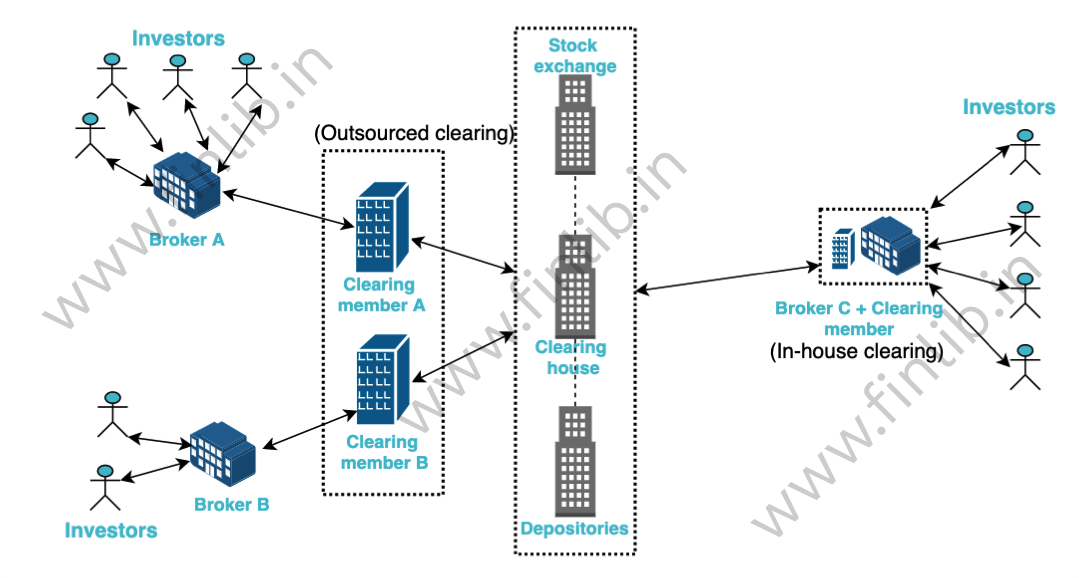
The diagram below illustrates this central role. The Clearing House (or Corporation) sits between the brokers (who may use separate Clearing Members) and the Depository, ensuring the final settlement occurs.
The T+1 Settlement Cycle
Now that we understand who does what, let's look at the timeline. India has one of the fastest settlement cycles in the world.
Since January 2023, India follows a T+1 settlement cycle for equities.
This means that a trade executed on day 'T' is settled on the next working day, 'T+1'. Let's break down what happens.
Clearing and Settlement Process in Stock Market
Let's return to the Angel One article for a step-by-step breakdown of the T+1 cycle.
Read the sections 'Step-by-Step: How the Clearing and Settlement Process Works' and 'T+1 Settlement Cycle: What Does It Mean?'. This will walk you through the events of T Day and T+1 Day.
To summarize and reinforce the process:
-
T Day (Trade Day):
- You place an order, and it gets executed on the NSE.
- Your broker immediately reflects this in your account. If you bought shares, funds are blocked. If you sold, shares are blocked in your Demat account.
- At the end of the day, the exchange sends all trade data to the NSCCL.
- The NSCCL performs the clearing process, determining the net obligations of all its members (brokers).
-
T+1 Day (Settlement Day):
- This is the day of the actual transfer, known as pay-in and pay-out.
- Pay-in: In the morning, brokers with a net obligation to pay funds or deliver securities transfer them to the NSCCL.
- Pay-out: After receiving all pay-ins, the NSCCL transfers the funds and securities to the brokers who are owed them.
- Your broker receives the shares (if you were a buyer) and credits them to your Demat account, or receives the funds (if you were a seller) and credits them to your trading account.
This entire process is automated and seamless from an investor's point of view.
Test your understanding!
You buy 50 shares of Tata Motors for delivery on Tuesday morning. Wednesday is a public holiday. When will the shares be credited to your Demat account?
Show answer
The shares will be credited on Thursday.
- T-Day is Tuesday.
- The settlement cycle is T+1 working days.
- Since Wednesday is a holiday, T+1 falls on Thursday.
Practical Implications for Your Trading Bot
As an engineer, you need to consider how this backend process affects your system's design.
-
Fund Availability: When your bot sells shares, the sale proceeds are credited to your Angel One account on T+1. While your broker may allow you to use a portion of these funds (e.g., 80%) for new trades on the same day, the full amount is not available for withdrawal until settlement is complete. Your bot must rely on the
available marginorcashfields provided by the Angel One API, not just an internal calculation based on trade P&L. This is a crucial detail for position sizing and risk management. -
Intraday vs. Delivery Trades:
- For intraday trades, your net position at the end of the day is zero. No shares are delivered or received. Only the net profit or loss is settled with your broker, and this is typically reflected in your account balance on T+1.
- For delivery trades, the full T+1 cycle applies, and you will see shares appear in or disappear from your Demat account.
-
Exception Handling (Short Delivery): Occasionally, a seller may fail to deliver the shares they sold. This is called a 'short delivery'. In this case, the NSCCL conducts an auction to buy the shares from the market and deliver them to you. This might cause a delay. While rare, a robust system should be able to reconcile its expected positions with the actual holdings reported by the broker to detect such discrepancies. You will eventually get the shares or the money back, but your bot needs to handle the temporary mismatch.
Conclusion
Congratulations on completing the first module! You've built the foundational knowledge of how the NSE operates, from market structure and order types to transaction costs and the final settlement of trades.
Key Takeaways:
- Clearing Corporation as a Guarantor: The NSCCL acts as a Central Counterparty (CCP), guaranteeing the settlement of all trades by becoming the buyer to every seller and the seller to every buyer. This eliminates counterparty risk.
- Clearing vs. Settlement: Clearing is the process of netting obligations, while settlement is the final, irreversible transfer of funds and securities.
- T+1 Cycle: The Indian equity market operates on a T+1 settlement cycle, meaning trades are settled one working day after the trade date.
- Bot Design Implications: The settlement cycle directly impacts fund availability for new trades and requires your bot to rely on the broker's API for real-time cash and position data rather than just internal state.
Preview of the Next Lesson:
With the market mechanics now covered, we are ready to move into the heart of algorithmic trading: strategy development. In our next lesson, we will kick off Module 2 by getting our hands dirty with Python and pandas. You will learn to calculate and implement Simple Moving Averages (SMA) and Exponential Moving Averages (EMA), two of the most fundamental building blocks of technical analysis. Get your development environment ready