Hello! Welcome back to our journey of building a mini-Kafka.
In the last lesson, we mastered the select statement, learning how to build responsive, non-blocking handlers using for-select loops, timeouts, and the "nil channel" trick. This pattern is the engine that drives long-running, stateful services in Go.
Introduction to the Lesson
Today, we'll apply these concepts to design one of the most critical components of our message broker: the Group Coordinator. The learning outcome for this lesson is to design the data structures and state management for consumer groups, including membership and offset tracking.
A consumer group is the mechanism that allows multiple instances of a service to work together to process a stream of messages in parallel, providing both scalability and fault tolerance. Managing these groups—tracking who is a member, what partitions they are assigned, and how far they've processed—is a complex state management problem.
We won't be implementing the full network protocol for joining and leaving groups today. Instead, we'll focus on the system design aspect: defining the core Go structs that will represent the state of our consumer groups. This is the foundational "model" upon which we will build the dynamic behavior in subsequent lessons.
We will cover:
- The conceptual roles and responsibilities within a consumer group.
- The Go data structures for tracking group membership, leadership, and partition assignments.
- The importance of a
GenerationIDfor maintaining consistency. - The design for a durable offset tracking system.
Let's begin by understanding what a consumer group is and why it's so important.
1. The Consumer Group: A System for Parallel Processing
At its core, a consumer group is a way to distribute the partitions of a topic among multiple consumers. This allows for horizontal scaling of message processing. Kafka guarantees that any given partition is consumed by at most one consumer within a group at any time.
To get a clear picture of this, let's watch a short overview from Confluent that explains the concept.
Apache Kafka® Consumers and Consumer Group Protocol
This video, 'Apache Kafka® Consumers and Consumer Group Protocol', introduces the core ideas of consumer groups, scaling, and the role of the Group Coordinator.
Watch from 00:00 to 02:36. Pay close attention to the concepts of: Dividing the load among consumers. The partition as the unit of distribution. The Group Coordinator as the central entity managing the group.
As the video explained, the Group Coordinator is a broker-side component that manages the lifecycle of a consumer group. In our project, we will build this coordinator. Its primary job is to maintain the state of all consumer groups.
To effectively design this component, we need to be precise about the terminology. The following roles are crucial:
- Group Coordinator: A component on the broker (which we are building) that manages group membership and partition assignments for multiple consumer groups.
- Group Member: A consumer client that belongs to a group.
- Group Leader: A specific group member that is elected by the coordinator. Its job is to decide on a partition assignment strategy for all members and report it back to the coordinator.
Our task today is to define the data structures the Group Coordinator will use to track all this information.
2. Designing the Core Data Structures
To manage consumer groups, our coordinator needs to maintain state. Since you have a background in system design, you'll recognize this as defining the core domain model for our group management service. Let's translate these concepts into Go structs.
We'll start with the main entity, the ConsumerGroup.
import (
    "sync"
    "time"
)

// ConsumerMember represents a single member (consumer) within a group.
type ConsumerMember struct {
    ID             string        // Unique ID for the member, generated by the coordinator.
    GroupID        string        // The group this member belongs to.
    SubscribedTopics []string      // Topics this member is subscribed to.
    SessionTimeout time.Duration // How long before the coordinator considers this member dead.
    LastHeartbeat  time.Time     // The last time a heartbeat was received from this member.
}

// ConsumerGroup represents a group of consumers.
type ConsumerGroup struct {
    mu           sync.RWMutex
    GroupID      string
    GenerationID int
    LeaderID     string
    Members      map[string]*ConsumerMember
    Assignments  map[string][]TopicPartition // MemberID -> []TopicPartition
}

// TopicPartition is a simple struct to identify a partition.
type TopicPartition struct {
    Topic     string
    Partition int
}
Let's break down the fields in ConsumerGroup:
mu sync.RWMutex: This is vital. The Group Coordinator will be a concurrent service. Multiple goroutines (handling requests from different consumers) will need to read and write this state. A read-write mutex allows multiple readers or a single writer, which is a perfect fit for our use case.GroupID: The unique name of the consumer group (e.g.,order-processors).GenerationID: This is a critical piece of state. Every time the group membership changes (a consumer joins, leaves, or dies), this ID is incremented. It acts as a fencing token. Any request from a member with an outdatedGenerationIDis rejected, preventing "split-brain" scenarios where a disconnected consumer tries to act on old assignments.LeaderID: TheMemberIDof the elected group leader.Members: A map tracking all the current members of the group. The key is the uniqueMemberID.Assignments: This map represents the current state of partition assignments. It tells us exactly which member is responsible for which topic-partitions.
The article "Understanding Kafka's Consumer Protocol" provides a great discussion on the need for the GenerationID and how it helps make rebalancing reliable.
Understanding Kafka's Consumer Protocol
This article discusses the metadata needed to manage a consumer group. It's a great text-based complement to the videos.
Read the subsections 'How Work Gets Divided: Partition Assignment' and 'Making It Reliable: Handling Failures'. Focus on the description of the Group Coordinator's responsibilities and the purpose of the 'generation ID'. You'll see it even suggests a model for the metadata, which is very similar to the Go structs we've just defined.
3. State Management for Offset Tracking
Knowing which consumer is processing which partition is only half the story. We also need to track their progress. If a consumer crashes and a new one takes over its partition, the new consumer needs to know where to resume processing from. This is done by tracking offsets.
A consumer periodically "commits" the offset of the last message it has successfully processed for a given partition. The Group Coordinator is responsible for storing these committed offsets.

In a real system like Kafka, this state is stored durably in an internal topic called __consumer_offsets. This ensures that even if a broker restarts, the consumer progress is not lost.
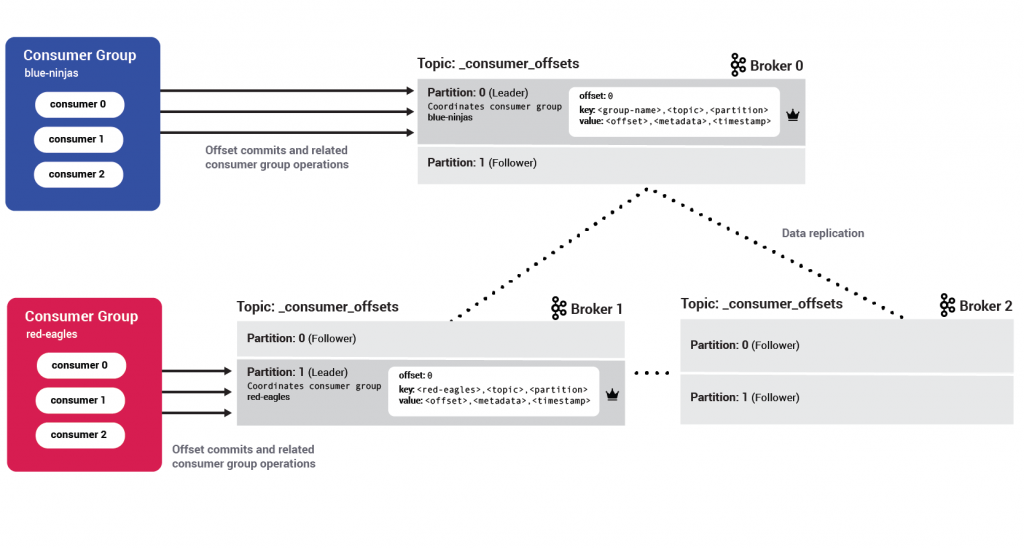
Given your goal of building a robust system and your experience with our previous modules, we can apply the same interface-driven design principle here that we used for our primary message storage. Let's define an OffsetManager interface.
// OffsetManager defines the interface for storing and retrieving consumer group offsets.
type OffsetManager interface {
    // CommitOffset persists the offset for a given group and topic-partition.
    CommitOffset(groupID string, topic string, partition int, offset int64) error

    // FetchOffset retrieves the last committed offset for a given group and topic-partition.
    FetchOffset(groupID string, topic string, partition int) (int64, error)
}
By defining this interface, we decouple the Group Coordinator's logic from the storage implementation. We could create two implementations:
- An in-memory
OffsetManagerfor simple use cases or testing. - A PostgreSQL-backed
OffsetManagerthat stores offsets in a dedicated table, reusing the database skills from Module 2. This would provide the durability a production system needs.
For now, we'll just define the interface. The Group Coordinator will hold an instance of this OffsetManager to handle offset-related state.
4. The Group Coordinator as a Stateful Service
Now, let's tie everything together. How will we use these data structures?
The Group Coordinator itself will be a long-running service. It will manage a collection of all the active consumer groups. A simple map protected by a mutex is a good start:
type Coordinator struct {
    mu             sync.RWMutex
    groups         map[string]*ConsumerGroup
    offsetManager  OffsetManager
}
This Coordinator struct will be the heart of our group management logic. Drawing from the previous lesson, we can imagine this service running inside a for-select loop:
- It would listen on channels for incoming requests (e.g.,
JoinGroup,LeaveGroup,Heartbeat,CommitOffset). - It would use a
time.Tickerto periodically scan through all members of all groups, checkingmember.LastHeartbeatagainstmember.SessionTimeoutto detect and remove dead consumers. - When a request comes in to modify a group (like a new member joining), it would acquire a write lock on that
ConsumerGroup's mutex, update its state (add the member, increment theGenerationID), and then release the lock. - Read-only requests, like fetching offsets, could use a read lock.
We have now designed the complete state model for our consumer group functionality. We have defined the data structures to hold the state and outlined how a stateful service will manage it concurrently.
Conclusion
In this lesson, we transitioned from high-level concepts to concrete system design, laying the architectural foundation for consumer group coordination in our broker.
Key Takeaways:
- Consumer groups are managed by a central Group Coordinator which tracks membership, leadership, and partition assignments.
- The state of a consumer group can be modeled in Go using
structsthat holdMembers,Assignments, and aGenerationID. - The
GenerationIDis a crucial fencing mechanism to ensure consistency during and after group membership changes (rebalances). - Concurrent access to group state must be protected, for which a
sync.RWMutexis well-suited. - Offset tracking is essential for fault tolerance. Abstracting this behind an
OffsetManagerinterface allows for swappable storage backends (e.g., in-memory vs. PostgreSQL), adhering to good design principles.
Next Up
We have designed the "what"—the data structures that represent our state. In the next lesson, we will begin implementing the "how." We'll focus on the network logic for the consumer group join and leave protocol. You will see how incoming JoinGroup and LeaveGroup requests from clients will directly manipulate the ConsumerGroup struct we designed today, bringing our static design to life.