Hello. This module is about a measurement problem: inner experience is private, yet researchers want to describe its patterns. This lesson compares three ways of asking about inner speech—general questionnaires, momentary experience sampling, and interview-based Descriptive Experience Sampling (DES). The aim is not to pick a single winner, but to see what each method actually measures and where its answers can mislead.
Allow about 40 minutes, including the selected reading and video passages.
General questionnaires: a view from memory
A general questionnaire asks you to summarize your experience across many occasions. An item might ask, “How frequently do you talk to yourself in your inner voice?” Answering requires more than recognizing inner speech when it happens. You must recall occasions, decide what counts, and somehow compress them into one mark on a scale.
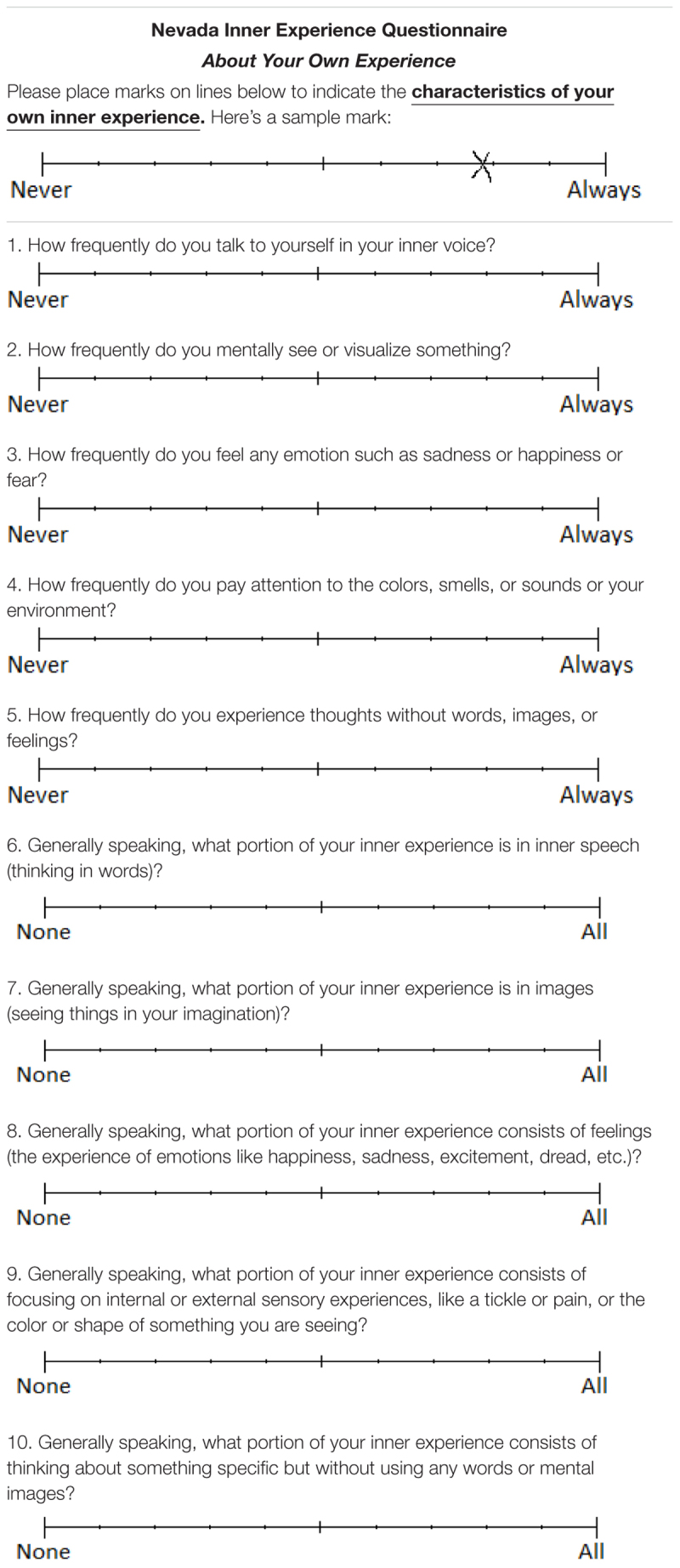
Questionnaires are useful when researchers need comparable responses from many people. They can ask about several kinds of experience without interrupting daily life. But the wording determines what the score means. “How frequently do you talk to yourself?” asks for an estimated frequency. “What is your inner speech generally like?” asks for a characterization of it when it occurs. Someone might strongly endorse “My inner speech is conversational” because a few conversations with themselves are memorable, even if inner speech occupies few sampled moments.
Read how a study of inner speech introduces one such questionnaire, the Varieties of Inner Speech Questionnaire (VISQ), and the difficulty of comparing general self-reports.
Read the Introduction of the study by Alderson-Day and colleagues to see what a general inner-speech questionnaire asks, and why agreement among questionnaires is not guaranteed.
In “Introduction,” find the paragraph beginning “Most recently” and read the VISQ description. Notice that its items concern forms and qualities of inner speech. Then find the final paragraph, beginning “However, the validity of investigating inner speech in this way,” and read the validity concern. Focus on the distinction between a scale giving consistent responses and different ways of asking yielding closely corresponding answers.
A questionnaire answer can reflect a genuine pattern while still being a poor estimate of the proportion of moments containing inner speech. Memorable self-criticism, for example, may come readily to mind; uneventful moments without words may not. Beliefs about thinking can also shape the answer: if someone assumes that thinking ordinarily involves words, they may classify ambiguous memories as inner speech. These are possible recall and interpretation biases, not proof that any particular respondent is mistaken.
Momentary sampling: changing the unit of observation
Instead of asking for a summary, a momentary sampling study sends prompts during ordinary life and asks about experience at or near each prompt. Its basic unit is a reported moment, rather than a person’s general impression. Repeated reports can show whether inner speech is reported across different sampled situations and how much reports vary within a person.

Watch a short explanation of what makes an assessment genuinely momentary, followed by a comparison of prompt schedules.
Ecological Momentary Assessment to Measure Emotion, Cognition, and Behavior in Daily Life | DIGIT-MI
“Ecological Momentary Assessment to Measure Emotion, Cognition, and Behavior in Daily Life,” from the Eisenberg Family Depression Center, explains how repeated reports in everyday settings differ from a general questionnaire delivered by phone.
Watch the definition for the emphasis on current experience and repeated assessment. Then watch prompt timing for the difference between predictable and randomized schedules. Apply both passages to inner speech: which parts of a day could a schedule miss?
Random or partly randomized prompts reduce reliance on a participant choosing memorable occasions to report. They do not remove every source of bias. A prompt can arrive when responding is inconvenient; unanswered prompts may therefore differ systematically from answered ones. A delayed response draws more heavily on memory than an immediate one. Allowed notification hours leave other hours unobserved. Repeated questions may also make someone more attentive to inner speech, while fixed answer choices may fit an ambiguous experience poorly.
The comparison in the inner-speech study is especially instructive. Its participants endorsed characteristics of inner speech more strongly on a general questionnaire than in reports tied to random alerts. The correspondence between methods also differed by characteristic: it was clearer for some forms, such as condensed inner speech, than for evaluative or motivational inner speech.
Return to Alderson-Day and colleagues’ study for its results and, more importantly, its caution about what the two kinds of report can be compared as measuring.
In “Similarities and Differences in Inner Speech,” read the correlations, then the following paragraph from “When the total scores for inner speech were compared” through the score comparison. In “Discussion,” read from “The main finding of the present study” through the interpretation. Finally, find the paragraph beginning “Why over-estimation would be occurring” and read the crucial qualification.
The qualification matters. The general VISQ asks how strongly a description fits one’s inner speech when it occurs; the random alerts ask about a particular moment, including moments when inner speech is absent. Lower momentary endorsements are therefore not, by themselves, proof that questionnaire respondents exaggerated. The study supports a narrower conclusion: general endorsements and sampled-moment reports are not interchangeable, and their relationship depends on the characteristic being measured.
DES: sampling a moment, then investigating its description
DES also samples moments in ordinary life, but does not stop at a brief response scale. A random signal directs the participant to the experience underway just before the signal interrupted it. The participant makes immediate notes; later, an interviewer helps examine each sampled moment in detail. The interviewer’s task is not to obtain a polished account of “what I’m usually like,” but to clarify what, if anything, was experienced in that specific moment.
Watch a DES researcher describe the procedure before reading the method’s account of its safeguards.
Is Inner Speech Universal? Descriptive Experience Sampling & Myths of the Mind | Russell Hurlburt
In “Is Inner Speech Universal? Descriptive Experience Sampling & Myths of the Mind,” Russell Hurlburt describes DES to the Mind-Body Solution channel. Watch for what the immediate note and later interview each contribute.
Watch the DES procedure. In particular, distinguish the experience selected by the signal from the later work of describing it; the interview cannot literally replay the original moment.
An interview can probe a distinction that a checkbox might hide. “I was thinking about calling someone” specifies the topic of a thought, not necessarily its form. The interviewer can explore whether words were experienced, whether an image was present, or whether the person is now putting an originally unworded thought into words. DES uses repeated sampling and interviews partly to help participants and interviewers notice such assumptions.
The Descriptive Experience Sampling method
Read Hurlburt and Akhter’s account of what the DES interview tries to achieve—and the ways it can fail. Treat its description of safeguards as a methodological proposal, not a guarantee of accuracy.
Under “The expositional interview,” read the interview aim (p. 279). Under “Iterative,” read the training account (pp. 280–281). Near the end of “Successive approximation to faithful reporting,” read the interviewer risk (p. 282). Then, under “Bracketing presuppositions,” read the account of assumptions (pp. 282–283).
DES’s strength is detail about a sampled experience: an interviewer can follow uncertainty instead of forcing an immediate category. Its costs are substantial time and interviewer expertise, usually limiting the number of people studied. It also retains vulnerabilities. The beep interrupts experience; notes and interviews depend on memory; and an interviewer’s expectations can influence a description, even while the method explicitly tries to restrain them. Calling the target experience “pristine” states an aim, not a claim that researchers can observe another person’s consciousness directly.
Put the measures side by side
| Method | What the response most directly describes | Main interpretive hazards |
|---|---|---|
| General questionnaire | A person’s summary judgment or endorsement across occasions | Recall, memorable exceptions, beliefs about thinking, and ambiguity between frequency and “what it is like when it happens” |
| Momentary sampling | Reports tied to multiple prompted times | Missed or delayed responses, limited time coverage, reactivity, and restrictive response options |
| Interview-based DES | Detailed descriptions of particular prompted moments, refined in later interviews | Memory between prompt and interview, interviewer influence, training demands, and limited scale |
These methods answer related but nonidentical questions. If a questionnaire says someone often talks to themselves, a momentary record contains few reports of inner speech, and a DES interview identifies uncertainty about what counted as “talking,” the results need not form a simple contradiction. The questionnaire may capture an important general impression; the sampled record describes only the moments it reached; the interview may expose a classification problem in either kind of report.
The most defensible reading asks which experience was queried, over what time span, using which wording, and with which opportunities to clarify an answer. None of the three methods alone provides a continuous record of everything that happens in a mind.
Conclusion
General questionnaires efficiently capture broad self-descriptions, momentary sampling records reports at selected times, and DES adds detailed interviews about selected moments. Each reduces some uncertainties while introducing or retaining others. In particular, a stable questionnaire response need not be a moment-by-moment frequency estimate, and a carefully interviewed sample is still a report—not direct access to experience.
Next, you will use this distinction to interpret a repeated-sampling record: what its observed moments support, and why unobserved moments remain open.