Welcome back. The previous lesson found that interfering with speech-related processing made one planning task less efficient, without showing that all planning requires an inner voice. Here the focus shifts to a more deliberate use of language: self-instruction. The question is whether prompting someone to state a goal or rule helps them follow it—and what that result can, and cannot, tell us about the inner speech they use spontaneously.
Keeping a rule available
Consider a task in which the same picture could be sorted by color or by shape. Knowing both rules is not enough. On each turn, the person must keep the current rule active, especially when the other rule feels tempting. A short instruction such as “color this time” might serve as a reminder at the moment of choice. That is a proposed function of self-instruction, not a claim that everyone normally hears those words.
One developmental account helps explain why researchers study spoken self-instruction alongside silent inner speech. In that account, guidance first occurs in conversations with others; children then sometimes guide themselves aloud, using private speech; some self-directed language later becomes internal. This is a theory of how a useful strategy can develop, not a timetable that every person must follow.
Inner Speech: Development, Cognitive Functions, Phenomenology, and Neurobiology
Read this review for the developmental account and for evidence that verbal cues can support rule-based tasks.
In “Vygotsky’s Theory,” read the initial account, from the explanation of internalization through the claim about regulating behavior. Then skip the paragraph contrasting Vygotsky with Watson and read the private-speech discussion, from its definition through its continued use in adulthood. In “The Cognitive Functions of Inner Speech in Childhood,” begin at “Most of the work in this area has concerned the role of verbal strategies” and read the switching discussion through the explanation of what verbalized strategies might be doing.
The review reports that younger children can benefit from prompts to use verbal labels in switching tasks. Yet it also notes a narrower interpretation of some switching results: verbal strategies may help someone maintain the response rule or remember the order of tasks, rather than improve the mental act of switching itself. That distinction matters. If saying “color” helps at the next picture, the word may be acting as a timely cue, not changing every aspect of cognitive flexibility.
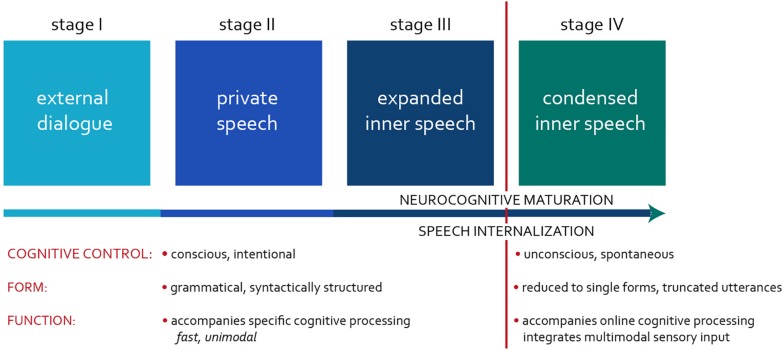
The image below depicts one proposed path from dialogue with others to increasingly internal forms of speech. Its stages are a model, not a way to infer an individual’s inner experience from their age or from whether they talk aloud.
Testing what a cue contributes
A useful experiment changes the information available at the moment a rule must be used. Suppose a sorting task displays the full word “SHAPE” on some trials but only the letter “S” on others. The full word supplies a ready-made reminder; the letter requires the person to retrieve what it stands for. If interfering with speech-related processing is more disruptive for the letter, that pattern supports the idea that verbal processing helps when the task itself provides an incomplete cue.
A different approach directly prompts a person to label or state something before responding. This tests whether an instructed action improves performance, rather than whether speech-related processing is disrupted.
This tutorial brings together cue and labeling studies. Read them as two related but distinct tests of verbal support for a rule.
Under “Task Characteristics Influence the Use of Inner Speech,” go to “Cue types.” Begin at “Several studies have manipulated cue type” and read the cue comparison through the adult study contrasting full-word and single-letter cues. Later in that subsection, begin at “Finally, there is evidence that more active processing of cues” and read the labeling study through its alternative explanations. Focus on what changed between conditions in each study.
In the adult cue study, repeating speech increased the cost of switching rules with single-letter cues, but not with full-word cues. This fits an account in which speech-related processing helps retrieve or complete a weak rule cue. It does not show that participants consciously said the rule to themselves on every trial: interference with a process is not direct observation of experience. Nor does it show that language is essential when a clear external reminder is available.
The labeling study asks a different question. Three-year-old children performed better on a card-sorting task when prompted to answer questions about an item and where it should go before responding, compared with a standard condition. The reported difference was not significant for four-year-olds. For the younger children, actively putting the response into words may have helped bring the relevant rule to bear. But the prompted condition also changed how actively children engaged with the cue. Better attention or comprehension could contribute to the result. A benefit from labeling is therefore stronger evidence that the prompting procedure helped than that a particular silent sentence maintained the rule.
When a spoken plan becomes part of the task
Some interventions make self-instruction more explicit: pause, state a plan aloud, then act. This is worth studying because an instruction can be introduced deliberately and compared with otherwise similar task practice. It also creates an interpretive challenge. If the whole routine helps, was the effective ingredient the words, the pause, the reminder to check the goal, or a combination?
Continue with the tutorial’s intervention discussion for an example of deliberately taught self-instruction and its limits.
In the intervention discussion that begins “Given that verbal mediation is an inherently language-based strategy,” move past the collaborative building program to the paragraph beginning “One way to investigate the effectiveness of complex executive function programs.” Read the stop-and-think account through the final sentence calling for research with other groups. Pay particular attention to what the children were told to do before selecting an answer and what the comparison group did.
In the preliteracy study described there, children using a computer program were instructed to voice their thoughts and a plan before choosing answers. Children given this “stop-and-think” routine made greater gains than children who completed the program without it; those with weaker executive-function skills at the outset benefited particularly. That comparison supports a benefit of the instructed routine in this setting. It does not isolate the contribution of verbalizing from the contribution of pausing and checking an answer.
The difference between these claims is small in wording but large in evidence. “A prompt to state a plan improved performance” describes the tested condition. “The children’s spontaneous inner speech caused the improvement” goes further: the routine was instructed, the plan was spoken aloud, and the study did not track every child’s unprompted silent experience. Likewise, being able to use self-instruction when asked does not establish how often someone uses it without a prompt. That distinction applies beyond these child studies: capacity, instructed use, and spontaneous frequency are different things to measure.
Conclusion
Self-instruction can give a goal or rule a usable form at the point of action. Evidence from labeling prompts, cue manipulations, and stop-and-think routines supports that task-dependent benefit. The strongest conclusions stay close to each comparison: a clear external cue can reduce reliance on speech-related processing, while a prompted verbal routine can improve performance without proving that its words alone caused the gain.
None of these findings establishes that everyone spontaneously thinks in words, or that successful self-regulation requires an audible-sounding inner voice. Next, the course turns to claims about anendophasia, beginning with what a study of low and high self-reports can establish—and what it cannot establish about a complete absence of inner speech.