In our last lesson, we categorized cloud services into IaaS, PaaS, and SaaS, focusing on the "what" of the cloud. Now, we turn our attention to the "where." To deliver these services with high performance and reliability on a global scale, AWS has built a massive physical footprint. Understanding this physical layer is essential for the Cloud Practitioner exam and for making informed decisions about deploying applications.
This lesson will describe the core components of the AWS Global Infrastructure: Regions, Availability Zones, and Edge Locations. We'll explore how these components work together to provide the fault tolerance, low latency, and global reach that are among the key advantages of the cloud.
The Hierarchical Structure of AWS Infrastructure
At a high level, the AWS Global Infrastructure is organized in a hierarchy. A great way to visualize this is to think of it as a set of nested building blocks designed for resilience and performance.

As you can see from the diagram, the structure flows from the largest geographical unit (Region) down to the individual data centers that house the servers. Let's break down each component.
1. AWS Regions: Your Geographic Anchor
An AWS Region is a physical, geographic location somewhere in the world where AWS clusters data centers. Think of "US East (N. Virginia)" or "Europe (Ireland)" as examples of Regions. Each Region is designed to be completely isolated from other AWS Regions. This isolation provides the greatest possible fault tolerance and stability.
When you deploy a service like an EC2 virtual server (IaaS), you must choose a Region to host it in. This decision is critical and is typically based on four key factors that frequently appear in exam scenarios:
- Latency: To reduce delay for your end-users, you should choose the Region closest to the majority of your user base.
- Cost: Pricing for AWS services can vary from one Region to another.
- Service Availability: Not all AWS services are available in every Region. Newer, more advanced services are often rolled out in specific Regions first before becoming globally available.
- Data Sovereignty and Compliance: Some countries have laws requiring that data about their citizens be stored within their geographic borders (e.g., GDPR in Europe). You must choose a Region that allows you to comply with these regulations.
2. Availability Zones (AZs): The Key to High Availability
Within each AWS Region, there are multiple, isolated locations known as Availability Zones (AZs). An AZ consists of one or more discrete data centers, each with its own redundant power, cooling, and networking. They are close enough to have low-latency network connections between them (single-digit milliseconds) but far enough apart to ensure that a disaster affecting one AZ (like a fire, flood, or power outage) is unlikely to affect another.
- Purpose: The primary purpose of AZs is to enable high availability and fault tolerance.
- Best Practice: The standard architectural best practice on AWS is to run your applications across at least two AZs within a Region. If one AZ fails, your application traffic can be automatically failed over to the other AZ, ensuring your application remains available to users.
This concept of multi-AZ deployment is fundamental to building resilient applications on AWS. To solidify your understanding of how Regions and AZs work together, this video provides an excellent and concise overview.
AWS Global Infrastructure Overview - Regions, Availability Zones, Edge Locations and more
This video from Digital Cloud Training explains the core concepts of the AWS Global Infrastructure. It clearly distinguishes between Regions and AZs and emphasizes what's important for the exam.
Watch the segments explaining Regions and AZs, how AZs are structured for redundancy, and the final reminder about focusing on the concepts over specific numbers for the exam.
3. Edge Locations: Bringing Content Closer to Users
While Regions and AZs are where you run your core applications and databases, what happens when your users are geographically distant from your chosen Region? Accessing your application from across the world could result in high latency (delay). To solve this, AWS uses a global network of Edge Locations.
An Edge Location is a site where AWS caches copies of your content so it can be delivered to users more quickly. These are much more numerous than Regions and are located in major cities around the world.
Edge Locations are primarily used by Amazon CloudFront, which is AWS's Content Delivery Network (CDN). Here’s how it works:
- Your application's static content (like images, videos, or CSS files) is stored in an origin, such as an Amazon S3 bucket in your chosen AWS Region.
- When a user requests a file for the first time, CloudFront fetches it from the origin and delivers it to the user.
- CloudFront also stores a copy of that file in the Edge Location closest to the user.
- The next time a user in that same area requests the same file, it is served directly from the Edge Location's cache, resulting in much lower latency.
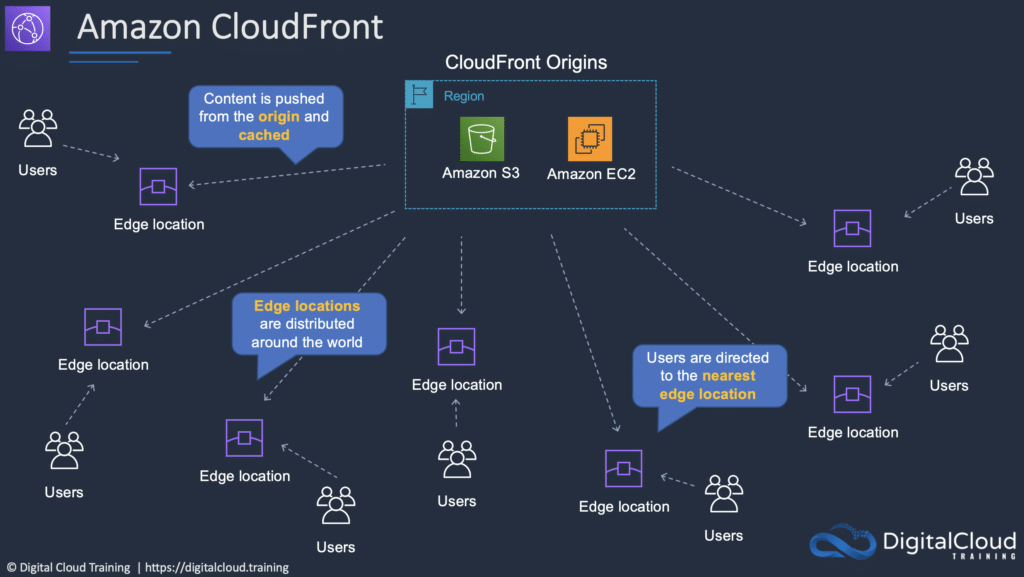
Edge locations are sometimes referred to as part of a network of Points of Presence (PoPs). Some of these PoPs are larger and also function as Regional Edge Caches, which hold a larger cache of content than individual Edge Locations, further optimizing content delivery. For the exam, the key takeaway is that Edge Locations + CloudFront = lower latency for global users.
To review the formal definitions and structure, the following reading breaks down each component clearly.
This article provides detailed, exam-relevant definitions for each component of the AWS Global Infrastructure.
Focus on the section "Components Of AWS Global Infrastructure." Read the definitions for Region and the criteria for selecting one. Then, review the definitions for Availability Zone (AZ) and Edge Locations. You can also quickly read about Regional Edge Caches to understand their role.
Conclusion
You've now covered the physical building blocks of the AWS cloud. Understanding the hierarchy and purpose of these components is crucial for answering exam questions related to architecture, availability, and global deployment strategies.
Key Takeaways:
- Regions are large, isolated geographic areas. You choose a Region based on latency, cost, compliance, and service availability.
- Availability Zones (AZs) are distinct locations within a Region, composed of one or more data centers. Deploying across multiple AZs provides high availability and fault tolerance.
- Edge Locations are a global network of sites that cache content close to users to reduce latency. They are a core part of Amazon CloudFront, the AWS CDN.
In our next lesson, we will build directly on these concepts by exploring the AWS Well-Architected Framework. This framework provides a set of best practices for designing and operating reliable, secure, efficient, and cost-effective systems in the cloud. The principles of high availability and fault tolerance, which are enabled by Regions and AZs, are a cornerstone of this framework.