Merhaba! Welcome to our second lesson.
In our last session, we learned the "golden rule" of English: the Subject-Verb-Object (SVO) sentence structure. You now know how to build a basic sentence like "I scan the network." Today, we're going to focus on that middle part—the Verb.
This lesson will teach you how to use the present simple tense to describe facts and routines. This is one of the most important tenses for your professional life. You will use it to talk about your job responsibilities, describe what a security tool does, and explain your regular tasks.
1. What is the Present Simple Tense?
In Turkish, we call this Geniş Zaman. We use it for two main purposes in a professional context:
-
To describe facts and general truths: These are things that are always true.
- Örnek: The firewall blocks unauthorized traffic. (Güvenlik duvarı yetkisiz trafiği engeller.)
- Örnek: Tenable.sc scans for vulnerabilities. (Tenable.sc zafiyetleri tarar.)
-
To describe routines and habits: These are actions you do regularly.
- Örnek: I write reports every week. (Her hafta rapor yazarım.)
- Örnek: The team meets on Monday mornings. (Ekip Pazartesi sabahları toplanır.)
To get a clear overview of when to use this tense, let's watch a short video. The explanation is in Turkish, which will help you grasp the core concepts quickly.
Sıfırdan İngilizce - İngilizce Present Simple Tense Detaylı Anlatım (Pdf konu anlatımı ile)
In this video, 'Sıfırdan İngilizce - İngilizce Present Simple Tense', the instructor explains the main situations where we use the present simple tense.
Please watch from timestamp 02:55 to 05:36. Focus on the two main uses explained: alışkanlıklar/günlük rutinler (habits/daily routines) and genel geçer gerçekler (general truths).
2. How to Form Present Simple Sentences
Now that you know when to use the present simple, let's look at how to build the sentences. The rule is simple, but there is one very important detail.
The sentence structure is still Subject + Verb + Object, but the verb form changes depending on the subject.
Rule 1: For subjects I, you, we, and they, use the base form of the verb.
- I
scanthe servers. - You
reportthe findings. - We
usePython for scripts. - They
fixthe bugs.
Rule 2: For subjects he, she, and it, add an -s to the end of the verb.
In your work, he could be a colleague (e.g., "the analyst"), she could be your manager, and it could be a tool or system (e.g., "the scanner," "the software").
- He
scansthe servers. (The analystscansthe servers.) - She
reportsthe findings. (My managerreportsthe findings.) - It
usesa database. (The softwareusesa database.)
This -s is one of the most important rules in basic English grammar!
This next short video provides a very clear visual summary of this rule.
Simple Present Tense (Geniş Zaman) Örnek Cümleler ile Konu Anlatımı | 7 Dakikada Öğren!
This video, 'Simple Present Tense (Geniş Zaman) Örnek Cümleler', quickly demonstrates how to form positive sentences and when to add the '-s' to the verb.
Watch from 00:37 to 02:35. Pay close attention to which subjects take the '-s' (he, she, it) and which do not (I, you, we, they).
This table provides a great visual summary of the rule for positive sentences. We will cover the "Olumsuz" (Negative) and "Soru" (Question) columns in our next lesson.
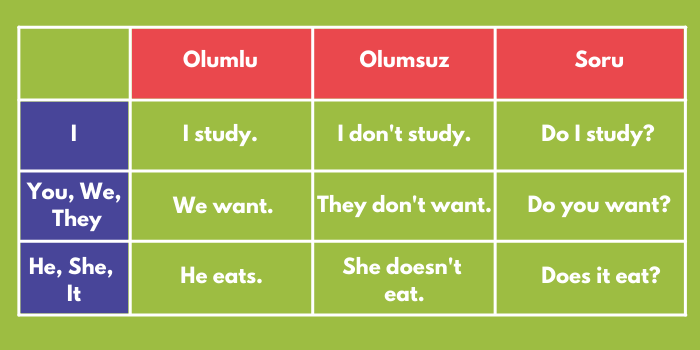
Spelling of the -s ending
Adding -s is usually simple, but there are a few special spelling rules. This is similar to how plural nouns are formed.
Simple Present Tense (İngilizce Geniş Zaman) Konu Anlatımı
This article, 'Simple Present Tense Konu Anlatımı', explains the specific spelling rules for adding '-s' to verbs for third-person singular subjects (he, she, it).
Please read the section titled 'Simple Present Tense Olumlu Cümleler Nasıldır?'. Scroll down to the 'ÖNEMLİ NOT' part. Focus on the exceptions for verbs ending in -o, -ch, -sh, etc., and verbs ending in -y.
Here is a summary of those special rules:
- For verbs ending in -o, -ch, -sh, -ss, -x, -z, add -es.
- go -> goes
- watch -> watches
- fix -> fixes
- For verbs ending in a consonant + y, change -y to -ies.
- study -> studies
- try -> tries
- For verbs ending in a vowel + y, just add -s.
- play -> plays
Test your understanding!
Choose the correct verb form for each sentence.
- I (review / reviews) the scan results.
- The software (generate / generates) a report.
- The security analyst (try / tries) to replicate the vulnerability.
- We (patch / patches) the systems regularly.
Show answer
- I review the scan results. (Subject is 'I')
- The software generates a report. (Subject is 'The software' -> 'it')
- The security analyst tries to replicate the vulnerability. (Subject is 'The security analyst' -> 'he' or 'she'. Verb ends in consonant + y)
- We patch the systems regularly. (Subject is 'We')
3. Present Simple in Your Daily Work
Let's see how this grammar applies directly to your profession. The following article describes the typical day of a cybersecurity professional. It is written almost entirely in the present simple tense because it describes facts and routines.
A Day in the Life of a Cybersecurity Professional
This article, 'A Day in the Life of a Cybersecurity Professional', provides excellent real-world examples of the present simple tense used to describe job duties.
Read the sections 'A typical day in cybersecurity likely includes' and 'Cybersecurity Analyst Sample Work Schedule'. As you read, notice how many sentences use a simple verb (like 'monitor', 'test', 'write') or a verb with an '-s' (like 'answers', 'monitors', 'writes').
After reading, think about your own job. How would you describe your daily tasks? Try to complete these sentences about your work.
- I _____ (use) Tenable.io and Invicti Enterprise.
- I _____ (perform) vulnerability analysis.
- My team _____ (manage) application security.
- A consultant _____ (write) a report for the client.
- The scanner _____ (find) new issues.
Conclusion
Excellent work today! You've learned how to use one of the most fundamental English tenses to talk about your professional life.
Key Takeaways:
- The present simple tense is used for facts (e.g., "The server runs Linux") and routines (e.g., "I test applications").
- The verb form depends on the subject:
- For
I, you, we, they: use the base verb (e.g.,scan). - For
he, she, it: add -s to the verb (e.g.,scans).
- For
- Remember the special spelling rules for verbs ending in -y, -o, -sh, etc.
Preview of the Next Lesson:
You can now make positive statements about your work. But what if you need to say something is not true, or ask a question? In our next lesson, we will learn how to form negative sentences ("I do not see any risks") and yes/no questions ("Does the system require an update?") using 'do' and 'does'.