Hello! Welcome to the final lesson in our module on Legal Research and Analysis.
In our last session, you learned how to brief a case by summarizing its key facts, issue, holding, and rationale. This is how you extract the essential information from a court decision. Today, we'll build directly on that skill by learning how to organize those components into a formal analytical structure.
This brings us to today's learning outcome: to outline research findings using the IRAC (Issue, Rule, Application, Conclusion) structure.
IRAC is the backbone of legal writing and analysis. It's not just an academic exercise; it's the logical framework you will use daily as a legal assistant to structure legal memos, answer your supervising attorney’s questions, and present your research findings clearly and persuasively. Mastering this framework is a crucial step toward becoming an effective member of a legal team.
1. Understanding the IRAC Framework
IRAC is an acronym that stands for Issue, Rule, Application, and Conclusion. It provides a step-by-step method for thinking through and presenting a legal analysis.
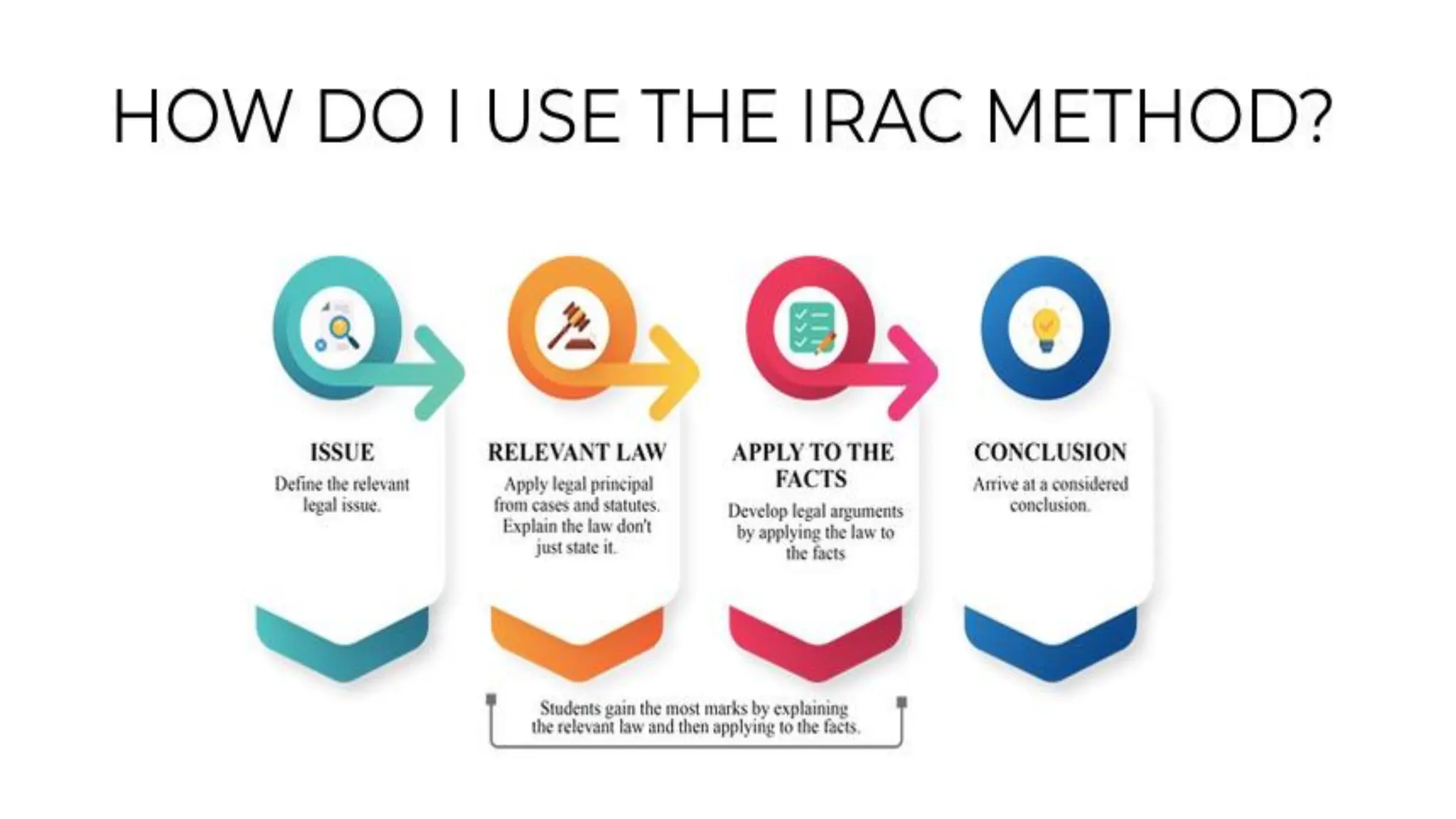
Let's break down each component:
- I - Issue: This is the specific legal question you need to answer. It identifies the legal problem raised by the facts of a case. In our last lesson, you practiced identifying the Issue in a court opinion. When you're analyzing a new problem for an attorney, you'll formulate the issue yourself. It should be a specific question that combines the key facts with the area of law.
- R - Rule: This is the statement of the governing law that applies to the issue. The rule can come from a statute (a law passed by a legislature) or from case law (the holdings of prior court decisions, also known as precedent). You practiced identifying the Rule and Holding in the last lesson—this is where that skill comes into play.
- A - Application (or Analysis): This is the most important part of the IRAC structure. Here, you apply the rule to the specific facts of your case. You explain how the rule works with your facts to lead to a certain outcome. This is where you connect the law to the client's situation and demonstrate your reasoning.
- C - Conclusion: This is the short, direct answer to the question you posed in the Issue. It summarizes the outcome of your analysis.
To solidify your understanding of these four parts, please read the following brief explanations.
using the irac structure in writing exam answers
The following resource from California State University, Northridge, provides clear, concise definitions for each component of the IRAC structure. It's a great reference to get started.
Please read the sections titled 'Issue,' 'Rule,' 'Analysis,' and 'Conclusion.' Pay attention to the examples provided for each part, as they help illustrate the definitions.
2. The Core of IRAC: The Application
As you just read, the Application (or Analysis) is the heart of the IRAC method. Simply stating the Rule and then jumping to a Conclusion is not enough. The Application is where you show your work. You must explicitly connect the elements of the rule to the specific facts of your problem.
A common mistake for beginners is to either just recite the facts or just recite the law. True legal analysis weaves them together.
The following video provides an excellent, visual method for understanding how to do this effectively.
Legal Analysis: Using Law and Facts Together
In 'Legal Analysis: Using Law and Facts Together,' Professor Halle Hara introduces a powerful technique to visualize the Application section. This will help you ensure your analysis is thorough and well-supported.
Watch the video from 09:52 to 20:12. Focus on the 'color-coding' method, where 'law words' are highlighted in one color and 'fact words' in another. Notice how the strongest analytical sentences contain a mix of both colors. This will help you avoid the common pitfalls of just listing facts or just stating the law.
The key takeaway from the video is that effective application requires you to use the specific language from the Rule and the specific details from the Facts—often in the same sentence—to build your argument. Using linking words like "because," "since," or "therefore" helps to bridge the law and the facts.
3. A Complete IRAC Analysis in Action
Now let's see how these pieces come together in a realistic scenario. In your work as a legal assistant, you'll often need to analyze how a past case (a precedent) might apply to your current client's situation. This involves comparing the facts and applying the reasoning from the precedent case.
The following video walks through a sample legal memo that does exactly this, using the IRAC structure.
This video, 'IRAC with cases - sample memo,' demonstrates how to apply the IRAC framework to a new set of facts using a rule from an existing case. This is a very practical and common task in a law firm.
Please watch the video from the beginning to 12:59. As you watch, pay close attention to how the speaker breaks down the analysis: Issue (0:38): Notice how the issue is framed as a specific question combining the law (negligence) with the key facts of the case. Rule (1:37): Observe that stating the rule involves more than just one sentence. The speaker explains the holding, the relevant facts, and the reasoning from the precedent case (Cohen v. Petty) to fully explain the applicable law. Application/Analysis (5:01): This is the core. Pay attention to how the speaker presents arguments for both sides by comparing and contrasting the facts of the new case with the facts of Cohen v. Petty. This is called analogical reasoning. Transitions (10:30): The speaker gives excellent advice on using transition words ('Here, ...', 'Unlike in...', 'Thus,...') to guide the reader through your analysis. This is a hallmark of professional legal writing.
This example shows how IRAC provides a robust structure for complex analysis. By first explaining the Rule from the precedent case in detail, you set the stage to effectively Apply it to your own facts.
Test your understanding!
Imagine you are analyzing a case for your supervising attorney. Your research finds a key precedent, Smith v. Jones. When writing the "Rule" section of your IRAC analysis, what three components of the Smith v. Jones decision should you explain to fully set up your analysis?
Show answer
Based on the video "IRAC with cases," you should explain the:
- Holding: What was the court's final conclusion in Smith v. Jones?
- Relevant Facts: What were the specific facts that led the court to that holding?
- Reasoning: Why did the court believe those facts should lead to that holding?
Conclusion
You have now reached the end of the first module and have built a strong foundation in legal research and analysis. You started by learning how to find the law, then how to verify and summarize it, and now you have the master framework—IRAC—to structure and present your findings.
Key Takeaways:
- IRAC (Issue, Rule, Application, Conclusion) is the fundamental structure for legal analysis and writing.
- The Issue is the specific legal question.
- The Rule is the governing law from statutes or case precedent. When using a case, you must explain its holding, facts, and reasoning.
- The Application is the most critical part, where you weave together the "law words" and "fact words" to explain how the rule applies to your case.
- The Conclusion is a direct answer to the issue.
Preview of the Next Lesson:
With IRAC, you've mastered the logical content of legal analysis. In our next module, "Foundations of Legal Document Drafting," we will shift our focus to professional presentation. The first lesson will cover how to format legal documents according to standard professional conventions, including margins, fonts, and headings. This will ensure that your well-structured analysis is also presented in a polished, professional document.