Introduction
In our last lesson, we discovered that the quantum numbers and are not arbitrary rules but necessary mathematical labels that emerge from solving the Schrödinger equation for the hydrogen atom. They are the integers that distinguish the physically valid, stable wave functions (eigenstates) from the infinite number of physically meaningless solutions. We established these numbers as the unique "address" for an electron's state.
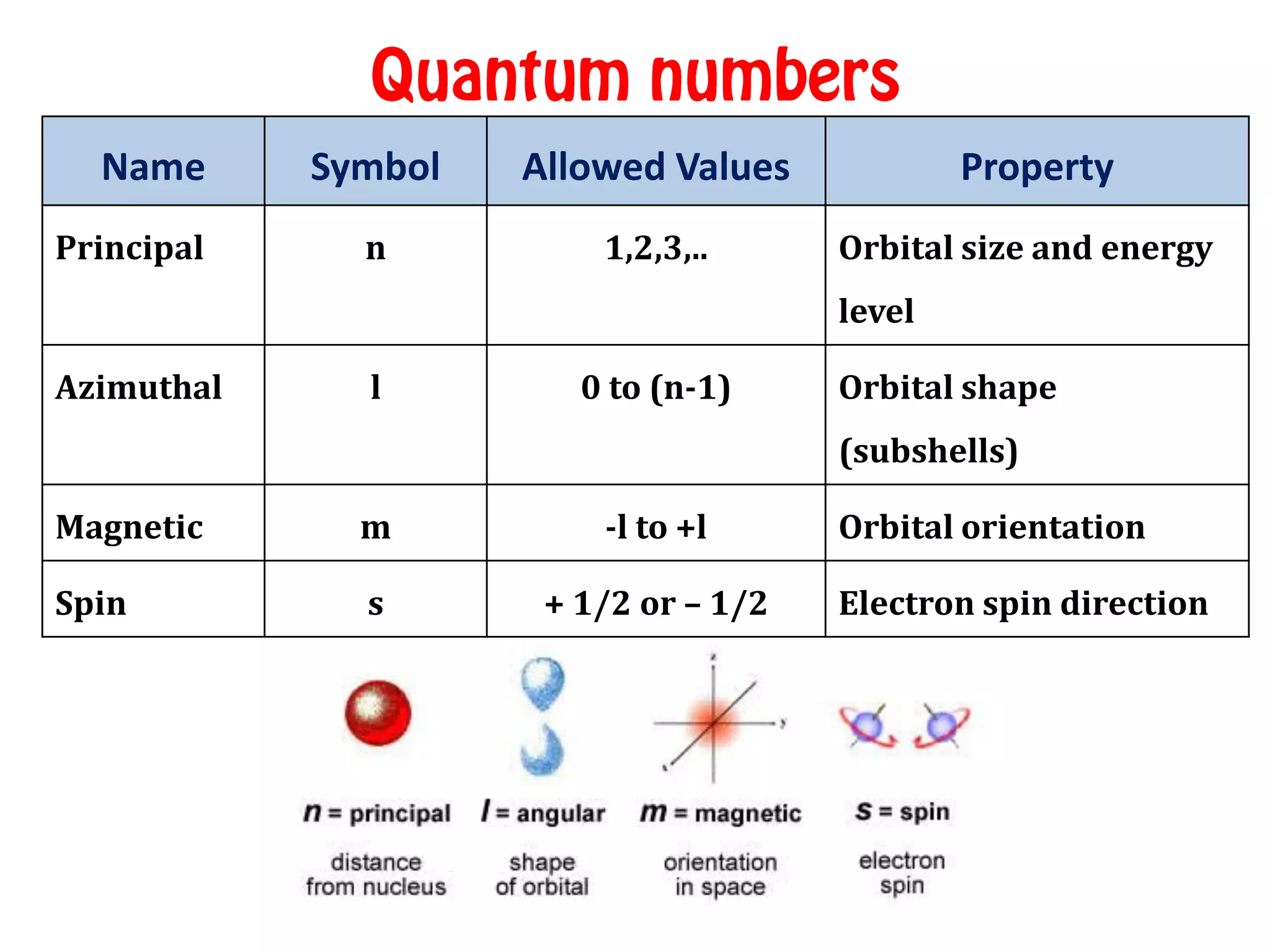
Today, we will decode that address. Our objective is to translate these mathematical indices into their profound physical meaning. We will explore how:
- The principal quantum number () governs the electron's energy and average distance from the nucleus.
- The azimuthal quantum number () dictates the orbital's fundamental shape and the magnitude of the electron's orbital angular momentum.
- The magnetic quantum number () specifies the orbital's orientation in space, corresponding to the quantized projection of the angular momentum vector.
We will begin by building an intuitive model based on the concept of nodes in standing waves, and then connect this intuition to the more rigorous physical principles of angular momentum and its quantization.
The Physical Meaning of the Quantum Numbers
In the last lesson, we separated the wave function into a radial part and an angular part . The quantum numbers and are parameters that define these very functions. Let's investigate the role of each.
To build a strong intuition for where the orbital shapes come from, let's watch a video that derives them from the simple idea of standing waves and nodes.
I finally understood orbital shapes intuitively! (My mind is blown)
The video 'I finally understood orbital shapes intuitively!' from the channel FloatHeadPhysics provides an excellent, first-principles derivation of orbital shapes. It starts with the analogy of a 1D standing wave on a string and extends the logic to three dimensions. Focus on how the number and type of nodes (places where the wave function is zero) dictate the energy and shape of the resulting orbital.
Watch the video from 02:41 to 30:09. This is a significant portion, but it builds the entire conceptual framework. Pay close attention to these key ideas: (02:41 - 06:00): How higher energy corresponds to more nodes, using the 1D string analogy. (06:00 - 12:06): How the ground state (1s) orbital is constructed. (13:25 - 18:25): The crucial distinction between a radial (spherical) node and an angular (planar) node, leading to the dumbbell shape of p-orbitals. (20:31 - 24:11): How two angular nodes lead to the shape of d-orbitals. (24:02 - 30:09): How this nodal structure directly maps onto the quantum numbers n, l, and ml.
This video provides the intuitive foundation. Now, let's formalize what each quantum number signifies.
1. The Principal Quantum Number, : Energy and Size
As we saw in the previous lesson and reinforced in the video, is the primary determinant of the electron's energy. The energy levels for a hydrogen-like atom are given by:
where is the Rydberg constant, is the atomic number, and .
-
Physical Meaning: A larger corresponds to a higher, less negative energy state, meaning the electron is less tightly bound to the nucleus. This also means the electron's average distance from the nucleus is greater. Therefore, determines the energy level and the overall size of the orbital. We refer to all orbitals with the same value of as belonging to the same electron shell.
-
Nodal Structure: The principal quantum number also tells you the total number of nodes in the wave function. For any given orbital, the total number of nodes is always .
2. The Azimuthal Quantum number, : Shape and Orbital Angular Momentum
The video introduced the idea of different types of nodes. The azimuthal (or angular momentum) quantum number, , specifies how many of the total nodes are angular nodes.
- Angular Nodes: These are planes or cones where the probability of finding the electron is zero. The number of angular nodes is equal to .
- Radial Nodes: These are spherical surfaces at a certain distance from the nucleus where the probability of finding the electron is zero. The number of radial nodes is given by .
Let's check this: Total Nodes = (Angular Nodes) + (Radial Nodes) = . This holds true.
- Physical Meaning (Shape): Since determines the number of angular nodes, it fundamentally determines the shape of the orbital.
- : 0 angular nodes. The orbital is spherically symmetric. We call this an s orbital.
- : 1 angular node (a plane). This creates the two-lobed, dumbbell shape. We call these p orbitals.
- : 2 angular nodes (two planes). This creates the four-lobed cloverleaf shape (and the unique shape). We call these d orbitals.
- : 3 angular nodes. These are f orbitals, with even more complex shapes.
This connection between nodes and shapes is beautifully illustrated by analogy to the vibrations of a 2D drumhead.
Tones on a Drum and Orbital Wave Functions
The webpage 'Tones on a Drum and Orbital Wave Functions' provides a wonderful 2D analogy for the 3D wave functions of orbitals. It will help solidify your understanding of nodal structure.
Read through the text and observe the animations. Focus on how the modes are labeled (e.g., m2,1) and relate them to our quantum numbers (n,l). Notice how modes with 0 'linear nodes' (like m1,0, m2,0) correspond to our spherically symmetric s-orbitals (l=0). The 'circular nodes' in the drum are analogous to our radial nodes. See how modes with 1 'linear node' (like m2,1) correspond to our p-orbitals (l=1). See how modes with 2 'linear nodes' (like m3,2) correspond to our d-orbitals (l=2). Finally, read the section 'Now let's look at 3 dimensional wavefunctions' which makes the translation from 2D drum to 3D orbital explicit.
-
Physical Meaning (Angular Momentum): The connection between and shape is not just geometric; it is profoundly physical. The shape of the electron's probability cloud is a manifestation of its orbital angular momentum.
An electron in an orbital () has zero orbital angular momentum. Classically, this would be like a planet that only moves radially towards or away from its star, but never revolves around it.
An electron in a orbital () or orbital () possesses angular momentum.Formally, the magnitude of the orbital angular momentum vector, , is quantized and determined by :
This is a cornerstone result of quantum mechanics. The value that determines the number of angular nodes also quantizes the magnitude of the electron's angular momentum.
3. The Magnetic Quantum Number, : Spatial Orientation
We have an orbital of a certain size () and shape (). But how is this shape oriented in three-dimensional space? This is determined by the magnetic quantum number, .
-
Physical Meaning (Orientation): For a given , there are possible values for (from to ). Each value corresponds to a different spatial orientation of the orbital.
- For an s orbital (): . There is only one orientation, which makes sense for a sphere.
- For p orbitals (): . There are three distinct orientations. We typically visualize these as the and orbitals, aligned along the Cartesian axes.
- For d orbitals (): . There are five distinct orientations.
-
Physical Meaning (z-Component of Angular Momentum): Just as is linked to the magnitude of the angular momentum vector , is linked to its direction. However, the uncertainty principle forbids us from knowing all three components of the vector () simultaneously. The operators for these components do not commute: .
As a compromise, nature allows us to know the total magnitude () and the projection of the vector onto one arbitrary axis simultaneously. By convention, we call this the z-axis. The magnetic quantum number quantizes the value of this projection, :
This leads to the famous "cone" model. The angular momentum vector has a fixed length , but its tip can lie anywhere on a cone that has a specific height along the z-axis. Its x and y components remain fundamentally uncertain.
[PDF] Orbital angular momentum
To understand the formal physics behind the link between l, m_l, and angular momentum, we will turn to a more advanced text. Focus on the conceptual conclusions, not just the mathematical derivation.
Please read the section '1.1.6 More insights into angular momentum conservation law and quantum number'. This is the most crucial part. Pay attention to the equations (1.58) and (1.59). They explicitly state that when the operators for angular momentum squared (\hat{L}^2) and its z-component (\hat{L}_z) act on a wave function, the result depends on l and m_l, respectively. This is the formal origin of their physical meaning. Study Figure 1.3 and its caption carefully. It is the visual representation of the uncertainty principle applied to the angular momentum vector. This cone diagram is a critical concept.
Guided Discovery
Let's test our understanding by connecting these concepts.
Problem 1: Deconstructing an Orbital
An electron is in a 4f orbital.
a) What are the values of its principal quantum number () and azimuthal quantum number ()?
b) How many total nodes does its wave function have?
c) How many of these nodes are angular? How many are radial?
d) What does this tell you about the general shape of the orbital compared to, say, a 4s or 4p orbital?
Problem 2: Quantifying Angular Momentum
Consider an electron in a 3d orbital ().
a) What is the magnitude of its orbital angular momentum, ? Express your answer in units of .
b) What are the possible values for the z-component of its angular momentum, ?
c) Why can the magnitude never be equal to ? (Hint: Look at the formulas for each).
Problem 3: The "Why" of Uncertainty
A fellow student argues: "If an electron is in a state with and , its angular momentum vector must be pointing straight up the z-axis, because its length is and its z-component is . Wait, that doesn't add up... something is wrong."
Your task:
a) First, confirm their calculation. Is equal to ?
b) Now, explain the conceptual flaw in their reasoning. Why is it physically impossible for the angular momentum vector to point perfectly along the z-axis? Use the uncertainty principle and the relationship between and in your explanation.
c) Describe what the "cone model" from Figure 1.3 in the PDF represents in this context.
Conclusion
We have now endowed the quantum numbers with physical meaning, moving them from abstract labels to descriptive properties of an electron's state.
Key Takeaways:
- : The principal quantum number determines the orbital's energy level and overall size. It also sets the total number of nodes to .
- : The azimuthal quantum number determines the orbital's shape by specifying the number of angular nodes (). It also quantizes the magnitude of the orbital angular momentum to .
- : The magnetic quantum number determines the orbital's spatial orientation. It quantizes the projection of the angular momentum vector onto the z-axis to .
- The uncertainty principle prevents us from knowing all components of the angular momentum vector simultaneously, giving rise to the "cone" model where the vector's orientation is constrained but not perfectly defined.
We have built a comprehensive picture of the electron's "house"—its orbital. But what about the electron itself? It turns out the electron has its own intrinsic angular momentum, independent of its orbit. This property is called spin, and it is described by the fourth and final quantum number. In our next lesson, we will explore the nature of spin and see why it is the crucial missing piece for understanding atoms with more than one electron.