Introduction
Welcome to our final lesson in this course on atomic structure and chemical bonding.
In our previous lesson, we established a quantum mechanical picture of the covalent bond. We saw it not merely as "sharing electrons," but as a process of constructive interference between electron waves (atomic orbitals), leading to the formation of a lower-energy bonding molecular orbital. We explored the geometric nature of this overlap (σ and π bonds) and the foundational role of the Pauli exclusion principle in enabling bond formation. The driving force behind all of this, we concluded, is the universal tendency of systems to seek a state of minimum potential energy.
Today, we will make this energetic perspective precise and quantitative. Our focus is on one of the most powerful and unifying concepts in chemistry: the potential energy curve. You have seen glimpses of this graph before, but now we will analyze it in detail.
Our learning outcome is to analyze a potential energy curve for a diatomic molecule to explain the concepts of bond length and bond energy as features of an energetic landscape. By the end of this lesson, you will be able to read this single graph and extract from it the core properties of a chemical bond: its stability, its length, and the forces that govern it. This curve provides the ultimate answer to the question of why atoms bond—because doing so places them in an energetically favorable state.
The Energetic Landscape of a Bond
Let's begin by building the potential energy curve from first principles. Imagine two hydrogen atoms, initially infinitely far apart. We define their potential energy in this state as zero, representing "no interaction." Now, what happens as we slowly bring them closer together?
As we discussed previously, a complex set of electrostatic forces comes into play:
- Attractive forces: Each electron is attracted to the other proton.
- Repulsive forces: The two electrons repel each other, and the two protons repel each other.
The total potential energy of the system at any given distance is the sum of all these interactions. To see how this plays out, let's watch a short video segment that visualizes this process and plots the resulting energy.
Why do atoms form molecules? The quantum physics of chemical bonds explained
This clip from Arvin Ash provides an excellent visualization of how the competing attractive and repulsive forces combine to create the characteristic shape of the potential energy curve.
Watch from 03:08 to 06:39. As you watch, focus on: The different electrostatic interactions that contribute to the total energy of the two-atom system. How the graph of Total Energy vs. Internuclear Distance captures the net effect of these forces. The physical meaning of the minimum point, or 'sweet spot,' in the curve.
The video beautifully illustrates how the potential energy curve emerges. It's an energetic landscape, and the system will naturally "roll" to the point of lowest energy. Let's formalize the key features of this landscape.
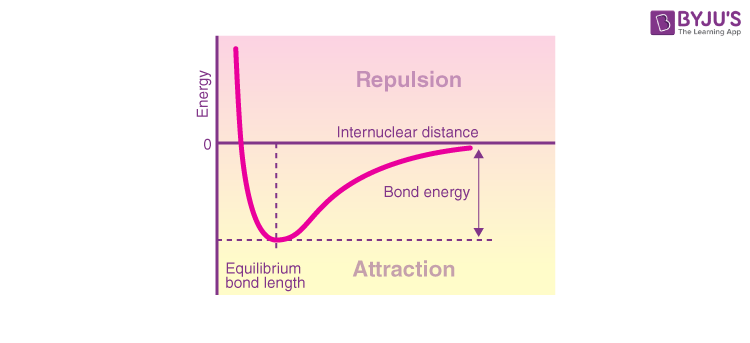
This curve contains two critical pieces of information about the bond:
-
Bond Length (rₑ): This is the internuclear distance at which the potential energy is at a minimum. It is the most stable position for the two atoms, representing the point where the attractive and repulsive forces are perfectly balanced. This is more accurately called the equilibrium bond length, as the atoms are always vibrating around this average distance due to thermal energy.
-
Bond Energy (Dₑ): This is the depth of the energy well, measured from the bottom of the curve up to the zero-energy line (where the atoms are infinitely separated). It represents the amount of energy the system released when the bond was formed. Conversely, it is the amount of energy that must be supplied to the molecule to break the bond and separate the atoms completely. It is a direct measure of the bond's strength and stability.
Reading the Forces from the Curve
The shape of this curve is not arbitrary. Your background in physics gives you a powerful tool to interpret it more deeply. In a conservative system, such as a molecule, the force acting on the particles is related to the potential energy by the negative gradient of the potential. In one dimension, this simplifies to:
This equation means that the force between the atoms at any distance is simply the negative of the slope of the potential energy curve at that distance. Let's explore this crucial connection.
Relationship Between Force and Potential Energy
This next video from the 'Physical Chemistry' channel explains the deep connection between potential and force. It bridges the gap between the physicist's view (forces) and the chemist's view (potentials), which is exactly what we need to fully analyze our curve.
First, watch from 01:45 to 02:22 to grasp the core mathematical relationship, F = -dV/dx. Then, watch from 05:19 to 06:44. This second part explains why this is so important for molecules and how to interpret the slope of a potential energy graph in terms of force.
Now, let's apply this principle to the potential energy curve we've been studying:
- At large distances (r > rₑ): The slope is negative. Therefore, the force is positive. A positive force here means it acts to decrease , so it is an attractive force, pulling the atoms together.
- At the equilibrium distance (r = rₑ): The curve is at its minimum, so the slope is zero. This means the net force is zero. This is the definition of equilibrium—the attractive and repulsive forces are in perfect balance.
- At very short distances (r < rₑ): The slope is large and positive. Therefore, the force is negative. A negative force acts to increase , so it is a powerful repulsive force, pushing the atoms apart.
This analysis reveals the dynamic nature of the bond. The potential energy curve is not just a static picture of stability; it is a complete map of the forces that govern the atoms' interaction at every possible separation.
The steepness of the repulsion at close range is also physically significant. It is a direct consequence of the Pauli Exclusion Principle. As the electron clouds of the two atoms are forced to occupy the same space, electrons with the same spin are forced into higher-energy antibonding orbitals, causing a dramatic increase in energy and a powerful repulsive force. This is what prevents matter from collapsing.
Guided Discovery Problem
Let's apply these ideas to interpret and compare the potential energy curves for two real diatomic molecules, O₂ and N₂.
Problem:
Below is a potential energy curve for the oxygen molecule, O₂.
(Note: This is a representative curve. Exact values are approximated for this problem.)
(a) Reading the Graph:
From the provided graph for O₂, estimate:
- The equilibrium bond length in picometers (pm).
- The bond energy in kJ/mol.
(b) Force Analysis:
Mark the following three points on the graph: r = 100 pm, r = 121 pm, and r = 250 pm. At each of these points, describe the net force acting on the two oxygen atoms as either "attractive," "repulsive," or "zero." Justify your answer by describing the slope of the curve at each point.
(c) Comparative Analysis:
The nitrogen molecule, N₂, has a triple bond, making it much stronger and shorter than the double bond in O₂. The bond energy of N₂ is approximately 945 kJ/mol, and its bond length is approximately 110 pm.
- On the same set of axes, sketch a rough potential energy curve for N₂ relative to the O₂ curve.
- What specific features of your N₂ curve (e.g., depth, position of the minimum) reflect the fact that its bond is stronger and shorter than the bond in O₂? Explain the connection.
(d) A Foundational Question:
Look again at the potential energy curve. Why is the energy defined as zero at infinite separation? And what does it physically mean for the bond energy to be, for example, -498 kJ/mol at the equilibrium distance? What is the reference point for this energy value?
- Insight from the Problem: This problem guides you to move from passive observation to active analysis of a potential energy curve. Part (a) is a direct data extraction task. Part (b) forces you to apply the relationship to connect the visual geometry of the curve (its slope) to the underlying physics (the forces). Part (c) is a synthesis task, requiring you to translate known chemical properties (stronger, shorter bond) into the graphical features of the potential energy landscape (deeper, shifted well). Finally, part (d) probes your understanding of energy as a relative quantity, forcing you to think about the meaning of the "zero" point and the negative potential energy of a stable system.
Conclusion
With our analysis of the potential energy curve, we have reached the culmination of our journey. This single diagram elegantly captures the essence of a chemical bond—a dynamic equilibrium driven by the universal quest for minimum energy.
Key Takeaways:
- A chemical bond is an energetic phenomenon, best described by a potential energy curve that maps the energy of the system versus the distance between atoms.
- The minimum of this curve defines two of the bond's most important properties: the equilibrium bond length (the position of the minimum) and the bond energy (the depth of the well).
- The slope of the curve at any point reveals the net force between the atoms, illustrating the balance between long-range attraction and short-range repulsion.
- The formation of a stable bond corresponds to the system moving "downhill" into this energy well, releasing energy and achieving a state of lower potential energy than the separated atoms.
This lesson concludes our formal exploration of atomic structure and chemical bonding. We began by questioning the very nature of matter, asking with the ancient Greeks whether it was continuous or discrete. We then journeyed inside Dalton's "indivisible" atom to discover its subatomic architecture. This led us to the quantum revolution, where the classical, deterministic model gave way to a world of waves, probabilities, and quantized states. Finally, we used these quantum principles to build a robust model of the atom and, from there, to understand the energetic and quantum mechanical reasons why atoms bind together to form the world around us.
Your curiosity and your insistence on understanding the "why" have been the driving force of this course. I hope this structured, first-principles approach has not only given you a deep and lasting mastery of this topic but has also reinforced the idea that the most complex phenomena can be understood by tracing them back to a few elegant, fundamental principles.