Introduction
In our last lesson, we established the existence of the electron as a universal, subatomic particle. We concluded that its charge-to-mass ratio () was constant regardless of its source and that its value was enormous compared to any known ion, implying the electron's mass was incredibly small. This was a monumental shift, transforming the atom from a hypothetical indivisible sphere into a physical object with a complex internal structure.
Today, we will dissect the intellectual architecture of that discovery. Our goal is to derive the logic of Thomson's charge-to-mass ratio measurement and identify what it leaves undetermined. We will not just look at the final formula, but reconstruct the chain of reasoning that makes the measurement possible. This process will reveal the genius of the experimental design and also expose its inherent limitations, which in turn, sets the stage for the next great leap in understanding the electron.
The Experimentalist's Dilemma: Too Many Unknowns
Imagine you are J.J. Thomson. You have a beam of particles. You know they are charged, but you don't know the charge (), the mass (), or the velocity (). You can exert forces on them with electric () and magnetic () fields, and you know the governing laws:
- Electric Force:
- Magnetic Force: (when velocity is perpendicular to the magnetic field)
- Newton's Second Law:
The challenge is clear: how can you possibly solve for the ratio when , , and are all unknown? A single experiment measuring deflection will entangle all three variables. Thomson's genius was to devise a two-step process to isolate and eliminate the velocity, thereby making the problem solvable.

Step 1: Taming the Velocity
The first, and most elegant, part of the experiment is to determine the velocity of the particles without knowing their charge or mass. Thomson achieved this by applying the electric and magnetic fields simultaneously and orienting them so that their forces on the electron beam would oppose each other.
To see how this works, let's watch a brief segment that visualizes this crucial step.
JJ Thomson Cathode Ray Tube Experiment: the Discovery of the Electron
The following clip from 'Kathy Loves Physics' clearly explains how Thomson used balanced forces to create a 'velocity selector', a method for finding the speed of the cathode ray particles.
Watch the segment from 04:47 to 05:55. Focus on the core logic: by adjusting the fields until the beam goes straight, what can you conclude about the forces acting on the particle, and how does this lead directly to an expression for its speed?
As the video explained, Thomson adjusted the strength of the magnetic field until the downward pull of the electric field was perfectly canceled by the upward push of the magnetic field. When the beam passed through undeflected, he knew the net force was zero.
Notice the beauty of this step. The unknown charge, , cancels from both sides of the equation. We can now solve for the velocity using only the strengths of the fields, which are macroscopic, measurable quantities:
This is a profound achievement. Thomson found the speed of an invisible, subatomic particle using nothing more than a voltmeter, a magnetometer, and some clever physics. The velocity was no longer an unknown.
Step 2: Measuring the Ratio
With the velocity known, Thomson could proceed to the second step: measure the ratio itself. He did this by turning off one of the fields and measuring the deflection caused by the other. Let's analyze this using the method detailed in his original work, where he turned off the magnetic field.
[PDF] Charge to Mass of Electron
The following PDF document, based on historical accounts, provides a clear, step-by-step derivation of the e/m ratio using the deflection caused by only the electric field.
Read the section titled 'MEASURING THE CHARGE - TO MASS RATIO OF ELECTRONS', starting from the second paragraph ('Once he measured v in this manner...'). Follow the derivation that leads to the equation for e/m. Pay close attention to the analogy made with a horizontally projected bullet.
Let's break down the logic you just read.
- With only the electric field active, the electron experiences a constant downward force .
- This force causes a constant downward acceleration .
- The motion is analogous to a projectile fired horizontally. The horizontal velocity (which we know from Step 1) remains constant. The vertical motion is one of uniform acceleration.
- If the electric field plates have a length , the time the electron spends being accelerated is .
- The vertical deflection during this time is given by basic kinematics: .
- Now, we substitute our expressions for and :
- Finally, we rearrange the equation to solve for the quantity we want, :
Every quantity on the right side of the equation is now known: is the measured deflection, is known from Step 1, and and are properties of the apparatus. Thomson had successfully measured the charge-to-mass ratio.
Alternative Method: It's also possible to perform Step 2 by turning off the electric field and measuring the deflection from the magnetic field alone. In this case, the magnetic force provides the centripetal force for a circular path. You can explore this derivation in the first video resource under LINK from timestamp 08:24 to 11:11 if you are curious. The logic is parallel and leads to the same result.
What Remains Undetermined? The Limit of the Ratio
Thomson's measurement yielded a value for of approximately Coulombs per kilogram, about 1800 times larger than the ratio for a hydrogen ion. This was a revolutionary result, but it's crucial to understand what it doesn't tell us.
The experiment measures a ratio. It provides no method for separating the two variables, and . The enormous value of the ratio could logically stem from two possibilities:
- The electron's charge () is very large, and its mass () is comparable to other ions.
- The electron's mass () is very small, and its charge () is comparable to other ions.
Thomson, guided by other physical principles like Faraday's laws of electrolysis which suggested a fundamental unit of charge, correctly inferred that the second option was the case. However, his experiment alone does not prove this. It cannot distinguish between a highly charged massive particle and a lightly charged tiny particle.
This is the central limitation of the experiment. The individual values of the electron's charge and mass remained undetermined.
This excerpt from a paper by John D. Norton explores the epistemic status of Thomson's discovery. It touches on what his experiment could and could not definitively prove, especially in its initial stages.
Read the first paragraph of section 3.2, 'Limitations'. Note the author's point that Thomson's analysis couldn't even rule out a continuous fluid-like model of electricity, as long as that fluid had a constant charge-to-mass density. This highlights a deeper philosophical limit to what the experiment shows.
The fundamental ambiguity of measuring only a ratio meant that a new experiment was needed—one that could measure either or directly. This challenge was famously met by Robert Millikan, whose oil drop experiment we will study in our next lesson.
Guided Discovery
The following problem is adapted from the diagram you see below. Work through the sub-questions to reconstruct the logic of the experiment yourself. This will solidify your understanding of how each step enables the next.
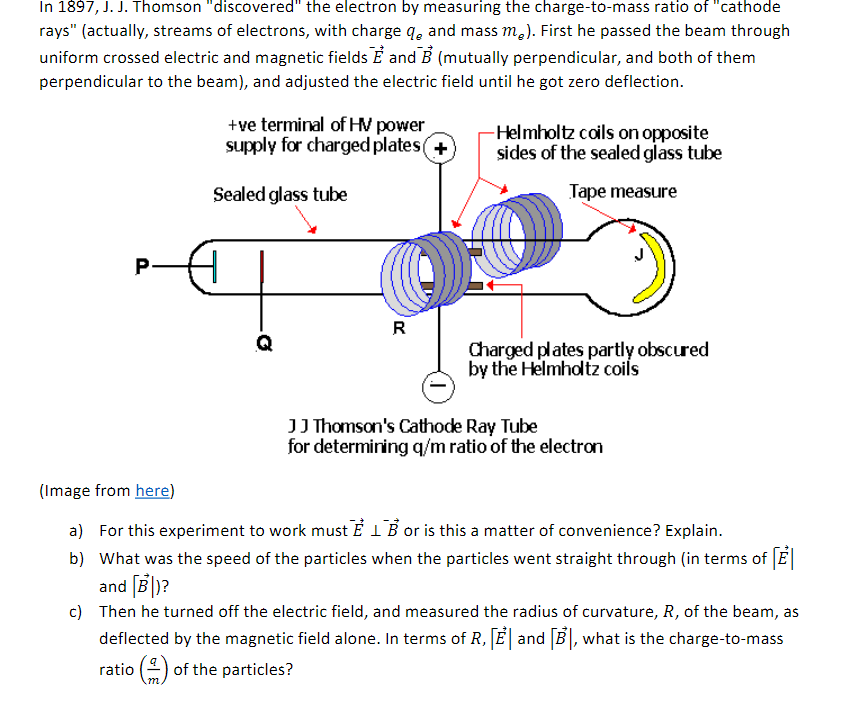
Problem:
Consider the experimental setup shown in the image above. A beam of electrons with velocity enters a region with a uniform magnetic field (out of the page) and a uniform electric field .
-
Finding Velocity: In the first part of the experiment, the electric and magnetic fields are adjusted so the electron beam is undeflected.
- Write down the expressions for the magnitudes of the electric force () and the magnetic force () on an electron with charge .
- Using the condition for zero deflection, derive an expression for the electron's speed, , in terms of and . Why is this step crucial for making the problem solvable?
-
Finding the Ratio: In the second part, the electric field is turned off (). The magnetic field causes the electrons to move in a circular path of radius .
- What force is responsible for this circular motion (i.e., what force provides the centripetal force)?
- Set the magnetic force equal to the centripetal force () and derive an expression for the charge-to-mass ratio, , in terms of , , and .
-
The Final Answer:
- Substitute the expression for from part (1) into your result from part (2) to get a final expression for that depends only on measurable quantities of the experiment (, , and ).
- Thought Experiment: A colleague of Thomson argues, "Your value is ~1800 times that of a hydrogen ion. This proves the electron's charge is enormous." Explain the logical flaw in this conclusion. What is the alternative, equally valid conclusion that can be drawn from the data of this experiment alone?
Conclusion
In this lesson, we moved beyond the mere fact of the electron's discovery to understand the logical scaffolding that made it possible. We saw how Thomson masterfully used a two-step method to navigate a problem with multiple unknowns.
Key Takeaways:
- Velocity Selection: By balancing opposing electric and magnetic forces, Thomson could determine the velocity of the electrons () independently of their charge or mass.
- Deriving the Ratio: Once the velocity was known, the deflection of the beam under a single field (electric or magnetic) could be used with the laws of motion () to calculate the charge-to-mass ratio, .
- Inherent Limitation: The experiment, by its very design, can only determine the ratio of charge to mass. It cannot disentangle these two fundamental properties. The question of whether the electron had a huge charge or a tiny mass remained open.
This unresolved question is not a failure but a driver of scientific progress. It created the intellectual necessity for a new experiment, one designed specifically to isolate and measure the fundamental unit of charge. In our next lesson, we will explore the beautiful and ingenious oil drop experiment of Robert Millikan, which did exactly that.