Introduction
In our last lesson, we walked through the mathematical engine of the Bohr model, a truly remarkable achievement. Starting from just two core assumptions—a classical force balance and a radical quantum condition—we derived the precise formula for the energy levels of the hydrogen atom. This led directly to the Rydberg formula, turning what was once a purely empirical observation into a consequence of fundamental constants. It was a moment of triumph, suggesting that physics was on the right track.
However, a successful scientific model must do more than solve one specific problem. It must be robust, generalizable, and conceptually sound. Today, we will act as critical evaluators. We will place the Bohr model under scrutiny, celebrating its genuine successes but also probing its deep and revealing failures. Our goal is to understand not only what the Bohr model accomplished but also why it was ultimately destined to be a brilliant, yet temporary, stepping stone.
The Successes: A Monumental Achievement
The Bohr model's ability to explain the hydrogen spectrum was its crowning glory. As we saw, it perfectly predicted the wavelengths of the spectral lines, organizing them into the Lyman, Balmer, and Paschen series based on the final energy state of the transitioning electron.

But the success went even deeper. Let's examine the key achievements that made the model so compelling.
Critique of Bohr Theory and of the “Old” Quantum Mechanics
To start, let's read a concise summary of the Bohr model's achievements from the document 'Critique of Bohr Theory'. This text highlights successes beyond just the hydrogen spectrum.
Read the first paragraph of the document. Focus on the list of successes: what did the model explain besides the hydrogen lines?
As the text points out, the model's triumphs included:
- Deriving the Rydberg Constant: It didn't just match the Rydberg formula; it explained the Rydberg constant () in terms of fundamental constants like the electron's mass and charge (), Planck's constant (), and the speed of light (). This is a profound shift from fitting a number to deriving it from first principles.
- Predicting Atomic Size: The model yielded the Bohr radius, nm, as the radius of the hydrogen atom in its ground state. This provided a theoretical estimate for the size of an atom that was consistent with experimental values.
- Generalizing to Hydrogen-like Ions: The model worked perfectly for other single-electron systems, such as He⁺ and Li²⁺, by incorporating the nuclear charge .
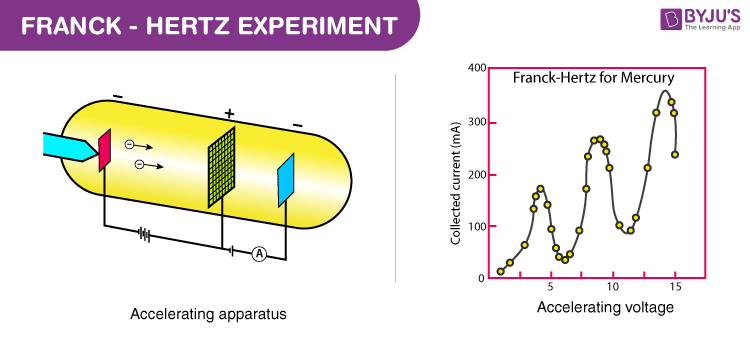
- Experimental Validation of Quantized Energy: This is a crucial point. Bohr postulated the existence of discrete energy levels. A few years later, the Franck-Hertz experiment provided direct, independent proof.
The Failures: Cracks in the Foundation
Despite its successes, physicists, including Bohr himself, knew the model was deeply flawed. It was a "desperate fix," not a fundamental theory. The following video provides an excellent, concise overview of the model's key shortcomings.
Understanding Bohr's Atom: his postulates and the limitations
Let's watch a short clip that clearly enumerates the failures of the Bohr model. Pay close attention to the list of problems, as we will discuss them in more detail.
Watch the segment from 9:33 to 11:36. The video lists several major problems. Try to categorize them in your mind: which are failures of prediction, and which are deeper, conceptual problems?
Let's dissect the two most significant categories of failure.
1. Empirical Failures: What the Model Couldn't Predict
The Bohr model's predictive power was extremely narrow. It was like a key that opened only one very specific lock.
- Multi-electron Atoms: The model fails completely for any atom with more than one electron, like neutral helium. Why? The calculations for orbital radius and energy are based on a simple two-body problem (one nucleus, one electron). The model offers no way to account for the complex electrostatic repulsions between multiple electrons orbiting a nucleus. Since hydrogen is the only neutral atom with one electron, the model was useless for explaining the rest of the periodic table.
- Spectral Line Intensities: If you look at the hydrogen spectrum, some lines are intensely bright while others are faint. This implies that some electron transitions are much more probable than others. The Bohr model predicts the wavelengths of these lines but provides no mechanism to calculate their relative intensities. It can tell you what transitions are possible, but not which are likely.
- Fine Structure and the Zeeman Effect: High-resolution spectrometers revealed that what appeared to be single spectral lines were often clusters of closely spaced lines (fine structure). Furthermore, when atoms were placed in a magnetic field, the lines would split into even more components (the Zeeman effect). The Bohr model, with its simple integer quantum number , could not account for any of this complexity. It hinted that the state of an electron was more intricate than a simple circular orbit.
2. Conceptual Failures: The Unstable Philosophical Ground
For a thinker like yourself, who values first principles and logical coherence, these are perhaps the most damning failures. The model was not a theory in the proper sense; it was an ad hoc hybrid of conflicting ideas.
Critique of Bohr Theory and of the “Old” Quantum Mechanics
The PDF 'Critique of Bohr Theory' also discusses these conceptual issues. Let's read its take on the philosophical problems with the model.
Read the second paragraph, starting with 'The failures of Bohr theory...'. Focus on the questions it raises about the model's assumptions. Why was it so philosophically unsatisfying?
The core problem was that the model violated its own logic. It used classical physics (Coulomb's Law) to define the electron's orbit but then arbitrarily commanded the electron to ignore classical physics (electromagnetic radiation from an accelerating charge). It introduced the quantization of angular momentum by fiat, without any underlying physical reason.
This leads to a profound question about causality, which Ernest Rutherford immediately raised.
What is the Bohr model of the atom?
This final video clip captures the essence of the conceptual problem with the Bohr model. It touches on Rutherford's deep and insightful criticism.
Watch the segment from 24:51 to 26:10. Listen carefully to Rutherford's question about how an electron 'knows' where it is going. What does this imply about the nature of cause and effect in the model?
Rutherford's question is piercing: How does an electron in a high-energy orbit know the energy of its final destination in order to emit a photon of precisely the right frequency? In classical physics, an event is caused by local conditions. In the Bohr model, the "jump" seems to be a non-local, instantaneous event that violates this principle. The model describes what happens but is completely silent on the how and why.
Guided Discovery
Let's reflect on these successes and failures. Your task is not to perform calculations but to think like a physicist grappling with these ideas in the 1920s.
Problem 1: The Helium Puzzle
Imagine you are a physicist in 1915. You have just celebrated the success of Bohr's model for hydrogen. A colleague shows you the emission spectrum for neutral helium (He, Z=2), and its lines do not match any prediction from the Bohr formula ().
a) How would you defend the Bohr model against the claim that it is simply "wrong"?
b) Privately, what would this failure with helium tell you about the fundamental limitations of your model's core assumptions?
Insight:
a) You would argue that the model was explicitly designed for a two-body system (one electron, one nucleus) and that its success there is undeniable. The presence of a second electron in helium introduces electron-electron interactions, a three-body problem that the model is not equipped to handle. Therefore, the helium spectrum doesn't invalidate the model within its stated domain.
b) Privately, you would be deeply concerned. The fact that the model collapses with the introduction of just one more particle suggests it is not a fundamental law of nature. It hints that the very concept of clean, independent circular orbits is a naive oversimplification and that a proper theory must have a built-in way to handle interactions between all particles in the atom.
Problem 2: The Question of Importance
The hydrogen spectrum shows that the red Balmer-alpha line (n=3 to n=2) is much brighter than the violet Balmer-gamma line (n=5 to n=2). The Bohr model correctly predicts their wavelengths but cannot explain their difference in brightness.
Why is this inability to predict line intensity considered a fundamental failure, rather than a minor detail to be filled in later? What does it say about what a "complete" theory of the atom should be able to do?
Insight:
A complete physical theory must do more than just list the possible outcomes; it must predict the probability of those outcomes. The brightness of a spectral line is proportional to the number of photons emitted per second, which in turn depends on the probability of that specific electron transition. The Bohr model's silence on this issue means it lacks a mechanism for calculating probabilities. It suggests the model is missing the underlying dynamics of how and why transitions occur. A complete theory must contain the rules that govern not just the "what" but also the "how likely."
Problem 3: The Most Damning Failure
Of all the failures discussed—multi-electron atoms, intensities, fine structure, Zeeman effect, and the philosophical incoherence—which one do you personally find to be the most "damning" to the Bohr model as a potential final theory of the atom? Justify your choice.
Insight:
There is no single correct answer here; the goal is to justify your reasoning.
- An argument for multi-electron atoms being the most damning would focus on utility and scope: a theory of the "atom" that only works for 1 out of 118 elements is not a very useful or fundamental theory.
- An argument for the philosophical incoherence being the most damning would focus on the search for truth and consistency: a theory that is internally contradictory, that picks and chooses which laws of nature to follow, cannot be a true description of reality. It is, at best, a clever calculational trick. This perspective aligns with the quest for first principles and logical rigor. It suggests the entire conceptual framework (classical orbits + quantum rules) is wrong, necessitating a completely new foundation.
Conclusion
Today, we've seen the Bohr model in its full context: a brilliant but flawed masterpiece.
Key Takeaways:
- Successes: The model was spectacularly successful at predicting the spectral lines of hydrogen and hydrogen-like ions, deriving the Rydberg constant from fundamental principles, and providing a reasonable estimate for atomic size. Its core idea of quantized energy levels was experimentally confirmed by the Franck-Hertz experiment.
- Failures: The model's authority collapsed when faced with multi-electron atoms, the varying intensities of spectral lines, and fine structure. Most importantly, it was built on philosophically shaky ground—an ad hoc mix of classical and quantum rules that lacked a coherent physical explanation and raised troubling questions about causality.
The failures of the Bohr model were ultimately more important than its successes. They provided a clear map of the territory that a new, more fundamental theory would need to conquer. The arbitrary quantization rule, the mysterious electron "jumps," and the wave-like behavior of light all hinted that a deeper principle was at play. In our next lesson, we will explore the radical idea that answered these questions: Louis de Broglie's hypothesis that if waves can be particles (photons), then perhaps particles can be waves. This insight will finally give us a physical reason for quantization and pave the way for the true quantum revolution.