Introduction
In our previous lesson, we explored de Broglie's radical proposal: that all matter, including electrons, possesses a wave-like nature described by the equation . We saw this not as a mere guess, but as a deep argument from physical symmetry, rigorously derived by attempting to unify relativity and quantum theory. This left us with a powerful new tool, but also a crucial question: What does it mean for an electron in an atom to be a wave?
Today, we will answer that question. Our goal is to connect the electron's wave nature to its confinement within the atom. You will see how the simple, physical requirement that an electron's wave must not destroy itself leads directly and naturally to the quantization of energy levels. This lesson will provide the physical justification for Bohr's postulate of quantized angular momentum, transforming it from an arbitrary rule into a logical consequence of matter waves.
The Universal Principle: Confinement Breeds Quantization
Before we even discuss the atom, let's establish a more fundamental principle that applies to all waves, from music to quantum mechanics. When a wave is confined to a finite region of space, it can only exist in a set of discrete, stable patterns. These stable patterns are called standing waves.
Think of a guitar string fixed at both ends. When you pluck it, you don't hear a chaotic blend of all possible sounds. You hear a clear note (the fundamental frequency) and its overtones (harmonics). Why? Because only waves that fit perfectly on the string, with nodes at the ends, can sustain themselves. All other wavelengths will reflect back and interfere destructively, quickly cancelling themselves out. The confinement (the fixed ends of the string) forces the wave's energy into discrete, quantized modes.
This principle is not a "quantum" secret; it's a fundamental property of waves. To see how this applies beyond simple strings, let's examine a more general explanation.
Quantization vs. continuous energy levels
The following discussion on Physics Stack Exchange provides an excellent, concise explanation of this core principle. Pay close attention to the first answer by user 'sintetico'.
Please read the first answer in the provided link. Focus on the central argument: 'The quantization of energy levels appears both in quantum and classical mechanics... It is a consequence of confinement.' Notice the analogy it draws between a quantum particle and a classical wave, and how imposing 'periodic boundary conditions' (like a string's ends or a loop) naturally leads to discrete solutions.
The key takeaway is that quantization is not inherently mysterious. It is the natural result of confining a wave. A free particle, like a wave in an open ocean, can have any energy. But a bound particle, like a wave in a harbor (or an electron in an atom), is restricted to specific, stable standing wave patterns.
The Electron as a Circular Standing Wave
Now, let's apply this principle to the atom. In the Bohr model's picture, the electron is confined to a circular orbit by the electrostatic attraction of the nucleus. If the electron is a wave, as de Broglie proposed, then for its orbit to be stable, its wave must form a standing wave along the circumference of the orbit.
What happens if it doesn't? Imagine a wave wrapping around a circle. If an integer number of its wavelengths do not fit perfectly into the circumference, then after one lap, the wave will be out of phase with itself. The peaks will overlap with troughs, and the wave will undergo destructive interference, effectively annihilating itself. An electron cannot exist in such an orbit.
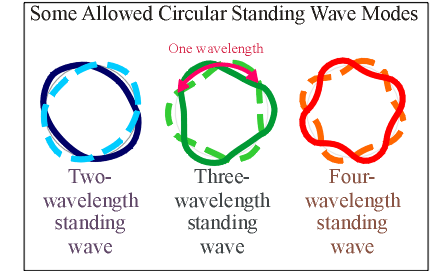
A stable orbit is only possible if the wave interferes constructively with itself. This happens only when the circumference of the orbit is an exact integer multiple of the electron's wavelength.
The Standing Wave Condition:
Here, is the number of full wavelengths that fit into the orbit. The state is the fundamental harmonic (like the base note on a guitar string), is the second harmonic, and so on.
This image beautifully illustrates the concept. The allowed orbits are those that can host a whole number of wavelengths.
Deriving Bohr's Postulate from First Principles
We are now at the critical juncture. We have two core ideas:
- De Broglie's Hypothesis:
- The Standing Wave Condition:
Let's see what happens when we combine them. We will substitute de Broglie's expression for the wavelength into the standing wave condition.
The following video provides a clear demonstration of this idea, using a physical vibrating ring to build intuition before showing the mathematical derivation.
demonstrating de Broglie's hypothesis of electrons as standing waves
This video from PhysicsHigh, titled 'demonstrating de Broglie's hypothesis of electrons as standing waves', provides a fantastic physical and mathematical explanation for how standing waves lead to quantization.
Please watch from 02:48 to 08:14. The first part (02:48 - 03:32) introduces the standing wave idea. The second part (03:32 - 06:57) shows a compelling physical demonstration with a vibrating loop. Notice how only specific frequencies create stable, resonant patterns (standing waves), while others result in chaos. This is the physical analogy for allowed vs. forbidden orbits. The final part (06:57 - 08:14) walks through the mathematical derivation that connects the standing wave condition to Bohr's quantization of angular momentum.
Let's write out the derivation ourselves to ensure we have command of the logic.
- Start with the standing wave condition for a stable orbit:
- Substitute de Broglie's relation, :
- Now, rearrange the equation to group the terms for angular momentum () on one side. Multiply both sides by and divide by :
This is precisely Bohr's ad hoc postulate for the quantization of angular momentum.

This is a profound result. We have not just guessed a rule that works. We started from the fundamental principle of wave-particle duality, applied it to a confined electron, and the quantization of the atom's properties emerged as a necessary consequence. Bohr's model was a brilliant but incomplete "what." De Broglie's standing wave model provides the "why."
Guided Discovery
Let's test our understanding of these connections.
Problem 1: The Forbidden Orbit
Imagine an electron is in a hypothetical circular orbit where the circumference is exactly times its de Broglie wavelength ().
a) In your own words, describe what happens to the electron's wave as it completes its first, second, and third trip around the nucleus. Use the concept of phase and interference.
b) Why does this self-interference imply that such an orbit is "unstable" or "forbidden"? What does it mean for a probability wave to "cancel out"?
Problem 2: Quantifying the Ground State
Let's apply these ideas to the ground state () of the hydrogen atom. The radius of this orbit is the Bohr radius, m.
a) Using the standing wave condition (), calculate the de Broglie wavelength of the electron in this orbit.
b) Now, using the de Broglie relation (), calculate the momentum () of this electron. (Use ).
c) From its momentum and mass ( kg), calculate the electron's kinetic energy (). Express your answer in joules and then convert to electron-volts (1 eV J).
d) In a stable circular orbit under an inverse-square force (like electrostatics), there's a neat relation from classical mechanics called the Virial Theorem, which implies that and the total energy is . Based on your calculated kinetic energy, what is the total energy of the hydrogen atom in its ground state? How does this compare to the experimentally known value of -13.6 eV?
Problem 3: Beyond Circles
This standing wave model perfectly explains quantization for circular orbits, but we know from modern quantum mechanics that electrons do not follow simple circular paths. They exist in three-dimensional "orbitals" with complex shapes (s, p, d, etc.).
How do you think the core idea of a "standing wave" applies to these more complex 3D probability clouds? If the electron is no longer a wave on a 1D circular string, what might it be analogous to? What is being "quantized" in this more realistic picture?
Conclusion
Today we took a major step in demystifying the quantum atom. By accepting the electron's wave nature, we have seen that quantization is not an arbitrary rule imposed on the atom from the outside. Instead, it is an inevitable consequence of confining a wave to the small space around a nucleus.
Key Takeaways:
- Confinement is Key: Quantization is a universal feature of confined waves. Any system where a wave is restricted to a finite space will exhibit discrete, allowed states (standing waves).
- A Physical Reason for Quantization: An electron's wave must form a stable standing wave in its orbit to avoid destructively interfering with itself.
- Deriving Bohr's Postulate: The condition for a circular standing wave (), when combined with de Broglie's wavelength equation (), logically and mathematically derives Bohr's rule for quantized angular momentum.
We have successfully replaced Bohr's arbitrary postulate with a more fundamental physical explanation. However, our model is still a hybrid: it treats the electron as a wave but still confines it to a classical, definite orbit. This is conceptually unsatisfying.
In our next lesson, we will complete the revolution. We will discard the idea of classical orbits entirely and embrace a fully wave-mechanical description of the atom. This will lead us to the Schrödinger equation, the master equation of non-relativistic quantum mechanics, whose solutions are the true three-dimensional standing waves—the orbitals—that define the structure of atoms.