Hello! Welcome to your next lesson in our exploration of Domain-Driven Design (DDD) with Python.
In the previous modules, we established the foundational principles of DDD. We discussed how strategic patterns like Bounded Contexts and the Ubiquitous Language help manage complexity at a high level. We then dove into tactical patterns, learning how to build a rich domain model using Entities, Value Objects, and Aggregates to represent business concepts and rules.
A key principle we've touched upon is that the domain model should be pure—focused solely on business logic, independent of technical concerns like databases. This raises a critical question: If our domain objects are just plain Python objects with no knowledge of how they are stored, how do we actually save them to and retrieve them from a database?
This lesson answers that question by introducing a crucial pattern: the Repository.
Lesson Goal: By the end of this 60-minute lesson, you will be able to explain the role of the Repository pattern in abstracting persistence logic from the domain model.
1. The Problem: When Business Logic and Data Access Collide
In many applications, the code that handles business rules is directly mixed with the code that saves data. You might see ORM (Object-Relational Mapper) calls, like those from SQLAlchemy or the Django ORM, scattered throughout your application services.
This tight coupling between the domain and the database creates several problems:
- Brittleness: A change in the database schema (like renaming a column) can force changes in the business logic layer, even if the business rule itself hasn't changed.
- Reduced Testability: Unit testing your business logic becomes difficult because you need to mock database connections or set up a test database.
- Lack of Flexibility: Swapping your database technology (e.g., moving from PostgreSQL to a NoSQL database) becomes a massive undertaking because data access code is woven throughout the application.
This violates the principles of Clean or Hexagonal Architecture, which state that the domain model should be at the core of the application, with dependencies pointing inwards. The database is an external detail, and the domain core should not depend on it.
To see a practical demonstration of this problem, please watch the following segment.
Using the Repository Pattern for better data access encapsulation (in Python)
The video 'Using the Repository Pattern for better data access encapsulation' from the microapis channel clearly illustrates the issues that arise from mixing API or business logic directly with database transactions.
Watch the sections 'Problem with Tightly Coupled Layers' (03:02 - 04:30) and 'How Repository Pattern Solves Coupling Issues' (04:30 - 06:54). Focus on the speaker's explanation of why having database queries directly in the API layer is problematic and how a repository helps solve this.
As the video explains, the solution is to centralize and encapsulate all data access logic. This is precisely the job of the Repository pattern.
2. The Repository: A Bridge to the Persistence World
The Repository pattern provides an abstraction over persistence. It acts as a mediator between your domain model and the underlying data storage, making the data storage look like a simple in-memory collection of your domain objects.
Let's get a formal definition.
The article 'The Repository Pattern' by Charlie Steele provides a concise and effective definition of the pattern and its relationship with dependency inversion.
Read the first two sections, 'What is the repository pattern?' and the paragraph immediately following it. Pay close attention to the quote from 'Architecture Patterns with Python' and the explanation of dependency inversion.
The key idea is Dependency Inversion. Instead of the domain model depending on the database/ORM, we invert the dependency. The domain defines an interface for what it needs (e.g., "get a product by its ID," "save a product"), and the infrastructure layer provides a concrete implementation of that interface that works with a specific database.
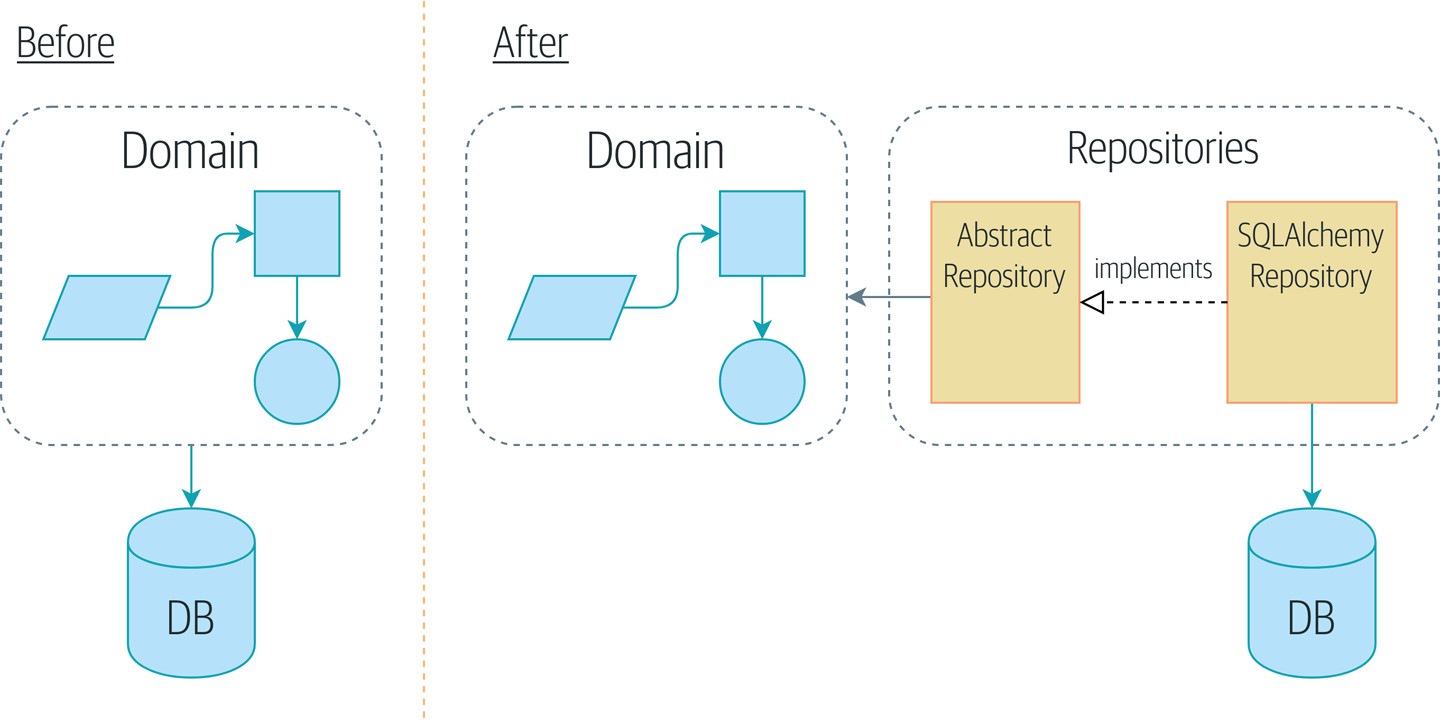
In DDD, repositories have a specific responsibility: they manage the lifecycle of Aggregates. You don't have a repository for every entity, only for Aggregate Roots.
The following video explains this from a DDD perspective.
Domain-Driven Design (DDD) Patterns in Python
In this segment from his talk 'Domain-Driven Design (DDD) Patterns in Python', Robert Smallshire explains the architectural significance of repositories and how they fit into a DDD architecture.
Watch the section 'Repositories: Abstraction of Persistence' (41:45 - 48:20). Focus on these key points: Repositories store and retrieve Aggregates. They are an abstraction over the persistence mechanism. The abstract repository (the interface) lives in the domain model, while the concrete implementation lives in the infrastructure layer.
To summarize, the repository's role is to:
- Provide a collection-like interface for accessing Aggregate Roots (e.g.,
add(aggregate),get(id)). - Encapsulate all the logic for querying the database and mapping data to and from your domain objects.
- Belong to the domain conceptually (as an interface) but be implemented in the infrastructure layer.
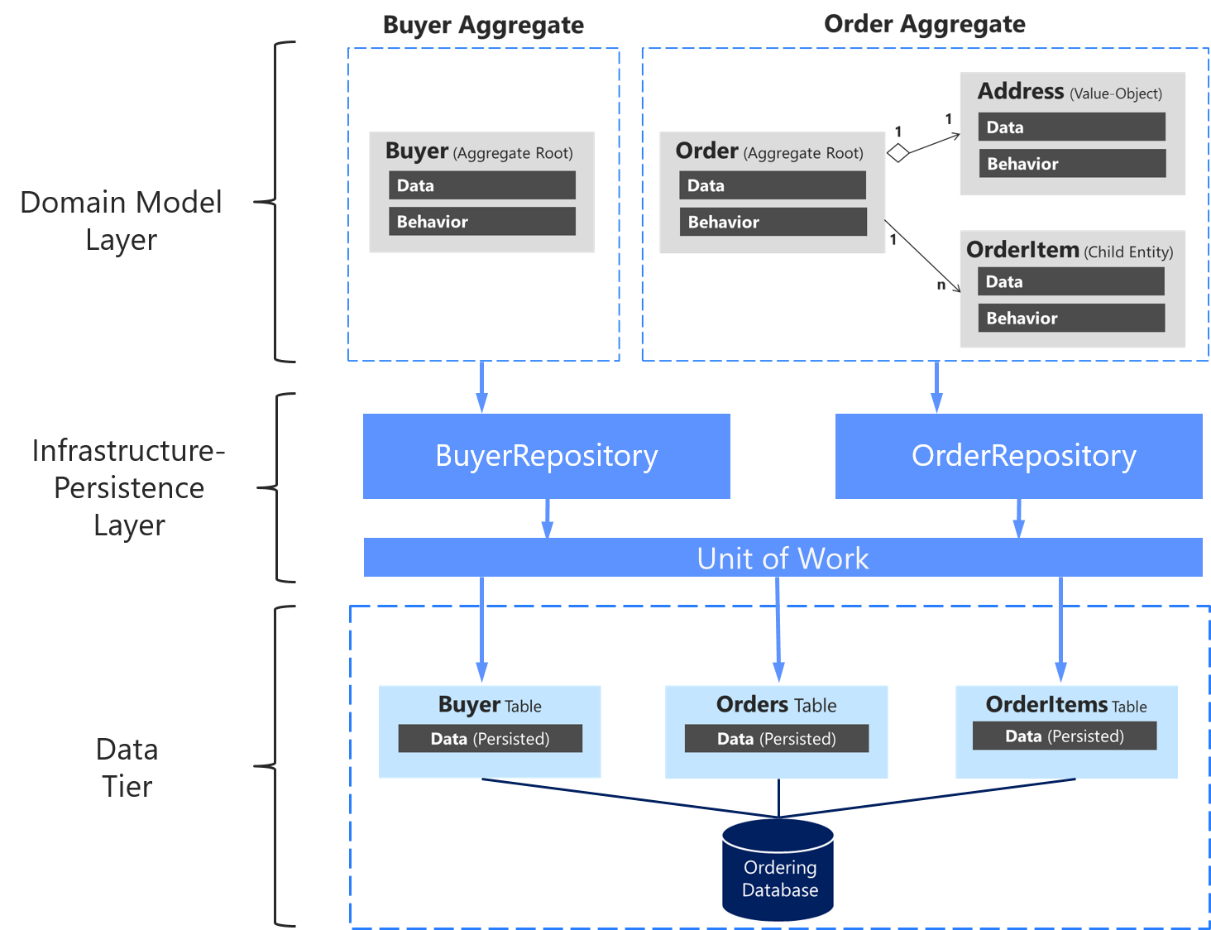
3. The Benefits of Abstracting Persistence
By introducing this layer of abstraction, we solve the problems we identified earlier and gain significant advantages.
The article 'The Repository Pattern' also does an excellent job of summarizing the primary benefits of using this pattern.
Read the section 'Benefits of the Repository Pattern'. This clearly outlines the three main advantages that directly stem from abstracting persistence.
Let's recap those benefits in the context of DDD:
-
Enables Domain Purity: Your domain model (Aggregates, Entities, Value Objects) remains completely clean of persistence concerns. It contains only business logic, making it easier to understand, reason about, and evolve. The Ubiquitous Language is reflected purely in the model, without being polluted by technical jargon like "SQL," "session," or "commit."
-
Improves Testability: This is a major advantage. When you test your application services or domain logic, you don't need a database. You can simply provide a "fake" in-memory repository implementation (e.g., one that uses a Python dictionary for storage). This makes your tests extremely fast, reliable, and easy to write.
-
Simplifies Swapping Data Storage: The repository interface acts as a contract. Your domain code interacts with this contract, not the implementation. This means you can have a
PostgresProductRepositorytoday and swap it for aMongoDbProductRepositorytomorrow without changing a single line of your domain or application code. You just need to create a new class that fulfills the same contract.
Conclusion
In this lesson, we've established the critical role of the Repository pattern as a cornerstone of a well-architected, domain-driven system.
Key Takeaways:
- The primary role of the Repository pattern is to abstract persistence logic away from the domain model, creating a clean separation of concerns.
- It acts as an in-memory collection of Aggregates, providing methods like
add,get, andlistthat are expressed in terms of the domain. - The pattern implements Dependency Inversion: the repository interface is defined in the domain layer, but its concrete implementation (e.g., using SQLAlchemy) resides in the infrastructure layer.
- This abstraction keeps the domain model pure, significantly improves testability by allowing for fake implementations, and provides the flexibility to change persistence technologies without impacting business logic.
Preview of the Next Lesson:
Now that we understand why repositories are essential, our next step is to define one. In the next lesson, we will focus on defining a repository interface in the domain layer, carefully considering what methods are needed to manage an Aggregate's lifecycle.