Hello! Welcome back.
In our last lesson, we defined the Aggregate as a crucial pattern for managing complexity by grouping related objects into a single consistency boundary. We established that any operation on the objects within this boundary must be atomic, ensuring that our business rules, or invariants, are never violated.
This raised a critical question: How do we technically enforce this boundary? How can we prevent other parts of our system from reaching inside an Aggregate, manipulating its internal parts directly, and potentially corrupting its state?
Today, we will answer that question.
Introduction
This lesson focuses on the guardian of the Aggregate's consistency. Our learning outcome is to: Designate an Aggregate Root to act as the single entry point for modifications within an aggregate.
We will cover:
- The definition and responsibilities of an Aggregate Root.
- The fundamental rules that govern interactions with Aggregates.
- How to implement the Aggregate Root pattern in Python to protect your domain model's integrity.
By the end of this lesson, you'll understand how to structure your Aggregates so they are robust, encapsulated, and truly in control of their own state.
1. What Is an Aggregate Root?
An Aggregate is a cluster of objects, but they are not all equal. Within every Aggregate, one specific Entity is designated as the Aggregate Root. This Root is the leader, the public face, and the sole gatekeeper for the entire Aggregate.
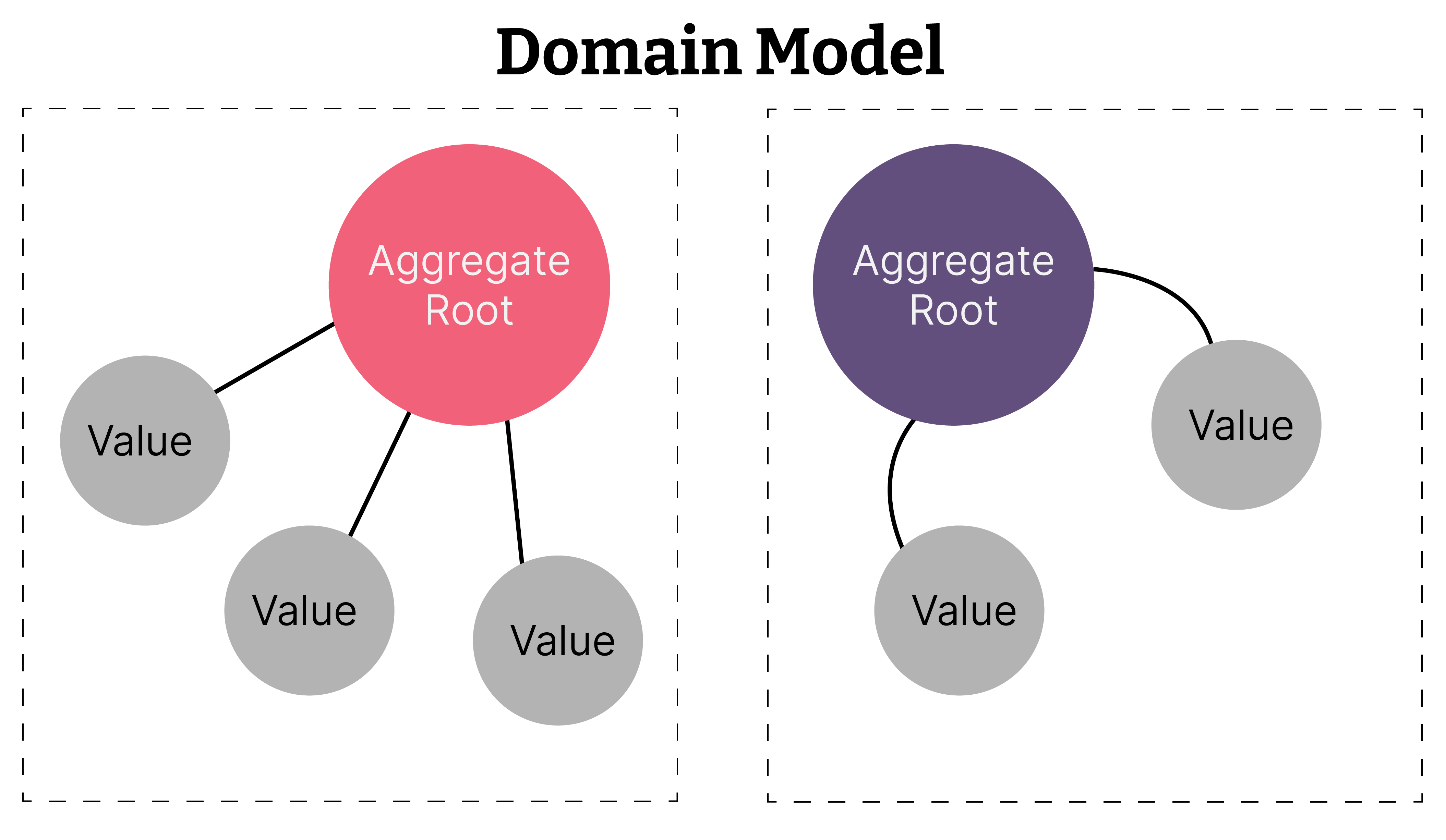
The concept is formally defined in Domain-Driven Design.
Domain models — eventsourcing 9.4.6 documentation
The 'eventsourcing' library documentation provides a concise summary of Eric Evans' original definition of an Aggregate and its Root.
Read the section 'Aggregates in DDD'. Focus on the quoted text from Eric Evans' book, which lays out the core idea: choose one entity to be the root and control all access through it.
As the text explains, the Aggregate Root has three primary responsibilities:
- To have a global identity. The Root is the only part of the Aggregate that is directly discoverable and referenced by external objects.
- To control access. It acts as a facade, hiding the internal implementation details of the Aggregate from the outside world.
- To enforce invariants. It is responsible for ensuring that any command executed against the Aggregate results in a valid state, satisfying all business rules for the entire cluster of objects.
This next video provides a clear explanation of the Aggregate Root's role and the constraints it imposes.
How to design great Aggregate Roots in Domain-Driven Design
In 'How to design great Aggregate Roots in Domain-Driven Design', Milan Jovanović explains the concept of the Aggregate Root and its visibility rules.
Please watch from 02:38 to 05:28. Pay attention to how the Aggregate Root is the only member visible from the outside and how it manages communication with other objects inside its boundary.
2. The Rules of Engagement
The principles described in the video can be distilled into a few strict rules. Adhering to them is essential for maintaining the integrity of your domain model.
- Rule 1: External objects can only hold references to the Aggregate Root. They cannot hold references to any other object inside the Aggregate.
- Rule 2: All modifications to any object within the Aggregate must be initiated through the Aggregate Root. You don't tell an
OrderItemto change its quantity; you tell theOrder(the Root) to update an item, and theOrderhandles the operation. - Rule 3: If an operation crosses Aggregate boundaries, the other Aggregate must be referenced by its Root's identity. You don't hold a direct object reference to another Aggregate, only its ID.
Violating these rules breaks the encapsulation and defeats the purpose of the Aggregate, as it opens the door for invariants to be broken.
The following video demonstrates this perfectly. It shows a "before" state where code reaches inside an Aggregate to modify an internal entity, and an "after" state where the code is refactored to correctly use the Aggregate Root as the single entry point.
Aggregate Root Design 101 | DDD, Clean Architecture, .NET 6
The video 'Aggregate Root Design 101' provides a practical demonstration of why direct access is a problem and how to fix it.
Watch the segment from 02:33 to 05:22. Although the code is in C#, the logic is universal. Notice how the Invitation can no longer be fetched directly. Instead, the Gathering (the Aggregate Root) is fetched first, and it provides access to the Invitation.
3. Implementing the Aggregate Root in Python
Now, let's translate these concepts into Python. The key is to design your Aggregate Root class so that it exposes methods for all valid state changes while hiding its internal components.
Let's revisit the Product Aggregate from our last lesson. The Product class itself is the Aggregate Root.
# From the previous lesson
class Product:
    """This is our Aggregate Root."""
    def __init__(self, sku: str, batches: list['Batch']):
        self.sku = sku
        self._batches = batches # Note: Changed to a "private" attribute

    def allocate(self, line: 'OrderLine') -> str:
        """This method is the single entry point for allocation."""
        try:
            batch = next(
                b for b in sorted(self._batches) if b.can_allocate(line)
            )
            batch.allocate(line)
            return batch.reference
        except StopIteration:
            raise OutOfStock(f"Out of stock for sku {line.sku}")

# --- External Code (e.g., in an Application Service) ---

# The WRONG way: Bypassing the Root
product = product_repository.get("SMALL-TABLE")
# This is an anti-pattern! Reaching into the aggregate's internals.
# If _batches was public, this would be possible and dangerous.
# product._batches[0].allocate(some_line)

# The RIGHT way: Using the Root's public method
product = product_repository.get("SMALL-TABLE")
product.allocate(some_line) # Correct! The command is sent to the Root.
product_repository.save(product)
By making the batches list a "private" attribute (by convention, using a leading underscore _), we signal that it should not be accessed from outside the class. All interactions must go through the public allocate method, which allows the Product Aggregate Root to enforce its rules.
A Practical Python Example
The following resource provides a complete, though simplified, example of a domain with an Aggregate Root in a Python/FastAPI context. It shows how the Report class is designated as the entry point for the report domain.
Python FastAPI Domains, Models & Controllers
The article 'Python FastAPI Domains, Models & Controllers' by Arkalos demonstrates a clear structure for a domain, with the Aggregate Root as the central controller.
Read the sections 'Domain Aggregate Root' and the code examples that follow it. Observe how the Report class is created as the aggregate root. Then, see how the HTTP route handler in app/http/routes/reports.py interacts only with the Report domain object, not with its internal actions or models.
An Event-Sourced Example
Another powerful way to see the Aggregate Root in action is through event sourcing. The eventsourcing Python library provides a base Aggregate class that makes this pattern explicit. Command methods on the aggregate trigger events that mutate its state.
This example of a Dog aggregate is simple but effective. The Dog class is the Aggregate Root. You can't just modify its list of tricks; you must call the add_trick method.
Domain models — eventsourcing 9.4.6 documentation
The documentation for the 'eventsourcing' library includes a simple example that perfectly illustrates the Aggregate Root's role.
Read the section 'Simple example'. Notice how the Dog aggregate is created via Dog.create() and its state is changed only by calling the add_trick() command method. This method is the designated entry point for this modification.
The Dog.add_trick() method is the public API for this state change. It encapsulates the logic for creating a TrickAdded event and applying it to the aggregate's state. This enforces the rule that all changes must go through the Root.
Conclusion
In this lesson, we've established the Aggregate Root as the protector of an Aggregate's consistency. By designating a single entity as the entry point, we create a clear, enforceable boundary that is fundamental to a well-designed domain model.
Key Takeaways:
- The Aggregate Root is a specific entity within an Aggregate that acts as the single entry point for all external commands.
- External objects are only permitted to hold a reference to the Aggregate Root, never to its internal objects.
- All state changes within the Aggregate are initiated by calling methods on the Aggregate Root.
- This pattern is the primary mechanism for enforcing an Aggregate's consistency boundary and protecting its invariants.
Preview of the Next Lesson:
We now understand that the Aggregate Root is the gatekeeper. But what exactly should the gatekeeper be doing? What logic belongs inside its methods? In our next lesson, we will focus on the heart of the domain model: Encapsulate business rules and invariants within an Aggregate Root's methods. We'll see how to make our domain objects rich with behavior, moving beyond simple data containers.