Hello! Welcome to the third lesson in our exploration of Domain-Driven Design.
Introduction
In our first lesson, we learned that DDD's primary goal is to manage complexity by creating software models that reflect the business domain, using a Ubiquitous Language shared between developers and experts. In our second lesson, we saw how Clean/Hexagonal Architecture provides a structure (Domain, Application, Infrastructure) to protect the core business logic of a single application or service.
Now, we'll zoom out. What happens when the business domain is too large and complex for a single model? How do we apply the "divide and conquer" principle to the entire system?
Today's lesson addresses this by focusing on a cornerstone of DDD's strategic design. Our learning outcome is to define a Bounded Context as a primary architectural boundary for a software model. We will explore how to break down a large system into manageable parts, each with its own consistent model and language.
1. The Problem: The Limits of a Single, Unified Model
As a system grows, trying to create a single, unified model for the entire business becomes impractical and often leads to confusion. Different departments or teams naturally use the same words to mean slightly different things. In linguistics, a word with multiple related meanings is a polyseme, and in software modeling, these polysemes are a major source of complexity.
For example, what is a "Student"?
- To the Enrollment team, a
Studentis someone who has registered and paid for a course. Their model cares aboutpaymentStatusandenrollmentDate. - To the Content team, a
Studentis someone actively learning. Their model cares aboutcourseProgressandquizScores. - To the Support team, a
Studentis anyone with an account who might need help, regardless of their enrollment status. Their model cares aboutsupportTicketsandlastLogin.
If we try to force all these concepts into a single Student class, it becomes bloated, confusing, and fragile. Changing it for one team's needs could break functionality for another.
This video explains this exact problem and introduces the solution.
Domain-Driven Design: Bounded Contexts Explained! 🚀
The video 'Domain-Driven Design: Bounded Contexts Explained!' from ByteMonk clearly illustrates why a single model fails as a system grows.
Watch from 00:44 to 02:47. Pay close attention to the 'student' example and the challenges that arise from trying to create one model for everyone.
DDD recognizes that total unification is not feasible. Instead, it provides a pattern for structuring multiple models within a larger system.
2. Defining the Bounded Context
The solution to the problem of a monolithic model is the Bounded Context.
Let's start with a foundational definition from Martin Fowler, a key figure in software design.
This article, 'Bounded Context' by Martin Fowler, is a canonical resource on the topic. It explains why DDD opts for multiple models instead of a single unified one.
Read the first four paragraphs, starting from 'Bounded Context is a central pattern...' and ending with '...a way of structuring MultipleCanonicalModels.' Focus on the definition and the rationale for dividing a large system.
As the article states, a Bounded Context is an explicit boundary within which a specific domain model applies. Inside this boundary, every term in the model has a precise, unambiguous meaning.
Think of it as a conceptual fence.
- Inside the fence: The model is consistent and unified.
- Outside the fence: A different model, with its own definitions, may exist.
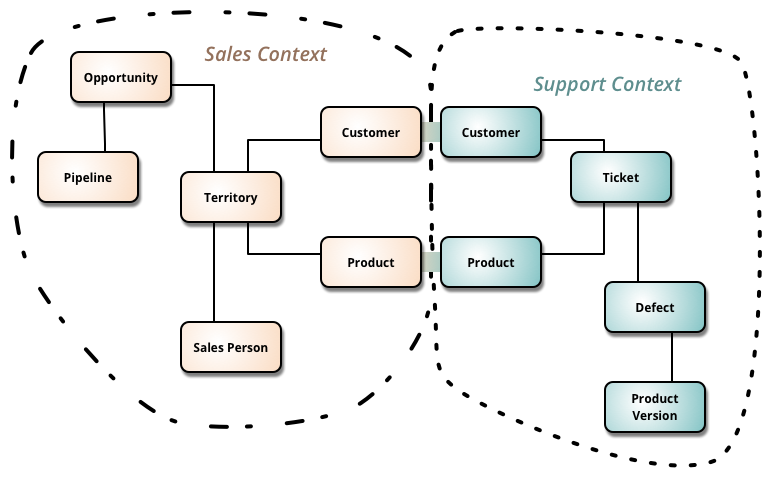
A Bounded Context is therefore the primary architectural boundary in DDD. It's the line you draw to create smaller, more manageable, and logically consistent parts of your system.
3. Bounded Context and the Ubiquitous Language
In our first lesson, we defined the Ubiquitous Language as a shared language between developers and domain experts. The concept of Bounded Context refines this idea significantly.
A Ubiquitous Language is not universal across the entire organization. It is specific to a single Bounded Context.
- In the Enrollment Context, the Ubiquitous Language includes terms like "prospect," "registered student," and "payment plan."
- In the Content Context, the language revolves around "lesson completion," "module progress," and "assessment score."
Each context has its own tailored language that is rich and precise for the problems it needs to solve. Trying to create a single language for everyone would dilute its meaning and effectiveness.
This short video clip reinforces this crucial point.
Domain-Driven Design: Bounded Contexts Explained! 🚀
Let's return to the ByteMonk video, which has an excellent segment clarifying the relationship between Bounded Context and Ubiquitous Language.
Watch from 06:15 to 07:04. The key takeaway is that the language is only ubiquitous within its context.
4. Bounded Context vs. Subdomain
It's easy to confuse Bounded Contexts with Subdomains, but the distinction is important for understanding DDD's strategic design.
-
Subdomain (Problem Space): This is a part of the business domain itself. It represents a distinct area of business activity or knowledge. Subdomains exist whether you are writing software or not. They are discovered by analyzing the business.
- Examples: Shipping, Billing, Inventory Management, Recommendations.
-
Bounded Context (Solution Space): This is a boundary in your software system. It's a decision made by the software development team about how to model and implement a solution. Bounded Contexts are designed.
- Examples: A
BillingServicethat models payments, aShippingServicethat models logistics.
- Examples: A
Often, there is a one-to-one mapping: one Bounded Context is created to implement one Subdomain. However, this isn't a strict rule. A single, very complex subdomain might be implemented by multiple Bounded Contexts.
This distinction is explained very clearly in the following video.
Domain-Driven Design: Bounded Contexts Explained! 🚀
This clip provides a clear breakdown of Subdomains (the business problem) versus Bounded Contexts (the software solution).
Watch from 08:13 to 10:27. Focus on the key questions each concept answers: 'What is the business area?' (Subdomain) vs. 'How do we implement it in software?' (Bounded Context).
5. Bounded Context as an Architectural Boundary
The "boundary" in Bounded Context is not just conceptual; it has concrete architectural implications. It defines how we structure our code, our teams, and our deployments.
- Codebase Boundary: In a monolithic application, Bounded Contexts can be separated into distinct Python packages or modules. This enforces a logical separation and prevents code from different contexts from becoming improperly entangled.
- Deployment Boundary: More commonly in modern systems, a Bounded Context maps directly to a separately deployable service (e.g., a microservice). The
Billing Contextbecomes theBilling Service, with its own database and API. This is where the Clean Architecture we discussed in the last lesson would be implemented—within a single Bounded Context. - Team Boundary: Bounded Contexts provide a powerful way to organize development teams. A single team takes full ownership of a Bounded Context (e.g., the "Billing Team" owns the
Billing Service). This autonomy allows the team to develop, deploy, and maintain their part of the system independently, reducing coordination overhead.
This final clip explains how these boundaries manifest in a system's architecture and team structure.
Domain-Driven Design: Bounded Contexts Explained! 🚀
This last clip from the ByteMonk video discusses how Bounded Contexts translate into physical systems and team ownership.
Watch from 10:27 to 12:42. Note the connection between Bounded Contexts, independent services, and team ownership.
Conclusion
In this lesson, we've introduced the Bounded Context as a fundamental pattern in strategic Domain-Driven Design. It is the primary tool for breaking down large, complex domains into manageable, coherent parts.
Here are the key takeaways:
- A Bounded Context is an explicit boundary within which a domain model and its Ubiquitous Language are consistent and unambiguous.
- It solves the problem of polysemous terms (words with multiple meanings) by giving concepts like "Customer" or "Product" different models in different contexts.
- A Subdomain is part of the business's problem space, while a Bounded Context is a boundary in the software solution space.
- Bounded Contexts act as primary architectural boundaries, often mapping to deployable services and aligning with team structures to promote autonomy.
By defining clear Bounded Contexts, you lay the foundation for a system that is modular, scalable, and truly reflects the complexities of the business domain.
Preview of the Next Lesson
We've now established the importance of both a Bounded Context and the Ubiquitous Language that lives within it. In our next lesson, we will focus on "Explain the concept of a Ubiquitous Language and its role in bridging communication between technical and domain experts." We will dive deeper into what makes a good Ubiquitous Language and how to cultivate it collaboratively.