Hello! Welcome back to our journey into Domain-Driven Design with Python.
In our last lesson, we built Application Services to orchestrate use cases. We followed a clear pattern: fetch an aggregate from a repository, call a domain method, and save the aggregate back. This works well for simple operations. However, we ended with a critical question: what happens when a single use case needs to modify multiple aggregates or perform several database operations? If one of those operations fails, our system could be left in an inconsistent, partially-updated state.
Today, we will solve that problem. This lesson addresses the final learning outcome in this module: Use the Unit of Work pattern within an Application Service to ensure atomic operations across one or more repositories.
We will explore how the Unit of Work (UoW) pattern acts as a container for our database operations, allowing us to treat a series of changes as a single, atomic transaction. This ensures that our data remains consistent, even during complex business workflows.
1. The Problem: Ensuring Atomic Operations
Imagine a use case like "reallocating an order." This might involve:
- Loading a
Batchaggregate. - Calling
batch.deallocate(order_line)to remove an allocation. - Saving the
Batchaggregate. - Finding a new
Batchto allocate to. - Calling
new_batch.allocate(order_line). - Saving the
new_batchaggregate.
If the system crashes between steps 3 and 6, we have a deallocated order that isn't reallocated anywhere—a critical inconsistency. We need a way to ensure that either all these steps succeed, or none of them do. This is the principle of atomicity.
The Unit of Work pattern provides this guarantee. It collects all our changes in memory and commits them to the database in one single transaction at the very end.
The Unit of Work Design Pattern Explained
To start, let's get a high-level overview of the Unit of Work pattern from ArjanCodes. This video explains its core purpose and benefits.
Watch the introduction from 00:00 to 01:26. Pay attention to the two main benefits mentioned: saving network traffic and, more importantly, enabling a rollback mechanism for atomic operations.
2. The Unit of Work and Clean Architecture
In our architecture, where does the responsibility for transactions lie? It's not a domain concern—your users don't talk about "database transactions." It's an application-level concern related to orchestrating a use case.
Domain-Driven Design (DDD) Patterns in Python
This clip from 'Domain-Driven Design (DDD) Patterns in Python' by Code Geek reinforces a crucial architectural principle we've been following. It explicitly states where transaction management belongs.
Watch from 00:43:55 to 00:44:30. The speaker makes a very clear point about resisting the temptation to put transaction logic in the domain model and placing it in the application layer instead. This is the justification for using the UoW within our Application Services.
This confirms our approach: the Application Service will manage the Unit of Work, which in turn handles the transaction. This keeps our domain model pure and our infrastructure concerns neatly separated.
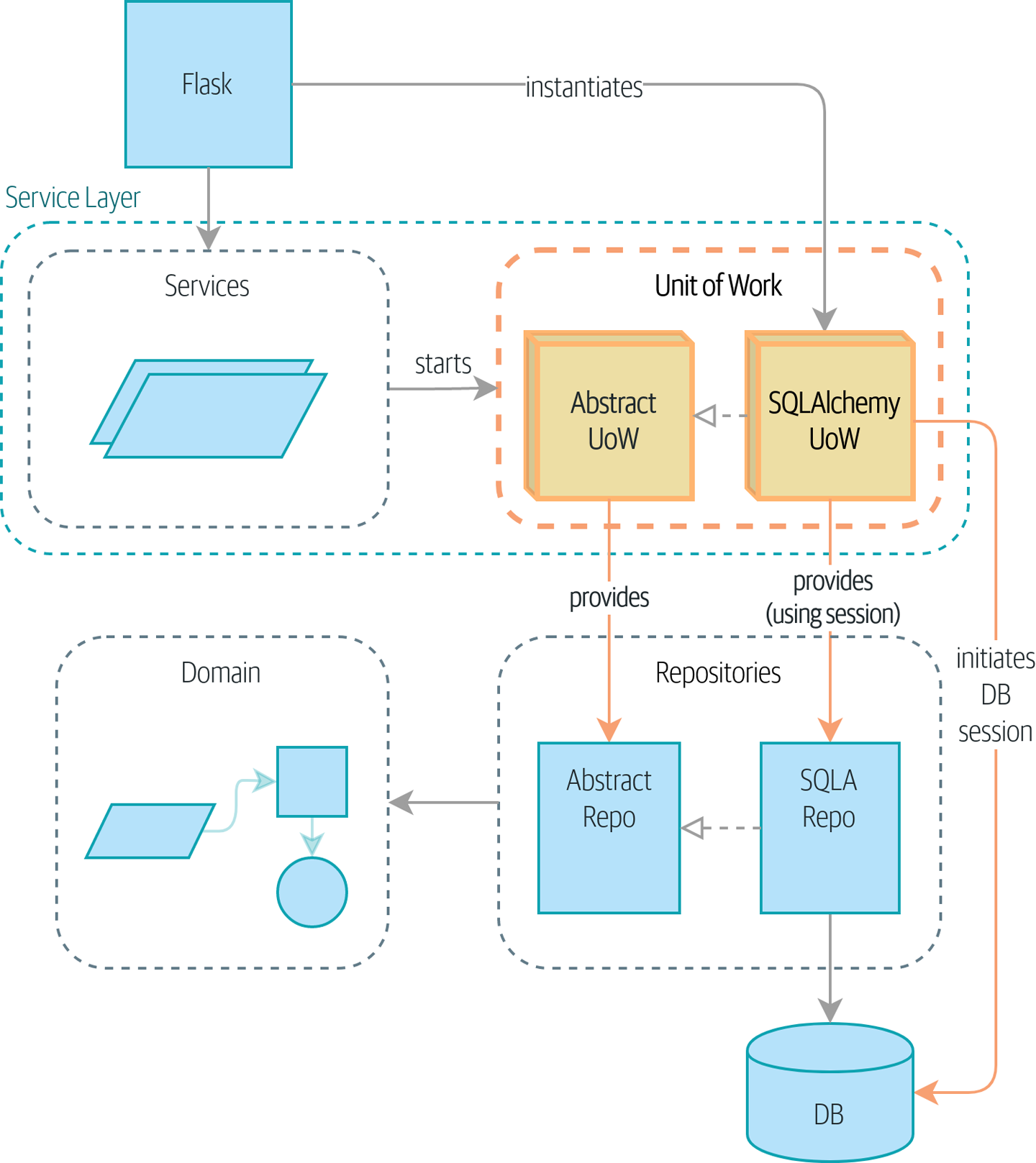
The diagram below shows our target architecture. The Flask/FastAPI entrypoint will start a Unit of Work and pass it to the Application Service. The service then uses the UoW to get repositories and orchestrate the use case, committing everything at the end.
3. Implementing a Unit of Work in Python
While SQLAlchemy's Session object is itself an implementation of the Unit of Work pattern, we will create our own abstraction on top of it. This follows the "Don't mock what you don't own" principle and gives us a simpler, application-specific interface, decoupling us from the full complexity of SQLAlchemy.
We will build our UoW as a context manager. In Python, this is a construct used with the with statement to manage resources like file handles or database connections. It's similar in purpose to Java's try-with-resources, ensuring that cleanup logic (like closing a connection or rolling back a transaction) is always executed.
Let's dive into the implementation, following the excellent guide from the "Cosmic Python" book.
This chapter from 'Cosmic Python' provides a step-by-step guide to building and using a Unit of Work. We'll focus on the core implementation details.
First, read the section 'Unit of Work and Its Context Manager' to understand the abstract interface. Then, read 'The Real Unit of Work Uses SQLAlchemy Sessions' to see the concrete implementation. Focus on: The AbstractUnitOfWork class and its commit() and rollback() methods. How the __enter__ and __exit__ methods define the context manager's behavior. In SqlAlchemyUnitOfWork, see how __enter__ creates a session and a repository, and how commit() and rollback() delegate to the session.
Let's break down the key components from the reading.
The Abstract Unit of Work
This defines our contract using an Abstract Base Class (ABC).
# src/allocation/service_layer/unit_of_work.py

import abc
from . import repository

class AbstractUnitOfWork(abc.ABC):
    batches: repository.AbstractRepository

    def __enter__(self):
        return self

    def __exit__(self, *args):
        self.rollback()

    @abc.abstractmethod
    def commit(self):
        raise NotImplementedError

    @abc.abstractmethod
    def rollback(self):
        raise NotImplementedError
batches: The UoW will provide access to our repositories.__enter__: This is called when we enter awithblock. It simply returns the UoW instance itself.__exit__: This is called when we exit thewithblock, either normally or due to an exception. Notice that it callsself.rollback()by default. This makes our system safe by default: if we don't explicitly commit, all changes are discarded.
The Concrete SQLAlchemy Unit of Work
This class implements the abstract interface using an SQLAlchemy session.
# src/allocation/service_layer/unit_of_work.py

class SqlAlchemyUnitOfWork(AbstractUnitOfWork):
    def __init__(self, session_factory):
        self.session_factory = session_factory

    def __enter__(self):
        self.session = self.session_factory()  # e.g., Session()
        self.batches = repository.SqlAlchemyRepository(self.session)
        return super().__enter__()

    def __exit__(self, *args):
        super().__exit__(*args)
        self.session.close()

    def commit(self):
        self.session.commit()

    def rollback(self):
        self.session.rollback()
__init__: It's initialized with asession_factory, which is responsible for creating new database sessions. This allows us to use different databases for production (PostgreSQL) and testing (SQLite).__enter__: This is where the magic happens. It creates a new session and instantiates a concreteSqlAlchemyRepository, injecting the session into it. The UoW now acts as a factory for our repositories, ensuring they all share the same session and transaction.commit()androllback(): These methods simply delegate the call to the underlying SQLAlchemy session.
4. Using the Unit of Work in an Application Service
Now we can refactor our Application Service to use our new UoW. The service will no longer depend on a repository directly; instead, it will depend on our AbstractUnitOfWork.
Let's continue with 'Cosmic Python' to see how the service layer is simplified by using the UoW.
First, read 'Using the UoW in the Service Layer'. Note how the allocate function now takes a uow argument and is wrapped in a with block. Then, read 'Examples: Using UoW to Group Multiple Operations...' to see how this pattern elegantly handles more complex use cases like reallocate.
Here is the refactored allocate service:
# src/allocation/service_layer/services.py

def allocate(
    orderid: str, sku: str, qty: int,
    uow: unit_of_work.AbstractUnitOfWork,  # Dependency is now the UoW
) -> str:
    line = OrderLine(orderid, sku, qty)
    with uow:  # Start the transaction boundary
        # 1. Get the repository from the UoW
        batches = uow.batches.list()

        # (validation logic...)

        # 2. Call the domain model
        batchref = model.allocate(line, batches)

        # 3. Explicitly commit at the end
        uow.commit()
    return batchref
This new structure is much more robust:
- The service depends on an abstraction (
AbstractUnitOfWork), upholding the Dependency Inversion Principle. - The
with uow:block clearly defines the transaction boundary. - We get our repository from
uow.batches, ensuring it uses the correct session. - We must call
uow.commit()to make our changes permanent. - If any exception occurs before
uow.commit()(e.g., duringmodel.allocate), the__exit__method is triggered,uow.rollback()is called, and the database is left untouched.
This pattern makes handling complex operations that touch multiple aggregates, like the reallocate example from the reading, clean and safe.
Conclusion
Today, we've integrated a crucial pattern for building robust applications. The Unit of Work gives us confidence that our business operations will either complete fully or not at all, preventing data corruption and inconsistencies.
Key Takeaways:
- The Unit of Work (UoW) pattern groups a set of object changes into a single atomic transaction.
- It solves the problem of maintaining data consistency when a use case involves multiple database operations.
- In Python, the UoW is elegantly implemented as a context manager (
withstatement), providing a clear transaction boundary and ensuring rollbacks happen by default on error. - The Application Service orchestrates the UoW. It receives a UoW, uses it to access repositories, calls domain logic, and finally commits the UoW.
- This approach creates a clean separation of concerns: the Application Service manages the transaction scope, while the UoW encapsulates the details of session management and commits/rollbacks.
Preview of the Next Lesson
We have now completed the core tactical patterns for building a single, cohesive Bounded Context. We can model our domain, persist it, and orchestrate use cases safely.
But what happens when an action in our domain needs to trigger a process in a different part of the system? For example, after a batch is successfully allocated, perhaps we need to notify the shipping department or send an email to the customer. Tightly coupling an EmailService into our allocate function would violate our architectural principles.
In the next module, we will introduce Domain Events, a powerful pattern for enabling communication between different parts of your system in a loosely coupled way.