Welcome to your sixth lesson. Over the past several lessons, we have delved into the specific 19th-century Muslim reform movements that emerged in response to British colonial rule: the revivalist Faraizi and Deoband movements, the modernist Aligarh Movement, and the synthesising approach of Nadwatul Ulama. Each represented a distinct strategy for navigating the community's profound political and social crisis.
Today, we will synthesize this knowledge to address a crucial "big picture" question, one that has appeared directly in the CSS exams (e.g., 2024 Q2): the Muslim shift from armed resistance to educational and political reform. This lesson moves from analyzing individual trees to understanding the entire forest. We will critically examine why this strategic pivot occurred, the different forms it took, and its monumental, long-term consequences for the future of Muslims in South Asia. This analysis is fundamental to understanding the intellectual and political groundwork of the Pakistan Movement.
The Era of Armed Resistance (Pre-1857)
In the late 18th and early 19th centuries, as Mughal power crumbled and the British East India Company's influence grew, the initial Muslim response was often militant and restorative. Rooted in religious revivalism, these movements sought to purify Islam and re-establish Muslim political authority through armed struggle.
Two key examples you've studied are:
- Syed Ahmed Barelvi's Jihad Movement (c. 1820s-1831): This pan-Islamic movement aimed to establish an Islamic state in the northwest frontier, viewing both the Sikhs in Punjab and the encroaching British as threats to Muslim identity and rule. Its culmination at the Battle of Balakot in 1831, though a military defeat, created a powerful legacy of ideological resistance.
- The Faraizi Movement (from 1818): In Bengal, under leaders like Haji Shariatullah and his son Dudu Miyan, this movement combined socio-economic protest against Hindu landlords and British indigo planters with a call for religious purification. It often took the form of organized peasant resistance.
These movements, while significant, were ultimately regional and lacked the capacity to challenge the organised military power of the British. They represented a strategy of confrontation, aimed at restoring a lost political order.
The Historical Trajectory of Political Awakening among Muslims in ...
This article provides an excellent overview of the early forms of resistance that characterized the pre-1857 period.
Please read the section titled "Early Religious-Political Resistance Movements." Focus on how movements like those led by Titu Mir and Syed Ahmed Barelvi combined religious revivalism with resistance against both local and foreign oppressors, establishing a pattern of armed response to the loss of political power.
The Cataclysm of 1857: A Watershed Moment
The turning point that rendered the strategy of armed resistance obsolete was the War of Independence of 1857.
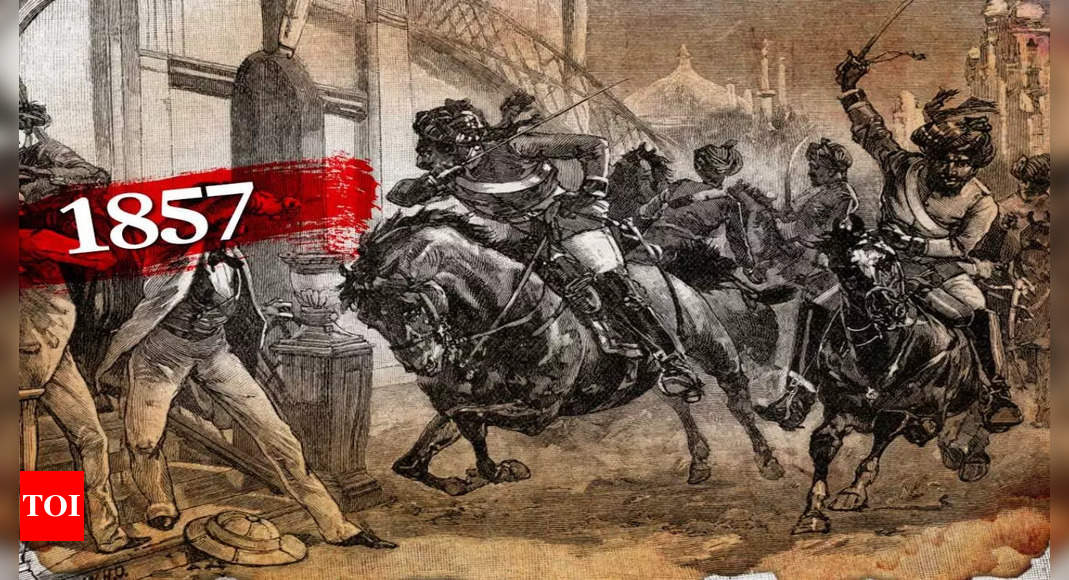
While the rebellion involved various communities, the British held the Muslims, with the nominal Mughal Emperor Bahadur Shah Zafar as a figurehead, primarily responsible. The aftermath was brutal. The Mughal Empire was formally abolished, and Muslims were systematically targeted, facing mass executions, confiscation of property, and exclusion from government and military employment. This event demonstrated with finality the futility of military confrontation. The British Empire was not just another regional power; it was a global industrial and military force that could not be dislodged by the methods of the past.
This traumatic realisation forced a profound strategic reassessment within the Muslim community. The question was no longer how to restore the old empire, but how to survive and navigate the new reality of British supremacy.
[PDF] research article sir syed ahmad khan: a visionary reformer and ...
This research article succinctly captures the strategic shift in thinking after 1857.
In the Introduction, please read the paragraph that outlines Sir Syed's core realizations. Pay close attention to the diagnosis that the brutal British reprisals made armed resistance suicidal. This single phrase captures the essence of the post-1857 strategic pivot.
The Pivot: Education, Cooperation, and Political Pragmatism
The chief architect of the new strategy was Sir Syed Ahmad Khan. His approach was not one of surrender, but of profound pragmatism. He argued that the path to reviving the Muslim community's fortunes lay not in confrontation, but in adaptation and engagement.

This new strategy unfolded on two main fronts:
1. The Educational Front: The Aligarh Movement
Sir Syed's primary objective was to bridge the educational gap that had left Muslims far behind Hindus in securing administrative positions. He believed that modern, Western education was the essential tool for survival and progress. His initiatives, culminating in the Muhammadan Anglo-Oriental (MAO) College at Aligarh, were designed to produce a generation of Muslims who were both well-versed in modern sciences and secure in their Islamic faith. This was a direct attempt to regain relevance and influence within the colonial system.
2. The Political Front: Strategic Cooperation and Abstention
Sir Syed's political philosophy was equally pragmatic and, for its time, radical.
- Loyalism to the British: He urged Muslims to demonstrate loyalty to the Crown. This was not an act of subservience, but a calculated political move to end the post-1857 persecution and win back the trust of the rulers, thereby creating the political space necessary for the community's social and educational development.
- Strategic Abstention from Politics: When the Indian National Congress was formed in 1885, Sir Syed famously advised Muslims to abstain from joining. This is often misunderstood as a rejection of politics. A more nuanced analysis, crucial for a CSS-level answer, reveals it was a strategic delay.
Aligarh Movement| Urdu Hindi Controversy 1867|Sir syed ahmad khan and his contributions
This video (in Urdu) offers an essential clarification on Sir Syed's political advice.
Watch the section from "To convince them to abstain from politics". The speaker explains that Sir Syed, himself a seasoned politician, was not permanently barring Muslims from politics. His logic was that the community first needed to achieve educational and social parity. Engaging in agitational politics from a position of weakness would be counterproductive. The goal was to first build a strong foundation (superstructure) and then engage in politics.
This two-pronged strategy represented a complete reversal from the pre-1857 approach. The focus shifted from overthrowing the British to working within their system to uplift the community from within.
Divergent Paths of Non-Militant Reform
While the Aligarh Movement was the most prominent example of the new strategy, the shift away from armed resistance took other forms as well. It's important to recognize that the post-1857 response was not monolithic.
Lecture 3 | Educational Movements | Pakistan Affairs | CSS With A CSP
This lecture provides a concise overview of the different educational movements and their distinct approaches in the post-1857 landscape.
First, watch the introduction to understand the broader context of Muslim decline under the new British system. Then, review the following segments to compare the different non-militant strategies: The Aligarh Movement (its initiatives and impact), representing engagement and modernization. The Deoband Movement (its goals and achievements), representing preservation through religious traditionalism and insulation. The Nadwa Movement (its 'middle road' approach), representing an attempt to synthesize the other two.
As the video illustrates, while Aligarh championed engagement, the Deoband Movement represented a different non-violent path: cultural and religious self-preservation through insulation. They also abandoned armed struggle but turned inward, focusing on strengthening Islamic identity through traditional seminaries to resist the cultural influence of the West. Later, the Nadwatul Ulama attempted to find a middle ground between these two poles. Together, they demonstrate that the "shift" was a complex recalibration of strategy across a spectrum of ideological thought.
Critical Analysis and Long-Term Legacy
The shift from militancy to reform was arguably the most significant strategic reorientation in the history of modern South Asian Muslims. A critical evaluation, as required by the CSS exam, must weigh its successes and its controversial consequences.
Successes:
- Survival and Revival: The strategy, particularly that of Aligarh, successfully arrested the socio-economic decline of the Muslim community. It allowed them to recover from the devastation of 1857.
- New Leadership: It produced a new, modern-educated elite that could articulate Muslim demands in the language of the colonizers and compete effectively in the new administrative and political landscape.
- Foundation for Political Consciousness: By emphasizing that Muslims were a distinct community with unique interests, this shift laid the intellectual and political groundwork for the Two-Nation Theory and the eventual demand for Pakistan.
Controversial Consequences:
- Political Separatism: Sir Syed's advice to avoid the Congress and the subsequent emphasis on a separate Muslim political identity, while pragmatic for its time, is seen by critics as the origin of the communal separatism that ultimately led to Partition.
- Policy of Loyalism: The loyalist stance, though strategic, drew criticism from nationalist circles who viewed it as collaboration with the colonial regime.
The Historical Trajectory of Political Awakening among Muslims in ...
This final section provides a high-level critical assessment of the entire historical trajectory, which is perfect for framing your analysis.
Read the section "Critical Assessment of the Overall Trajectory (1000 – 1947)." Focus on the analysis of the post-1857 period, which is described as the true political awakening. Note the discussion on the role of religion, British "Divide and Rule" policy, and the internal divisions within Muslim political thought. This provides the multi-dimensional analysis required for an advanced answer.
Conclusion
The 19th-century Muslim shift from armed resistance to educational and political reform was not an event, but a process—a profound strategic re-evaluation born from the ashes of 1857. It marked a transition from a futile attempt to restore a bygone era to a pragmatic strategy for survival and revival within a new colonial reality. Spearheaded by the visionary pragmatism of Sir Syed Ahmad Khan, this pivot took the form of educational modernization and calculated political cooperation. Parallel movements like Deoband chose a path of non-violent insulation, highlighting the diversity of the new strategic thinking. This monumental shift, while ensuring the community's survival and fostering a distinct political consciousness, also set the stage for the separate political trajectory that would ultimately lead to the creation of Pakistan, making its legacy both foundational and deeply complex.
Key Takeaways:
- The Initial Strategy: Pre-1857 Muslim responses to British encroachment were often characterized by armed resistance aimed at restoring political power.
- The Turning Point: The failure of the 1857 War of Independence demonstrated the futility of military confrontation, forcing a strategic rethink.
- The New Strategy: Sir Syed Ahmad Khan championed a pragmatic shift towards educational uplift (Aligarh Movement) and political cooperation to ensure community survival and progress within the colonial system.
- Divergent Paths: The shift away from militancy was not monolithic; it included both the engagement model of Aligarh and the preservationist model of Deoband.
- Complex Legacy: The strategy succeeded in reviving the Muslim community and laying the groundwork for the Pakistan Movement, but it also cemented a separate political identity that contributed to communal divisions.
This lesson concludes our module on the 19th-century renaissance and reform movements. We now transition to the next phase of our study. Building directly on today's analysis, our next lesson will delve deeper into the political ideology of Sir Syed Ahmad Khan, specifically his relationship with the Indian National Congress and his measures to counter the perceived threat of Hindu majority rule.