Welcome to our next lesson. In our previous session, we evaluated Quaid-e-Azam's strategic leadership in transforming the Muslim League and securing the creation of Pakistan. We concluded by asking a pivotal question: having won the state, what kind of nation did its founder envision? Today, we will answer that question by undertaking a deep analysis of one of the most significant and debated speeches in South Asian history: Muhammad Ali Jinnah's inaugural address to the Constituent Assembly of Pakistan on August 11, 1947.
This speech, delivered just three days before independence, is not merely a historical artifact; it is a foundational document that outlines a vision for Pakistan's political and social structure. For your CSS examination, understanding the nuances of this speech and the enduring debate over its meaning—particularly concerning the role of religion in the state—is absolutely critical. This lesson will deconstruct the speech's key themes and equip you with the scholarly analysis needed to formulate a sophisticated argument on its legacy.
The Context: A Vision for the New State
Imagine the scene: the first Constituent Assembly of the nascent state of Pakistan convenes in Karachi. Muhammad Ali Jinnah, the Quaid-e-Azam, has just been unanimously elected as its first President. The air is thick with both the euphoria of imminent freedom and the immense uncertainty of building a new nation from scratch amidst the chaos of partition. In this moment, Jinnah steps to the podium to deliver his first major policy address.
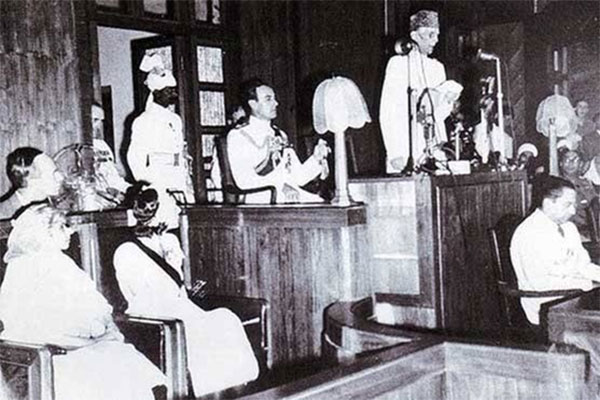
This was not just a ceremonial speech. Jinnah used this platform to lay down the fundamental principles of governance and the primary duties of the assembly. To understand his vision, let's first examine the framework he established.
[PDF] Critical Discourse Analysis of Quaid-i- Azam Muhammad Ali ...
This research paper provides a structured analysis of the speech's content and context. It breaks down the key functions and guidelines Jinnah articulated.
First, read the paragraph under "Introduction" that explains the vital role of the speech in setting the foundations for the future constitution. Next, in the "Social Analysis" section, locate the sub-heading "The functions of assembly" and read the paragraph that outlines the two main functions Jinnah assigned to the assembly.
As the reading makes clear, Jinnah tasked the Assembly with two monumental and interwoven responsibilities:
- To frame the future constitution of Pakistan. This was its foremost and most urgent task.
- To function as a "Federal Legislature of the country," a fully sovereign body responsible for governing the new state.
By emphasizing the assembly's sovereignty, Jinnah was immediately establishing a democratic and parliamentary foundation for Pakistan. He was not positioning himself as an autocrat but as a constitutionalist, entrusting the nation's future to its elected representatives.
Deconstructing the Speech: The Pillars of Jinnah's Vision
With the assembly's role defined, Jinnah proceeded to outline the guiding principles that should inform their work. His vision rested on three main pillars: establishing the rule of law, eradicating social evils, and defining the nature of citizenship.
1. The Primacy of Law and Order
Jinnah's first point was unequivocal: "The first duty of a government is to maintain law and order, so that the life, property and religious beliefs of its subjects are fully protected by the State." This was a foundational statement, establishing the state's core responsibility as the guarantor of security for all its citizens, irrespective of their faith.
2. A War on Corruption
Jinnah, a man known for his personal and professional integrity, then launched a blistering attack on the "poison" of bribery and corruption and the "curse" of black-marketing. He called them "a colossal crime against society" and demanded they be dealt with by an "iron hand." He also took a firm stand against nepotism and jobbery. This was his blueprint for a meritocratic and just administration, where public office is a trust, not an opportunity for personal gain. This theme resonates powerfully with Pakistan's contemporary governance challenges.
3. The "Hallmark" Declaration: Equal Citizenship for All
The most consequential part of the speech, and the one that continues to define the debate on Pakistan's identity, was his declaration on the status of minorities and the relationship between religion and the state. He declared:
"You are free; you are free to go to your temples, you are free to go to your mosques or to any other place of worship in this State of Pakistan. You may belong to any religion or caste or creed—that has nothing to do with the business of the State... We are starting with this fundamental principle that we are all citizens and equal citizens of one State... in course of time Hindus would cease to be Hindus and Muslims would cease to be Muslims, not in the religious sense, because that is the personal faith of each individual, but in the political sense as citizens of the State."
This was a radical and profound statement. At the very birth of a state created in the name of a religious minority, its founder declared that religion was a private matter and would have no bearing on a citizen's rights, privileges, or obligations. This declaration immediately sparked the central question that has preoccupied Pakistan for over 75 years: Did Jinnah envision a secular, pluralistic democracy or an Islamic theocracy?
The Great Debate: A Secular Vision
For your CSS exam, you must engage with this debate at a scholarly level. The argument that Jinnah's vision was fundamentally secular is compelling and well-supported by evidence. The renowned Indian lawyer and author A.G. Noorani has written one of the most definitive analyses on this subject.
Jinnah's 11 August 1947 Speech - A Powerful Vision of Religious ...
This article by A.G. Noorani argues forcefully that Jinnah's speech was a clear and consistent expression of his long-held secular beliefs.
Please read this article carefully, focusing on the following key arguments: The initial section quoting the speech and arguing it marked an abandonment of the two-nation theory as a state policy. The section discussing the immediate reaction, including attempts to censor the speech by members of the establishment. The evidence of Jinnah's rejection of an "Islamic State" in his interactions with the Raja of Mahmudabad and Sir Prakasa. The section citing his earlier speeches to demonstrate his consistent view that religion and politics should be separate. The comparison of the 11th August speech with his press conference on July 14, 1947, where he answered the direct question: "Will Pakistan be a secular or theocratic state?" Finally, his broadcast to the United States in February 1948, where he again stated that Pakistan would not be a theocratic state.
Noorani's analysis provides a robust framework for your own arguments. The key points to internalize are:
- Consistency of Vision: The 11th August speech was not an aberration. It was the culmination of Jinnah's long-held constitutionalist and modernist beliefs, which he had articulated as early as 1935.
- Rejection of Theocracy: Jinnah repeatedly and explicitly rejected the idea of a theocratic state. His famous retort, "I do not know what a theocratic state means," followed by his clear statements on equal citizenship, underscores this.
- Political vs. Religious Motivation: The demand for Pakistan was a political move to secure the rights of a minority in a post-colonial democracy, not a religious crusade to establish an Islamic caliphate. The two-nation theory was a political tool to achieve statehood; once achieved, Jinnah sought to build a single nation of Pakistanis.
- The Censorship Attempt: The fact that elements within the bureaucracy tried to black out the speech is powerful evidence that its secular message was understood and opposed by those who held a different vision for the country.
Dr. Yaqoob Khan Bangash, a prominent Pakistani historian, concisely summarizes this vision.
Jinnah’s Vision vs Today’s Pakistan: Who Really Controls the Narrative? | World Times
In this clip, Dr. Bangash discusses the two foundational pillars of Jinnah's vision for Pakistan.
Watch this short segment from the discussion on Jinnah's vision. Note how he identifies democracy (rooted in the 1945-46 elections) and equal citizenship (articulated in the 11th August speech) as the essential, non-negotiable principles for Pakistan's success.
Addressing the Ambiguity
A critical analysis must also address the counter-arguments. How do we reconcile the secular vision of August 11th with Jinnah's own references to "Islam" and a "Muslim state" both before and after this speech?
As Farzana Shaikh notes (quoted in Noorani's article), Jinnah was "famously ambivalent" and often used the language of Islam for political mobilization. This created a legacy of ambiguity that his successors exploited. However, it's crucial to distinguish between:
- A "Muslim State": A state with a Muslim-majority population, where the culture is influenced by Islamic traditions, but governance is not dictated by religious law.
- An "Islamic State": A theocracy where laws are derived from and must conform to religious scripture, and where non-Muslims may not have equal rights.
Jinnah consistently endorsed the former while explicitly rejecting the latter. His 11th August speech is the clearest possible articulation of this distinction. It was his definitive blueprint for the nation's constitution and society.
Conclusion
Jinnah's speech on August 11, 1947, was far more than a formality. It was a foundational charter that laid out a progressive, democratic, and pluralistic vision for Pakistan. He envisioned a state anchored in the rule of law, committed to administrative integrity, and defined by a common citizenship that transcended religious divisions. While the subsequent political history of Pakistan has often deviated from this path, the speech remains the most authentic testament to the founder's intent and a powerful ideal for those who advocate for a modern, democratic Pakistan.
Key Takeaways:
- Foundational Mandate: Jinnah established the Constituent Assembly's dual role: to frame a constitution and to act as a sovereign legislature, laying the groundwork for a parliamentary democracy.
- Core Principles: His vision was built on the rule of law, protection of all citizens, zero tolerance for corruption, and absolute meritocracy.
- Equal Citizenship: The speech's "hallmark" was the unequivocal declaration that every individual, regardless of religion, caste, or creed, is an equal citizen, and that faith is a personal matter separate from the business of the state.
- Secular vs. Theocratic: Overwhelming evidence from Jinnah's life, other speeches, and interviews supports the interpretation that he envisioned a modern democratic state, not a theocracy.
In our previous lessons, we analyzed the intellectual visions of Allama Iqbal and Quaid-e-Azam separately. Our next lesson will bring these threads together to compare and contrast their conceptual understandings of an Islamic state. This comparative analysis is crucial for tackling one of the most complex and frequently asked questions in the CSS Pakistan Studies exam.