Introduction
In our previous lesson, we unraveled the complex drivers of inflation in Pakistan, concluding that a combination of external price shocks, currency devaluation, and fiscal indiscipline has persistently eroded the purchasing power of citizens. We also established that the policy tools used to fight inflation have often proven ineffective, caught between structural economic weaknesses and political constraints. This lesson follows that thread to its most direct human consequence: the entrenchment of poverty and the challenge of unemployment.
Today, we will address the learning outcome: Analyze the dimensions of poverty and unemployment in Pakistan and evaluate the effectiveness of current alleviation strategies. We will move beyond simplistic definitions to understand poverty as a multidimensional crisis, critically examining how it is measured and why official figures may not capture the full reality. We will then dissect the latest data on unemployment, linking it to the structural economic challenges we have previously discussed. Finally, we will evaluate the flagship government programs designed to combat these issues, assessing whether they offer a genuine pathway out of hardship or merely temporary relief. This critical perspective is essential for constructing the nuanced arguments required for the CSS examination.
The Dimensions of Poverty: Beyond the Official Line
Poverty is more than a lack of income; it is a deprivation of essential capabilities that allow individuals to live a life of dignity. While income-based measures are a common starting point, a comprehensive analysis, particularly for a CSS essay, requires a multidimensional view.
1. Measuring Monetary Poverty: A Contested Terrain
The official method for measuring poverty in Pakistan is the Cost of Basic Needs (CBN) approach. This method calculates a poverty line based on the cost of a basket of goods (both food and non-food) that provides a minimum calorific intake and satisfies other basic needs. Anyone whose consumption falls below this line is considered poor.
The chart below shows the trend of the official poverty headcount rate over two decades, including recent projections.
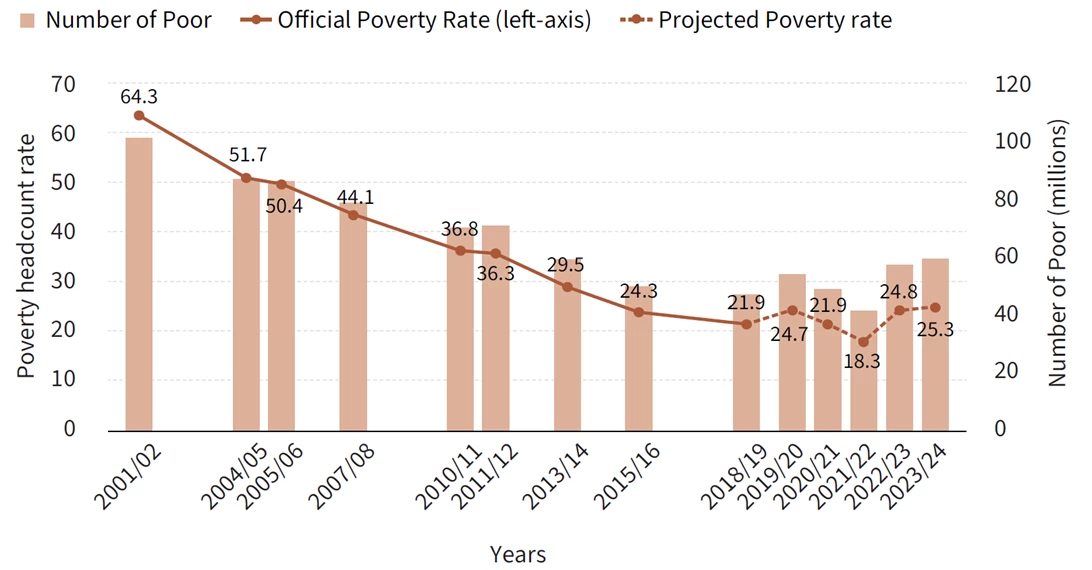
However, these official statistics are the subject of significant scholarly and institutional debate. A recent report from the Social Policy and Development Centre (SPDC) offers a compelling critique, arguing that the actual poverty level is substantially higher.
Poverty 14.6% above official estimates: SPDC
This article from The Express Tribune is crucial as it contrasts the official poverty data with an alternative, and arguably more realistic, assessment. It provides the kind of critical data you can use to challenge standard narratives in an exam.
Please read the article in its entirety. Focus on the following key points: The stark difference between the SPDC's estimate (43.5%) and the official figure (28.9%). The methodological critique: understand the difference between the government's CBN approach and the SPDC's Food Energy Intake (calorific) approach, and why the former might underestimate poverty. The alarming trend of rising urban poverty, which grew faster than rural poverty between 2018-19 and 2024-25. The conclusion that Pakistan faces a broad-based deterioration in living standards, necessitating more accurate data for policymaking.
The SPDC's analysis highlights a critical flaw in the official method: by using a CPI basket that reflects the consumption of better-off households, it fails to capture the specific and disproportionate inflation experienced by the poor, especially in food and essential services. This discrepancy is not merely a technical detail; it has profound implications for how policymakers understand and address the scale of the poverty crisis.
2. Multidimensional Poverty: A Fuller Picture
To capture the non-monetary aspects of deprivation, economists use measures like the Global Multidimensional Poverty Index (MPI). The MPI assesses poverty across three key dimensions: Health, Education, and Living Standards, using ten specific indicators.
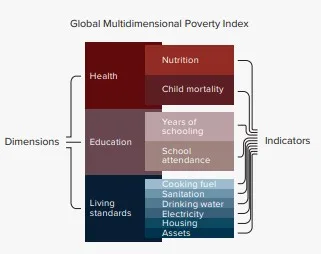
This framework helps us see that a family might be above the monetary poverty line but still suffer from severe deprivations, such as having a malnourished child, children out of school, or lacking access to clean drinking water and sanitation. This aligns with recent World Bank data on Pakistan, which highlights these very issues.
Economic issues of Pakistan: Basic terminologies and Historical analysis | Sir Usman PAS
In this segment of a lecture by Sir Usman (PAS), he contextualizes Pakistan's economic performance by looking at key social indicators.
Please watch the portion from current economic status. Note his reference to a World Bank report mentioning that over one-third of children are out of school and 40% are stunted. This is a powerful real-world example of multidimensional poverty, linking economic struggles directly to devastating social outcomes in education and health.
By combining monetary, multidimensional, and social indicator analysis, you can present a far more sophisticated and accurate picture of poverty in Pakistan—one that reflects a crisis of capability and well-being, not just income.
The Challenge of Unemployment: A Structural Crisis
Poverty and unemployment are deeply intertwined. A lack of decent work is a primary cause of poverty, and a stagnant economy that fails to create jobs ensures that poverty remains entrenched. The latest data from Pakistan's Labour Force Survey paints a concerning picture.
1.4m more jobless in four years - Newspaper - DAWN.COM
This Dawn article provides the most up-to-date statistics on Pakistan's labor market from the 2024-25 Labour Force Survey. It is an invaluable resource for quoting current, official data in your exam answers.
Read the article carefully, focusing on these dimensions of the unemployment crisis: The headline figures: A 31% surge in the unemployed population, with the total number rising to 5.9 million. Youth Unemployment: The particularly high rate among the 15-24 age group (12.6%), indicating a significant "youth bulge" struggling to find work. Gender and Geographic Disparities: Note the higher unemployment rate for females (9.7%) and in urban areas (8.0%). The Rise of the Gig Economy: For the first time, the survey estimates the role of gig work, which accounts for a significant 10.6% of secondary jobs, showing how people are adapting to a lack of formal employment.
The data reveals that unemployment is not just a number; it has distinct demographic and geographic features. But what drives this chronic lack of jobs? The roots lie in the structural weaknesses of the economy.
- Economic Growth vs. Population Growth: As Sir Usman noted in the video clip, Pakistan's economic growth (around 2.5%) is currently lagging behind its population growth (around 2.9%). An economy that grows slower than its population cannot possibly create enough new jobs to absorb the hundreds of thousands of young people entering the workforce each year.
- Fiscal Constraints and Lack of Public Investment: As we've discussed, Pakistan's economy has historically relied on government spending to spur growth and create jobs. However, under IMF programs, the government is committed to fiscal consolidation—cutting spending and reducing the deficit. While necessary for macroeconomic stability, this austerity severely limits the state's ability to invest in job-creating infrastructure projects.
- Low Investment and Industrial Stagnation: The private sector has not stepped in to fill the gap. A hostile business environment, political instability, and lack of policy continuity have deterred both local and foreign direct investment (FDI). Without investment, new industries cannot be built, and existing ones cannot expand, innovate, or create high-quality jobs.
Economic issues of Pakistan: Basic terminologies and Historical analysis | Sir Usman PAS
To connect these drivers, watch two more brief clips from Sir Usman's lecture.
First, watch his analysis of the constraints on government spending. He explains that in the absence of private investment, government spending is the last resort for job creation, but this path is blocked by external conditionalities. Next, see his explanation of why Pakistan struggles to attract international investment. He argues that despite our potential, a lack of trust in our institutions prevents the FDI needed for industrial expansion and job growth.
Evaluating Alleviation Strategies: Relief vs. Reform
Given this backdrop, how effective have government strategies been in tackling poverty and unemployment?
Poverty Alleviation: The Social Safety Net
The cornerstone of Pakistan's poverty alleviation strategy is the Benazir Income Support Programme (BISP). It is the country's largest social safety net, providing unconditional cash transfers to the poorest households.
- Effectiveness: BISP is widely acknowledged as a vital lifeline. It provides a crucial consumption floor, preventing millions from falling into destitution, and has been instrumental in cushioning the population from economic shocks like floods and hyperinflation. Its use of a proxy-means test for targeting has also been recognized as relatively efficient.
- Limitations: However, for a critical analysis, it is essential to recognize that BISP is a palliative, not a cure. It treats the symptom (lack of income) but does not address the root causes of poverty (inflation, lack of jobs, poor public services). It is a strategy of relief, not structural reform. While it helps people survive, it does not, by itself, provide a sustainable pathway out of poverty.
Unemployment Strategies: Mismatched and Underscaled
Government responses to unemployment have typically involved skills training programs (e.g., NAVTTC) and youth loan schemes for entrepreneurship.
- Effectiveness: On an individual level, these programs can be successful. Some people acquire valuable skills, and some successfully start small businesses.
- Limitations: At a macro level, their impact is negligible. They are dwarfed by the scale of the problem.
- Skills Mismatch: Training programs often fail to align with the actual demands of the modern job market.
- Structural Barriers: Loan schemes cannot overcome the fundamental barriers to business success in Pakistan, such as high energy costs, bureaucratic hurdles, and a low-growth economic environment. You cannot create millions of entrepreneurs by decree when the ecosystem for business is hostile.
- The Gig Economy Illusion: As the Dawn article revealed, many are turning to the informal gig economy. While this provides an income, it is often precarious, low-paid, and lacks the security and benefits of formal employment. This trend is less a sign of a dynamic new economy and more a reflection of the failure of the formal sector to provide sufficient opportunities.
Conclusion
Poverty and unemployment in Pakistan are not temporary problems but deep-seated structural crises. A sophisticated analysis must move beyond official headlines to reveal the true scale and multidimensional nature of these challenges.
Key Takeaways:
- Poverty Measurement is Political: Official poverty statistics, based on the CBN method, likely understate the true extent of poverty. Alternative measures like the calorific approach and the MPI reveal a deeper crisis of deprivation, particularly in urban areas.
- Unemployment is Structural: The inability of the economy to create sufficient jobs is a direct result of growth that is too slow to keep pace with population expansion, compounded by a chronic lack of public and private investment.
- Strategies Offer Relief, Not Resolution: Current alleviation strategies, while important, are fundamentally reactive. Social safety nets like BISP provide an essential cushion against destitution but do not empower people to escape poverty. Job creation schemes are too small and disconnected from the macro-economic realities to make a significant dent in unemployment.
- The Path Forward: A sustainable solution lies not in expanding handouts but in pursuing deep structural reforms aimed at fostering an investment-led, export-oriented economy capable of creating millions of quality jobs.
Preview of the Next Lesson:
The failure to enact these necessary structural reforms and the reliance on short-term, palliative measures points to a deeper issue. Why do successive governments struggle to implement effective, long-term economic strategies? The answer often lies in institutional weakness, a lack of political will, and accountability failures. In our next lesson, we will explore these issues as we tackle the learning outcome: Analyze the major obstacles to good governance in Pakistan, such as institutional weakness and lack of accountability, and propose reforms.