Hello! Welcome back.
In our first lesson, we explored the foundational concepts of Russian pronunciation: the vowel system and the crucial distinction between hard and soft consonants (palatalization). We learned that how a vowel is written often tells us more about the consonant before it than about the vowel sound itself.
Today, we'll tackle the other side of that coin: what happens to vowel sounds when they are not stressed. This phenomenon, known as vowel reduction, is the final key to understanding and producing natural-sounding Russian speech. Mastering this will make a significant difference in your accent and your ability to understand native speakers.
Our learning outcome for this lesson is to apply vowel reduction rules in unstressed syllables. We'll cover:
- The linguistic principle behind why Russian spelling and pronunciation diverge.
- The specific reduction rules for the vowels о, а, е, and я.
- Which vowels are stable and do not change.
Let's begin.
The "Why": Pronunciation vs. Spelling
As someone with a background in linguistics, you're familiar with the idea that writing systems can be more or less phonetic. Russian orthography operates on what's called the morphological principle. This means the spelling of a morpheme (like a word root or prefix) stays consistent even when its pronunciation changes due to stress shifts.
For example, the word for "water" is водá ([vɐˈda]). The word for "waters" (plural) is вóды ([ˈvodɨ]). Even though the first vowel sounds different in each word, the root вод- is spelled the same. This can be a challenge for learners, because you can't always write what you hear.
The resource below explains this concept clearly.
Russian Spelling Rules: #1 Guide for Learners of All Levels
The article 'Russian Spelling Rules' from Russian Enthusiast explains the concept of vowel reduction and the morphological principle that governs Russian spelling.
Read the section titled 'Vowel reduction and unstressed vowels'. Pay close attention to the explanation of the 'morphological principle' and the examples given, such as 'молоко́' and 'соба́ка'.
This principle is why we need to learn a few rules about how unstressed vowels behave.
The Main Event: Reduction of О and А
The most common and noticeable vowel reduction affects о and а. The rule depends on the vowel's position relative to the stressed syllable.
To get a feel for this, let's start with a short video that uses a helpful analogy from English.
This video, 'Vowel reduction (I)' from the Russian grammar channel, introduces the concept and then dives into the specifics for 'o' and 'a'.
Watch from the beginning to timestamp 02:09. The first 45 seconds provide the general concept. The following part details the two main ways 'o' and 'a' are reduced.
As the video explained, there are two main levels of reduction for o and а:
-
First-degree reduction: In the syllable immediately before the stress (the "pre-tonic" syllable), or at the very beginning of an unstressed word, о and а both merge into an "[a]"-like sound. This is similar to the schwa sound /ə/ in English, like the 'a' in "sofa".
- окнó (window) → pronounced [а-KNO]
- пагóда (pagoda) → pronounced [pа-GO-da]
-
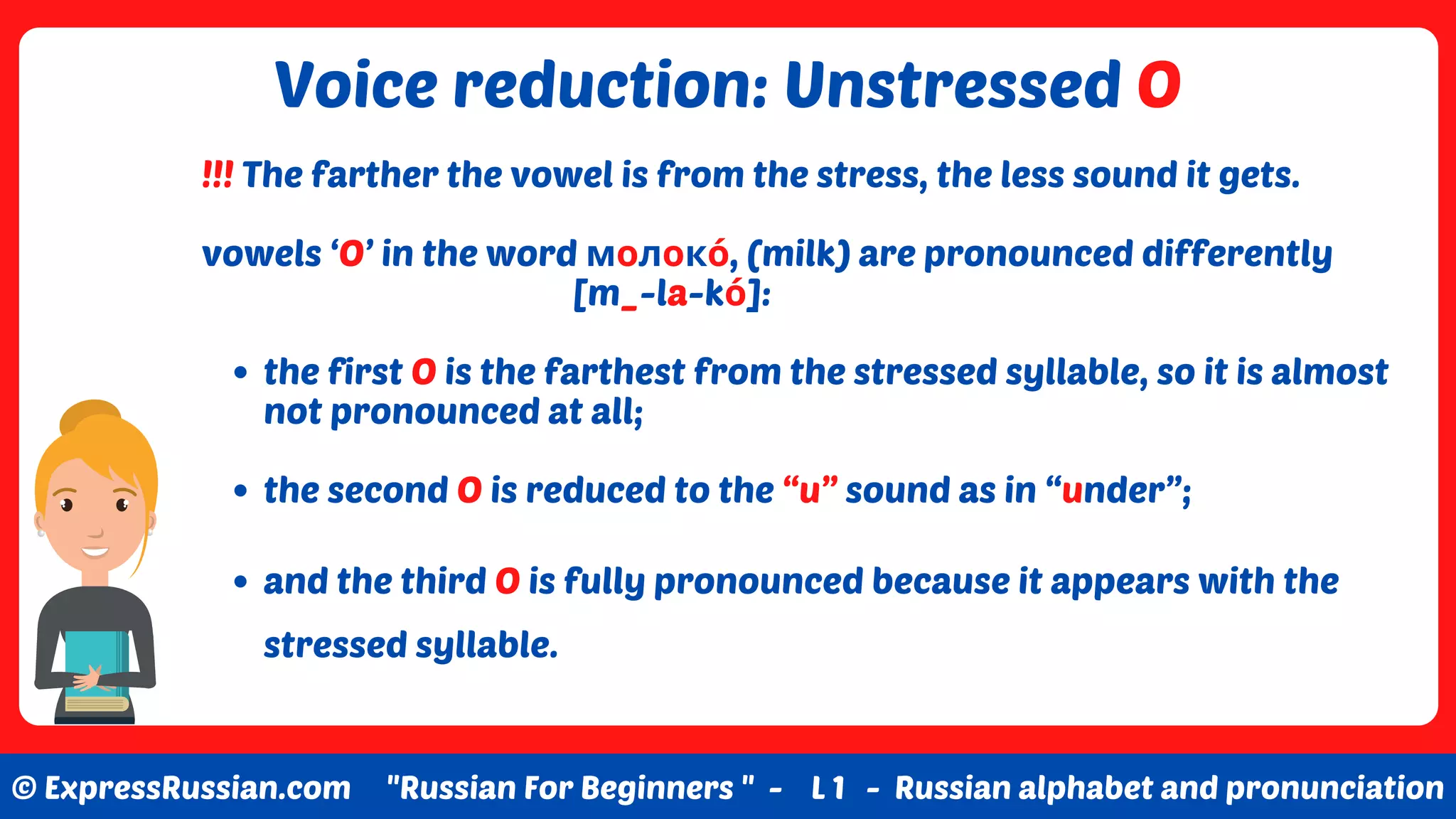
Second-degree reduction: In all other unstressed positions (e.g., two or more syllables before the stress, or in syllables after the stress that are not word-final), о and а are reduced even further to a very weak, short, and indistinct vowel sound.
- хорошó (good) → pronounced [khə-ra-SHO]. The first 'o' is two syllables before the stress and is heavily reduced. The second 'o' is immediately before the stress and has first-degree reduction.
The word молоко́ (milk) is the classic example that demonstrates both types of reduction in a single word.
Test your understanding!
The Russian word for "head" is головá. The stress is on the final syllable: г-о-л-о-в-á. How would you expect the two unstressed 'o's to be pronounced?
Show answer
The first о is two syllables before the stress, so it undergoes second-degree reduction and becomes a very weak, short sound ([ə] or [gə-]). The second о is in the pre-tonic position (right before the stress), so it undergoes first-degree reduction and is pronounced like [a] ([-la-]). The full pronunciation is approximately [gəlɐˈva].
The Other Pair: Reduction of Е and Я
The vowels е and я also reduce, but they follow a different pattern. When unstressed, they tend to sound like the Russian vowel и ([i] or the English 'i' in "bit").
Unstressed vowels E , Я / Russian pronunciation
The video 'Unstressed vowels Е , Я' from Live Russian focuses specifically on this pair of vowels.
Watch the section from 02:09 to 03:25. This part directly explains and demonstrates how unstressed 'е' and 'я' are pronounced, using clear examples.
Here is the core rule:
- In unstressed syllables, е and я are generally pronounced as an [i]-like sound ([ɪ]).
- сестрá (sister) → pronounced [s'i-STRA]
- язы́к (language) → pronounced [yi-ZYK]
- девять (nine) → pronounced [D'EV'it'] (Here the 'я' is in a post-tonic syllable)
This reduction is why listening comprehension can be tricky at first. A word you see written with е or я may sound as if it has an и.
The Stable Vowels: No Reduction Here!
Thankfully, not all vowels are subject to reduction. This simplifies things considerably.
The vowels у, ю, ы, и, and the always-stressed ё do not change their sound in unstressed syllables.
They are always pronounced the same way, which means you can trust what you see and hear with them. For example, the у in урок (lesson, [uˈrok]) sounds the same as the у in пáуза (pause, [ˈpauzə]).
Summary and Practice
The most important takeaway for a learner is to train your ear. As one of the videos wisely suggests, "trust your ears more than your eyes." When you listen to Russian, pay active attention to the unstressed vowels. When you speak, try to replicate this "flattening" of the vowel sounds.
The following resource provides a set of handy tables summarizing these rules. You can use it as a quick reference guide or "cheat sheet" as you continue your studies.
Study Resource: Guide to Russian vowel reduction
The 'Guide to Russian vowel reduction' from Mango Languages provides a concise summary of all the rules in a clear table format.
Skim through the page, focusing on the tables for 'а', 'о', 'я', and 'е'. Notice how they align with what you've learned. Also, confirm the information in the 'Important' box about which vowels do not reduce.
Key Takeaways
- Russian spelling follows the morphological principle, meaning roots are spelled consistently even if their pronunciation changes with stress.
- Vowel reduction is the weakening or changing of vowel sounds in unstressed syllables.
- Unstressed о and а reduce to an [a]-like sound (if right before the stress) or a more indistinct sound (if further away).
- Unstressed е and я reduce to an [i]-like sound.
- The vowels у, ю, ы, и, and ё are stable and do not reduce.
Next time...
Excellent work! You've now covered the three pillars of Russian pronunciation: the vowel inventory, palatalization, and vowel reduction. With this phonological framework in place, you are perfectly equipped to start speaking and understanding words and phrases.
In our next lesson, we will move from the mechanics of sound to practical communication by learning how to use basic greetings, farewells, and expressions of courtesy.