Hello! Welcome to the next lesson in our journey to learn Russian.
In our last session, we focused on making your first personal statements: introducing yourself, your profession, and your nationality. You learned the fundamental structure of Russian present-tense sentences that don't use a verb for "to be," like Я студентка (I am a student).
Today, we will build directly on that knowledge. We'll shift from talking about ourselves to asking about the world around us. By the end of this lesson, you will be able to ask two of the most essential questions in any language: Что это? (What is this?) and Кто это? (Who is this?).
From a linguistic standpoint, this lesson introduces a core distinction in Russian grammar: the concept of animacy. Understanding why you use one question for a person and another for an object is key to thinking in Russian.
The Core Concept: Animate vs. Inanimate
In English, we typically use "who" for people and "what" for everything else. Russian expands this idea. The question word you choose depends on whether the noun is considered "animate" (living) or "inanimate" (not living).
- Кто? (kto) is used for animate nouns: people and animals.
- Что? (chto) is used for inanimate nouns: objects, plants, and abstract concepts.
This is a fundamental grammatical category in Russian that you'll see appear again and again, especially when we get to noun cases. Getting it right from the start will make your life much easier later on.
To see this concept in action with lots of clear examples, let's watch a video.
Russian lessons – Lesson 1. Russian for beginners. Who or What Is It? Russian cartoon
The video 'Russian lessons – Lesson 1. Who or What Is It?' from the Russian Language School channel is a perfect introduction to this topic. It visually demonstrates the difference between asking about living beings and objects.
Watch the video from the beginning until 04:10. First, it will introduce the concept (00:13-01:02). Then, it will show you many examples of animate nouns with 'Кто это?' (01:02-02:13) and inanimate nouns with 'Что это?' (02:13-04:10). Don't worry about memorizing every word; focus on grasping the pattern of when to use 'Кто' and when to use 'Что'.
Breaking Down the Phrases
Now let's look at the components of these simple but powerful questions.
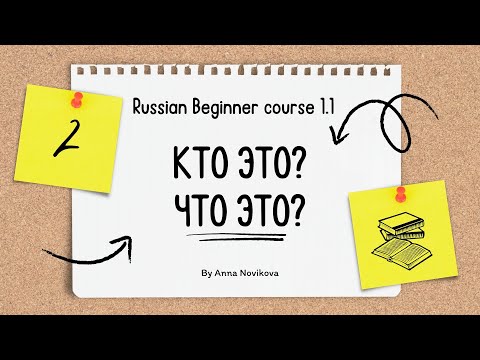
The structure is simple: [Question Word] + это?
-
The Question Words:
- Кто? [kto] — Who? (for people and animals)
- Что? [chto] — What? (for objects and things)
-
The "Pointer" Word: Это
The word это [éta] is incredibly useful. In this context, it functions as a demonstrative pronoun that means "this is" or "these are."Notice how this mirrors the verb-less sentences from our last lesson:
- Я психолог. (I am a psychologist.)
- Это книга. (This is a book.)
The structure for an answer is simply Это + [Noun].
A key feature you'll appreciate from your linguistics background is that in this construction, это is indeclinable. It does not change for gender or number.
- Это стол. (This is a table.) — стол is masculine
- Это книга. (This is a book.) — книга is feminine
- Это окно. (This is a window.) — окно is neuter
- Это книги. (These are books.) — книги is plural
This simple, unchanging
этоis what you will use to form your answers.
For a deeper dive into this versatile word, the post 'A Guide to Using ЭТО' provides an excellent explanation.
Read the first section titled 'ЭТО - the demonstrative pronoun'. It clearly explains how 'это' works as 'this is/these are' and reinforces the verb-less sentence structure.
Putting It All Together: Questions and Answers
Now you have all the pieces. Let's practice forming questions and answers.
-
You see a dog. A dog is animate.
- Question: Кто это? (Who is this?)
- Answer: Это собака. (This is a dog.)
-
You see a house. A house is inanimate.
- Question: Что это? (What is this?)
- Answer: Это дом. (This is a house.)
Test your understanding!
For each of the following Russian nouns, would you ask Кто это? or Что это?
- студент (student)
- телефон (telephone)
- кошка (cat)
- журнал (magazine)
- врач (doctor)
Show answer
- Кто это? (A student is a person - animate)
- Что это? (A telephone is an object - inanimate)
- Кто это? (A cat is an animal - animate)
- Что это? (A magazine is an object - inanimate)
- Кто это? (A doctor is a person - animate)
Let's Practice!
Here is a worksheet with various images. Look at each picture, decide if it's animate or inanimate, and practice forming the correct question and answer in your head. The word bank at the bottom provides the vocabulary you need.

Try it for a few images:
- The second image in the top row (a tree).
- The first image in the second row (a boy).
- The last image in the third row (a book).
Think about the question and answer for each before moving on.
- Tree: Что это? — Это дерево.
- Boy: Кто это? — Это мальчик.
- Book: Что это? — Это книга.
Conclusion
Excellent work! You have now mastered two of the most fundamental questions for interacting with the Russian-speaking world. This skill allows you to learn new vocabulary simply by pointing at something and asking what it is.
Key Takeaways:
- Russian grammar distinguishes between animate (living) and inanimate (non-living) nouns.
- Use Кто? (Who?) for people and animals.
- Use Что? (What?) for objects, plants, and concepts.
- The questions are formed as Кто это? and Что это?.
- The answer structure is Это + [Noun] (e.g., Это дом.).
- In this context, это means "this is" or "these are" and does not change for gender or number.
Next time...
You can now point to an object and identify it, for example, "Это книга." (This is a book). In our next lesson, we will learn how to make this sentence negative by adding the particle не, so you can say "Это не журнал." (This is not a magazine). This will add another crucial layer to your descriptive abilities.