Introduction
In our last lesson, we examined Falsifiability, the first pillar of the FLOATER framework. We established that a claim must be testable and refutable to be considered scientific. However, a claim can be perfectly falsifiable yet still be built on a weak foundation. For instance, the claim "This new bra strap material reduces shoulder pressure" is falsifiable, but the argument used to support it could be nonsensical.
This brings us to the second pillar of our framework: Logic. The learning outcome for this lesson is to evaluate whether the reasoning supporting a claim follows a logically valid structure. We will dissect the anatomy of an argument, distinguishing between the truth of its individual statements and the validity of its overall structure. By the end of this lesson, you will be able to differentiate between valid and sound arguments and recognize several common forms of deductive reasoning.
1. The Anatomy of an Argument
In the context of validating claims, an argument is not a disagreement. It is a structured set of statements designed to persuade. It consists of two parts:
- Premises: The reasons or evidence offered in support of the conclusion.
- Conclusion: The claim that is meant to follow from the premises.
The logical connection between the premises and the conclusion is called an inference.
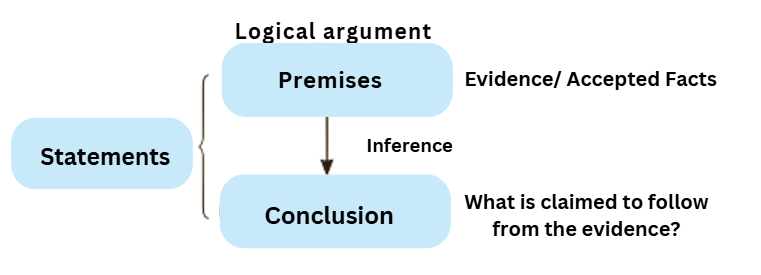
When we evaluate the "L" for Logic in the FLOATER framework, we are interrogating that inference. We are asking: Do these premises truly lead to this conclusion?
Consider this example from your interest in polyamorous dynamics:
- Premise 1: In a one-female, multiple-male polyamorous relationship, the perceived fairness of time and attention distribution is crucial for stability.
- Premise 2: In the observed triad (A, B, C), a detailed scheduling system is used to ensure equal time allocation.
- Conclusion: Therefore, the observed triad (A, B, C) has a key component for stability in place.
Our task is not yet to question whether the premises are true (we'll address that later under 'Evidence'). Our task is to determine if the conclusion logically follows from them.
2. Validity vs. Truth: The Core Distinction
The most important concept in evaluating logical structure is the strict separation of validity from truth.
- Truth applies to individual statements (premises and conclusions). A statement is either true or false.
- Validity applies to the argument's structure or form. It describes the strength of the inference between premises and conclusion.
A startling but crucial fact is that an argument can be logically valid even if its premises are completely false. Likewise, an argument can have all true statements but be logically invalid.
The following video provides an excellent and clear explanation of this distinction.
Valid vs Invalid Arguments | Deductive Reasoning Made Simple
The video 'Valid vs Invalid Arguments' from the channel Let's Get Logical clearly explains why validity and truth must be evaluated separately. It uses simple analogies to show that validity is about the argument's form, not the factual accuracy of its content.
Please watch from the beginning to 05:24. The video will first introduce the concepts, then distinguish validity from truth, provide a formal definition of validity using a shell game analogy, and finally reinforce the distinction by showing how perfectly valid reasoning can lead to a false conclusion if based on false premises.
As the video explains, here is the formal definition of a valid deductive argument:
An argument is valid if it is impossible for its premises to be true and its conclusion to be false simultaneously.
In other words, in a valid argument, if you assume the premises are true, the conclusion is guaranteed.
Let's illustrate with examples from your interest in bra design:
Example 1: A Valid but Unsound Argument
- Premise 1: All fabrics that stretch are made from rubber. (False)
- Premise 2: The fabric used in this bikini top stretches. (True)
- Conclusion: Therefore, the fabric used in this bikini top is made from rubber.
The argument's structure is valid. If it were true that all stretching fabrics are rubber, and this fabric stretches, then the conclusion would be inescapable. However, because Premise 1 is false, the argument is factually incorrect, even though it is logically valid.
Example 2: An Invalid Argument with True Statements
- Premise 1: Many popular lingerie designs from the 1950s used non-stretch lace. (True)
- Premise 2: This new design is inspired by 1950s lingerie. (True)
- Conclusion: Therefore, this new design uses non-stretch lace.
This argument is invalid. Even if both premises are true, the conclusion does not necessarily follow. The design could be "inspired" by the 1950s in its shape or color, while using modern stretch lace for comfort. There is no logical guarantee connecting the premises to the conclusion.
3. Soundness: Where Validity and Truth Converge
So, if validity alone doesn't guarantee a true conclusion, what does? For that, we need soundness.
An argument is sound if it is valid AND all of its premises are true.
A sound argument is the gold standard of deductive reasoning because it guarantees a true conclusion. This is what we strive for when validating a data-driven claim.

The next video explains the concept of soundness and its importance.
CRITICAL THINKING - Fundamentals: Soundness [HD]
In 'CRITICAL THINKING - Fundamentals: Soundness' from Wireless Philosophy, the speaker builds on the concept of validity to define soundness. It clearly explains why a sound argument is so powerful: it forces us to accept the conclusion.
Please watch the entire video (it's about 5 minutes). It will walk you through the two requirements for soundness (validity and true premises) and provide several examples of unsound and sound arguments.
Let's create a sound argument related to polyamorous relationships:
- Premise 1: Any relationship structure requiring the coordination of schedules for more than two adults will face greater logistical complexity than a dyadic (two-person) relationship. (True, by definition)
- Premise 2: A single-female-multiple-male polyamorous relationship involves coordinating schedules for more than two adults. (True)
- Conclusion: Therefore, a single-female-multiple-male polyamorous relationship will face greater logistical complexity than a dyadic relationship.
This argument is sound. The structure is valid, and the premises are factually true. Therefore, the conclusion must be accepted as true.
4. Recognizing Common Valid Argument Forms
Evaluating validity doesn't always require starting from scratch. Logicians have identified common, recurring patterns of valid deductive reasoning. Recognizing these can speed up your evaluation of a claim's structure.
The following reading introduces some of the most common forms.
Deductive reasoning in research: Definition, uses & examples
The article 'Deductive reasoning in research' provides a clear overview of the key criteria and types of deductive arguments. We'll focus on the sections that define specific, common logical structures.
Please read the sections titled 'Criteria for assessing deductive reasoning arguments' and 'Types of deductive reasoning'. Pay close attention to the definitions and examples for Syllogism, Modus Ponens, and Modus Tollens.
Let's review these three common forms with our own examples:
A. Syllogism
A classic two-premise structure.
- Structure: All A are B. C is an A. Therefore, C is a B.
- Bra Design Example:
- Premise 1: All underwires with a 'U' shape are designed for breasts with wide roots (All A are B).
- Premise 2: This prototype bra uses a 'U' shape underwire (C is an A).
- Conclusion: Therefore, this prototype bra is designed for breasts with wide roots (C is a B).
B. Modus Ponens (The Way of Affirming)
This form affirms the "if" part of an "if-then" statement.
- Structure: If P, then Q. P is true. Therefore, Q is true.
- Polyamory Example:
- Premise 1: If all members of a polycule have agreed to practice fluid-bonding (P), then regular STI testing is a required safety protocol (Q).
- Premise 2: All members of this polycule have agreed to practice fluid-bonding (P).
- Conclusion: Therefore, regular STI testing is a required safety protocol for this polycule (Q).
C. Modus Tollens (The Way of Denying)
This form denies the "then" part of an "if-then" statement.
- Structure: If P, then Q. Q is false. Therefore, P is false.
- Bra Design Example:
- Premise 1: If a bra is a true plunge style (P), then the center gore (the piece between the cups) will be less than 1 inch tall (Q).
- Premise 2: The center gore on this bra is 2.5 inches tall (Q is false).
- Conclusion: Therefore, this bra is not a true plunge style (P is false).
5. Spotting Common Invalid Forms
Just as there are common valid forms, there are common invalid forms, often called formal fallacies. These are deceptive because they look similar to valid forms. The most common two are mistakes related to Modus Ponens and Modus Tollens.
-
Fallacy: Affirming the Consequent (Mistaken Modus Ponens)
- Structure: If P, then Q. Q is true. Therefore, P is true. (INVALID)
- Polyamory Example: "If a relationship is struggling (P), its members will report high stress levels (Q). The members of this triad report high stress levels (Q). Therefore, their relationship is struggling (P)."
- Why it's invalid: The high stress could be due to work, family, or other external factors, not the relationship itself.
-
Fallacy: Denying the Antecedent (Mistaken Modus Tollens)
- Structure: If P, then Q. P is false. Therefore, Q is false. (INVALID)
- Bra Design Example: "If we use this expensive Italian lace (P), the final product will be beautiful (Q). We are not using the expensive Italian lace (P is false). Therefore, the final product will not be beautiful (Q is false)."
- Why it's invalid: It could still be beautiful using a different, less expensive lace or an elegant design.
Being able to spot these structural flaws is a powerful tool for quickly identifying weak arguments.
Conclusion
In this lesson, we moved from the testability of a claim to the logical integrity of the argument supporting it. We've established that the reasoning behind a claim must have a valid structure for the claim to be considered logically supported.
Key Takeaways:
- An argument uses premises to support a conclusion. Evaluating logic means checking the inference between them.
- Validity is a structural property. It means if the premises were true, the conclusion would have to be true. An argument can be valid even with false premises.
- Soundness is the goal. A sound argument is one that is both valid and has all true premises, guaranteeing a true conclusion.
- Recognizing common valid deductive forms like Syllogism, Modus Ponens, and Modus Tollens can help you assess an argument's structure.
- Beware of common invalid forms like Affirming the Consequent and Denying the Antecedent, which are structural fallacies.
Preview of the Next Lesson:
We now know a claim should be falsifiable and its supporting argument should be logically valid. But what if the premises themselves, the very evidence the argument is built on, are biased? In our next lesson, we will tackle the "O" in FLOATER: Objectivity. We will explore how to identify and account for potential biases in the evidence supporting a claim.