Introduction
Welcome to our final lesson in the ROCCC module on information validity. In the previous lessons, we've systematically built a framework for evaluating data sources. We have established that for a dataset to be trustworthy, it must be Reliable, Original, Comprehensive, and Current.
Today, we address the final, crucial component: Cited. This criterion acts as the capstone for the entire framework. A citation is more than an academic formality; it is the verifiable link to a dataset's origin, context, and history. It is the key that unlocks transparency and allows us, as researchers, to independently verify claims.
In this lesson, you will learn how to verify that a data source is properly cited and traceable back to its origin. We will dissect the anatomy of a proper data citation and explore the concept of data provenance, or its "lineage."
1. What it Means for Data to be "Cited"
At its core, citing a data source is about giving it a clear, unambiguous reference so that others can find and inspect it. It's about establishing a chain of accountability.
Let's begin with a straightforward definition.
The importance of identifying good data sources
The following resource provides a concise summary of the 'Cited' criterion within the ROCCC framework. It helps frame the basic idea of credibility.
Please read the section under the heading 'The last C is for cited.' Then, read the final paragraph of the article that begins 'The last thing is to check...'. Note the questions it suggests asking about any data source.
The resource emphasizes that uncited data is a "no-go" because it lacks credibility. It prompts us to ask:
- Who created the dataset?
- Are they part of a credible organization?
- When was the data last refreshed?
These questions are the starting point. For your work at a graduate level, we need to go deeper into not just why we cite data, but how a correct citation enables rigorous science.
2. The Deeper Purpose of Data Citation
Proper data citation serves several functions that are fundamental to research integrity. These go far beyond simply giving credit.
For a comprehensive academic perspective on this, we'll turn to a guide on data citation from FORS, the Swiss Centre of Expertise in Social Sciences. This will elevate our understanding from a general principle to a core research practice.
Please read Section 2, 'WHY CITE DATA?'. As you read, consider how each point—from attribution to data sharing—would apply to your own potential research, whether in lingerie design or relationship dynamics.
As the guide explains, proper citation provides a multitude of benefits for the entire research ecosystem:
- Attribution & Recognition: It acknowledges the work of data creators, treating data as a legitimate scholarly contribution.
- Findability & Access: It allows you and others to easily locate the exact dataset used in an analysis.
- Transparency & Reproducibility: It is the cornerstone of reproducible research. Without access to the original data, it's impossible to verify findings, test for errors, or replicate the analysis.
- Impact & Reuse: It allows the impact of a dataset to be tracked and encourages other researchers to build upon existing work, fostering new discoveries.
Imagine you read a study claiming a new bra-strap design significantly reduces shoulder pressure. Without a citation for the underlying biomechanical data, you cannot verify the measurements, check the sample size, or assess the methodology. The claim remains unsubstantiated.
3. The Anatomy of a Proper Data Citation
Knowing why citation is important is only half the battle. You must also be able to recognize a proper, useful citation and spot a poor or missing one. A vague reference like "internal company data" or "a survey on a social media group" is insufficient because it prevents findability and verification.
A correct data citation contains specific, structured information. Let's examine the essential components.
We will now use the same FORS guide to learn the specific, non-negotiable components of a valid data citation. This will provide you with a concrete checklist for evaluating sources.
Please read Section 3.1, 'CORE COMPONENTS OF A DATA CITATION'. Pay close attention to the six essential elements listed.
To summarize, the six core components of a data citation are:
- Author: The individual(s) or organization that created the data.
- Title: The official name of the dataset.
- Year of Publication: When the dataset was made public.
- Version: The specific version number (e.g., 2.0.1), which is crucial as datasets are often corrected or updated.
- Publisher: The entity that hosts and disseminates the data (e.g., a university data archive, a government portal, or a repository like Zenodo or Dryad).
- Persistent Identifier (PI): A unique and permanent link to the data, most commonly a Digital Object Identifier (DOI). Unlike a standard URL, a DOI is designed not to break.
Let's see what this looks like in your areas of interest.
Example 1: Bra Design Research
Suppose you encounter a paper making a claim about breast root shape.
-
Invalid Citation: "We analyzed 3D body scans from our lab."
- Critique: This is untraceable. Who are "we"? Which scans? When were they taken? How can anyone else access them to verify the findings?
-
Valid Citation (example using APA 7th style):
Lingerie Innovation Lab. (2023). Three-Dimensional Torso Scans of 500 North American Women for Bra Design (Version 2.1) [Dataset]. Zenodo. https://doi.org/10.5281/zenodo.1234567
- Analysis: This citation contains all six core components. With the DOI, you can go directly to the dataset's landing page, read its documentation (metadata), and, permissions allowing, download it for your own analysis.
Example 2: Polyamorous Relationship Research
Imagine you're reviewing literature for a study on relationship longevity.
-
Invalid Citation: "Data was sourced from a 2019 survey on the /r/polyamory subreddit."
- Critique: While this is more specific than the first example, it's still inadequate. Who created the survey? What were the exact questions? Is the raw data available? A link to a Reddit thread is not a persistent identifier and provides no guarantee of data quality or availability.
-
Valid Citation (example):
Smith, J., & Rodriguez, C. (2021). The PolyDynamics Longitudinal Survey, Wave 2: Relationship Stability and Communication Patterns (Version 1.0.0) [Dataset]. UK Data Service. https://doi.org/10.5255/UKDA-SN-98765
- Analysis: This is a robust, verifiable citation. It points to a specific version of a dataset held in a reputable social science data archive. You can trust that the data has been curated and preserved according to professional standards.
4. Traceability and Data Provenance
A proper citation is your entry point to an even deeper concept: data provenance. Provenance is the documented history of a dataset—its origin and all the transformations it has undergone. It provides the ultimate level of traceability.
Consider the following diagram which illustrates this concept.
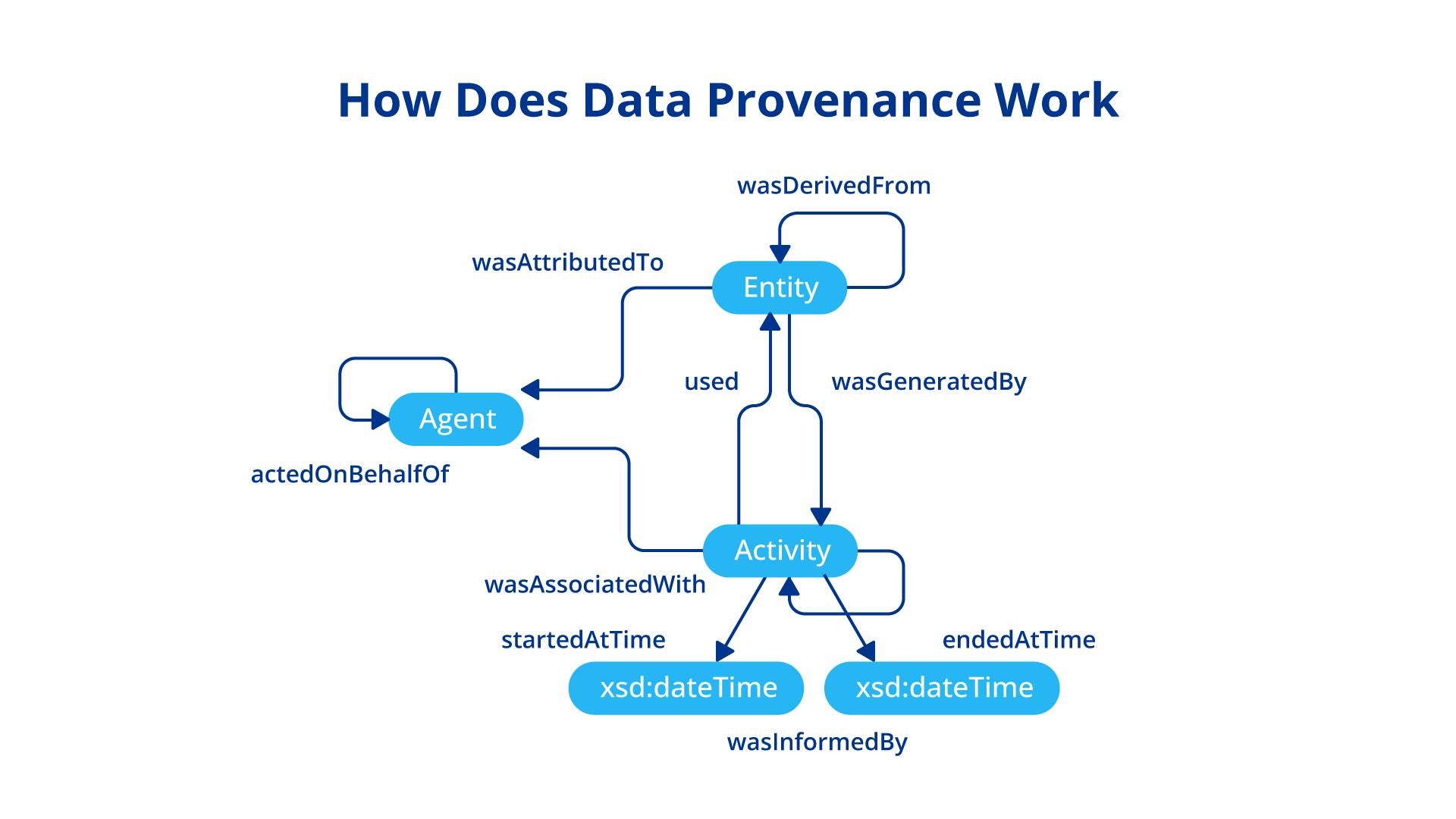
Let's break this down:
- Entity: The data itself. This could be the raw interview transcripts from a study on polyamorous dynamics, or a spreadsheet of bra measurements.
- Activity: A process that creates or alters the data. Examples: "Transcribing audio interviews," "Running a script to anonymize participant names," "Calculating bust-to-band ratios from raw measurements."
- Agent: The person, organization, or software that performs the activity. Examples: "Research Assistant A," "OpenRefine v3.5," "Dr. Eleanor Vance."
When a dataset is well-documented (often in the metadata associated with its citation), you can trace this entire history. You can see if outliers were removed, how variables were coded, and who was responsible for each step. This transparency is what allows you to fully assess the data's fitness for your own purpose and to have complete confidence in its lineage.
Conclusion
This lesson completes our journey through the ROCCC framework for assessing information validity. By adding Cited to Reliable, Original, Comprehensive, and Current, we have a powerful toolkit for interrogating any data source.
Key Takeaways:
- The 'Cited' criterion demands that data be accompanied by a formal, structured citation that allows it to be uniquely identified and located.
- A proper data citation includes six core components: Author, Title, Year, Version, Publisher, and a Persistent Identifier (like a DOI).
- Good citation practice enables transparency, reproducibility, and the proper attribution of scholarly work, treating data as a first-class research output.
- A citation is the gateway to understanding a dataset's provenance—its complete history—which is the ultimate standard for traceability.
Preview of the Next Lesson:
Having mastered how to validate external data sources, we will now turn our attention inward. The next module, Metadata (SAD), is about how we document our own data to make it understandable, discoverable, and usable for others. You will find that the principles of good citation are directly linked to the creation of good Administrative and Descriptive metadata. We are shifting from being critical consumers of data to being responsible producers of it.