Introduction
Welcome back to our final module on validating data solutions using the PULPED framework. In our previous lesson, we focused on the 'L' for Logically Sound, establishing that a solution must have a clear, unbroken chain of reasoning connecting it to the original SMART question. We learned to use tools like "If...Then" statements and the "Five Whys" to build and stress-test this logical foundation.
A solution can be practical, low-risk, and logically coherent on paper, but this still leaves a crucial question: has anything like it actually worked before? This brings us to the next letter in our framework, the second 'P' in PULPED, which stands for Precedent-backed.
Today's lesson addresses the learning outcome: Determine whether a proposed solution is supported by precedent from similar successful implementations. We will explore how to find, analyze, and learn from past projects to build confidence in our proposed solution and avoid reinventing the wheel—or repeating known mistakes.
1. Understanding Precedents in Data Solutions
In the context of validating a solution, a precedent is more than just a similar idea. It is a documented instance of a comparable problem being addressed with a comparable method, resulting in a demonstrable outcome. By studying precedents, you can:
- Reduce Risk: If a similar approach has succeeded elsewhere, the probability of success for your project increases.
- Gain a Blueprint: Successful precedents offer a template for implementation, highlighting potential methodologies, necessary resources, and realistic timelines.
- Identify Pitfalls: Failed or partially successful precedents are just as valuable. They provide warnings about what can go wrong, allowing you to proactively design safeguards.
Precedents can be categorized into two main types:
- Direct Precedents: Solutions implemented for the exact same problem in the exact same context. For example, a successful bra sizing algorithm used by a direct competitor.
- Analogous Precedents: Solutions used to solve structurally similar problems but in a different context. For example, applying principles from military-grade body armor fitting to inform the design of supportive bras.
Your work as a social researcher is built on this principle—reviewing existing literature to understand what has been studied before. The same rigor applies here.
2. Precedents in Technical and Design Domains: Bra Sizing
When a proposed solution involves a significant technical or design component, precedents are often found in industry standards, historical projects, and technical literature. Let's explore this through the lens of creating a data-driven bra sizing system.
The very idea of using systematic body measurements (anthropometry) to inform apparel design is a solution built on over a century of precedent.
Anthropometric Survey - an overview
To grasp the historical weight behind this concept, let's examine an overview of anthropometric surveys. This reading will show how large-scale data collection has long been the standard for solving sizing problems.
Please read the following sections from the article to trace the history of this precedent: Start with section 2.3.1, 'Definition and history', to see how military research in the 1930s and 40s established the initial precedent for using anthropometric data in apparel design. Next, read section 4.3.1, 'The 3D anthropometric sizing surveys'. Focus on the list of major national surveys like CAESAR, SizeUSA, and SizeUK. These are large-scale, successful precedents of data-driven solutions for apparel sizing. Finally, review the text under the headings 'Key issues affecting apparel sizing and fit' (the first paragraph) and 'Key issues...' (the fifth paragraph, discussing the 1939/1940 women's survey). Notice the explicit language calling these surveys 'historical benchmarks' and 'precedent survey'. \nPay attention to how these past projects established not only the viability of the approach but also the methodologies that are still used today.
The reading shows that proposing a data solution based on an anthropometric survey is strongly precedent-backed. Projects like SizeUK and SizeUSA are not just historical footnotes; they are massive, successful implementations that prove the concept works at a national scale. They provide a powerful argument that your proposed solution rests on a solid, empirically validated foundation.
However, "precedent-backed" also applies to the specific technology you propose. Imagine your solution isn't just a survey but a novel mobile app that uses a phone's LiDAR sensor to take measurements automatically. How do you find a precedent for that? You would look at the evolution of measurement technology itself.
Automatic Measurements of Garment Sizes Using Computer Vision ...
This research paper proposes a new method for garment measurement using computer vision and LiDAR. It's an excellent case study in how to use precedents, as the authors first review prior methods to justify their new approach.
Please focus on these key sections: Read Section 2, 'Related Work'. This section is a literature review of precedents. Note how the authors critique previous automated methods that relied only on 2D images, pointing out their limitations (e.g., needing strict workbench controls). Now, read Section 5, 'Discussion', and pay close attention to Table 3. This table provides a direct comparison between the precedents ('By 2D Image Recognition') and their proposed new solution. \nThis demonstrates a critical skill: evaluating a precedent involves understanding not only its successes but also its failures or limitations, which can justify your own, improved solution.
As this paper illustrates, validating against precedent isn't just about finding a success story and copying it. It involves a critical evaluation:
- What was the precedent? Previous methods used 2D image recognition.
- Was it successful? Partially, but it had major practical limitations.
- What are the key differences in our proposed solution? We are proposing to use LiDAR and deep learning, which avoids the need for calibrated workbenches.
- Conclusion: Our solution is precedent-backed in its goal (automated measurement) but improves upon the precedent's known flaws. This is a very strong position to be in.
3. Precedents in Social and Behavioral Domains: Polyamorous Dynamics
When your data solution targets social or behavioral outcomes, precedents are more likely to be found in academic studies, case reports, and documented social patterns. Let's consider our proposed solution for a polyamorous household: a shared digital calendar to reduce scheduling conflicts and improve relationship satisfaction.
First, is there a precedent for the problem itself being worthy of a solution? We can look at social trend data.

This data suggests that the challenges faced by polyamorous individuals are not niche or fleeting. The growing number of people in these relationships establishes a precedent for the relevance of the problem.
Next, we look for precedents for the solution. Has a calendaring tool been studied in this context before?
- Direct Precedent Search: A literature search for terms like "polyamory," "scheduling tools," "relationship satisfaction," or "group calendar." You might find case studies or even blog posts from polyamory community leaders detailing what has worked.
If a direct precedent is scarce, we turn to analogous ones by identifying the core structure of the problem. Our problem is about coordinating the schedules of multiple non-cohabiting adults with intimate, interdependent ties.
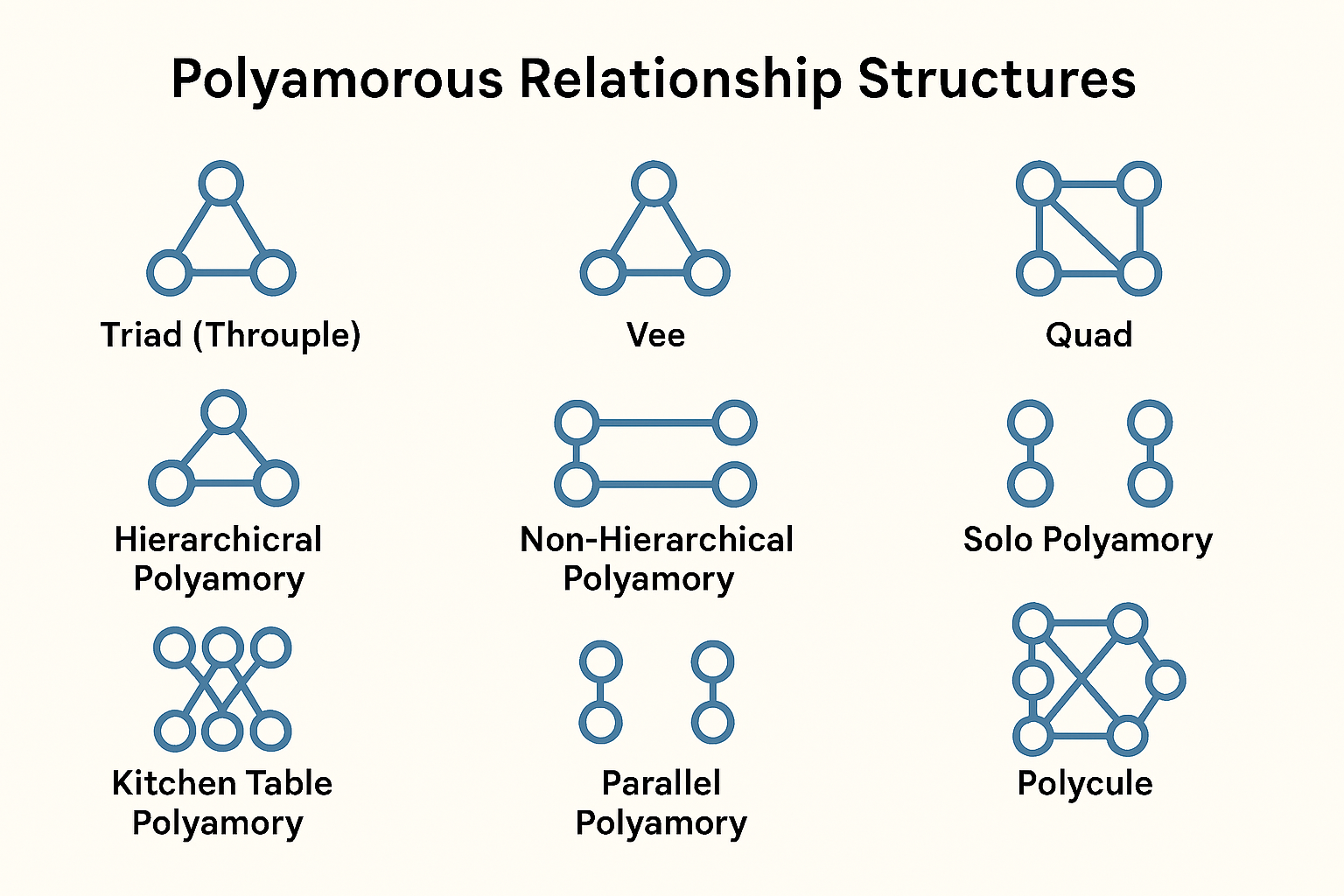
Let's assume our one-female, multiple-male group is structured as a "Vee" (one person is a "hinge" connected to others who are not connected to each other).
- Analogous Precedent Search:
- Structurally Similar Families: Research on scheduling and coordination in complex blended families (e.g., co-parents coordinating childcare across households).
- Highly Interdependent Teams: Studies on productivity and communication tools used by small, distributed work teams or startups.
When evaluating these analogous precedents, you would ask:
- What was the intervention? A shared calendar app (e.g., Google Calendar, or a specialized project management tool like Asana).
- How was success measured? Fewer missed appointments, self-reported reduction in stress, qualitative feedback on improved communication.
- What were the limitations? Privacy concerns, difficulty in getting universal adoption, the tool feeling "too corporate" for a personal context.
By analyzing these precedents, you could refine your proposed solution. For example, learning from the "too corporate" feedback, you might specify that your app needs a user interface that feels personal and intimate, rather than like a business tool. This is how you use precedent not just to justify your solution, but to make it better.
Conclusion
In this lesson, we explored the crucial validation step of ensuring a data solution is Precedent-backed. A solution that stands on the shoulders of prior successes is less risky and more likely to be effective.
Key Takeaways:
- A precedent is a prior, similar solution to a similar problem with a demonstrable outcome. Studying them reduces risk and provides a blueprint.
- Precedents can be direct (same context) or analogous (structurally similar problem, different context).
- In technical domains like bra design, precedents are found in industry standards, historical data (like national sizing surveys), and technical literature that compares methodologies.
- In social domains like relationship dynamics, precedents are found in academic studies, case reports, and analogous situations (like blended families or small teams).
- Evaluating a precedent requires critically assessing its success, its limitations, and its contextual relevance to your own project.
Preview of the Next Lesson:
We have now confirmed our solution is Practical, considered its Unintended consequences, ensured it is Logically sound, and backed it with Precedent. We are almost at the end of the PULPED framework. In our next lesson, we will address the 'E': Ethically Sound. We will revisit the CTO POC framework from Module 2 and apply it not to the initial data collection, but to the deployment and impact of the final data solution itself.