Hello! Welcome to your tenth lesson.
In our last session, we developed a systematic method to determine the precise pressure, volume, and temperature at every key vertex of a thermodynamic cycle. This "coordinate system" for cycles is the essential foundation for today's topic.
Our learning outcome for this lesson is to calculate the total work done in a cyclic process by finding the area enclosed on a P-V diagram. We will see how the tedious process of summing the work from each individual step of a cycle can be replaced by a powerful and elegant geometric shortcut. This is a core technique for quickly solving complex cycle problems in the JEE Advanced exam.
1. From Summing Work to Finding Area
Recall the fundamental definition of work done by a gas during a process from state A to state B:
Graphically, this integral represents the area under the P-V curve for that specific path.
Now, consider a simple cyclic process like the rectangular one below, going A → B → C → D → A.
A simple rectangular P-V cycle. Path A->B is an isobaric expansion, B->C is isochoric cooling, C->D is isobaric compression, and D->A is isochoric heating.
The total or net work done in the cycle is the sum of the work done in each step:
Let's analyze this step-by-step:
- A → B (Expansion): The volume increases. The work done by the gas, , is positive and equals the area under the line AB.
- B → C (Isochoric): The volume is constant, so . Thus, .
- C → D (Compression): The volume decreases. The work done by the gas, , is negative. Its magnitude is the area under the line CD.
- D → A (Isochoric): The volume is constant, so .
The net work is therefore . Since is the large positive area under the top path and is the smaller negative area under the bottom path, the net work is:
This is a general and powerful result: The net work done by the gas in any closed cycle is equal to the area enclosed by the cycle on the P-V diagram.
2. The All-Important Sign Convention
Since area is always a positive quantity, how do we know if the net work is positive or negative? This depends on the direction of the cycle.
-
Clockwise Cycle: In a clockwise cycle, the work done during expansion (the "upper" path) is greater in magnitude than the work done during compression (the "lower" path). The gas does more work on the surroundings than the surroundings do on it.
- Net work done by the gas is positive. ()
-
Counter-Clockwise Cycle: In a counter-clockwise cycle, the work done during compression (the "upper" path) is greater in magnitude than the work done during expansion (the "lower" path). The surroundings do more work on the gas than the gas does on them.
- Net work done by the gas is negative. ()
This simple rule is extremely useful for quickly verifying your answers.
3. Worked Examples: Rectangular and Triangular Cycles
The following video provides excellent worked examples that solidify these concepts. It first calculates the net work for a rectangular cycle by summing the work from each leg and then shows that the result is identical to the enclosed area. It then applies the same dual approach to a triangular cycle.
PV Diagrams, How To Calculate The Work Done By a Gas, Thermodynamics & Physics
Watch this segment from 'PV Diagrams, How To Calculate The Work Done By a Gas' by The Organic Chemistry Tutor. It clearly demonstrates the equivalence of summing work and calculating the enclosed area, and explains the sign convention.
Watch from 7:09 to 11:45 to see the analysis of a rectangular cycle. Then, watch from 15:57 to 20:18 for the analysis of a triangular cycle. Pay close attention to how the clockwise and counter-clockwise directions determine the sign of the net work.
To reinforce this, let's watch a very quick summary from a different perspective. In a previous lesson, we analyzed a triangular cycle and calculated the work for each step. The presenter now sums those values and explicitly connects the result to the enclosed area.
PV-Diagram Ideal Gas Cycle: Calculate Heat, Work, Change in Internal Energy, and Efficiency
In this short clip from the Physics Ninja video we've seen before, the presenter sums the work from each leg of a cycle and arrives at the net work.
Watch from 13:57 to 14:42. Notice how the sum of the work from the three processes (90,000 J, 0 J, and -60,000 J) gives a net work of 30,000 J, which is then identified as the area inside the cycle.
4. Reading and Reference: Formalizing the Concepts
For a concise summary of these rules, you can refer to the following resources. They provide clear definitions and diagrams that are excellent for quick revision.
Thermodynamic Processes | RK Vision Academy
The document 'Thermodynamic Processes' from RK Vision Academy provides a very clear and direct explanation of work in cyclic processes.
Read the sections on 'Work (ΔW)' and 'Cyclic and Non-cyclic Process'. Focus on point (iv) under 'Work' and point (3) under 'Cyclic Process', which explicitly state the area rule and the sign convention.
A Note on Different Sign Conventions
As you requested, let's explicitly address the different sign conventions you might encounter. Most JEE Physics problems and textbooks use the physics/engineering convention:
- First Law:
- is the work done by the system on the surroundings.
- Clockwise cycle: .
However, many chemistry resources use the IUPAC/chemistry convention:
- First Law:
- is the work done on the system by the surroundings.
- Thus, .
- Clockwise cycle: .
The resource THERMODYNAMICS-01 that we've used before follows the chemistry convention. In its summary table (section 5), it correctly states that for a clockwise cycle, the work is negative. This is because it's referring to the work done on the system. Being able to spot which convention a problem is using is a key skill. Usually, the phrasing "work done by the gas" vs. "work done on the gas" is your primary clue.
5. Advanced Application: Composite Cycles
Let's test your understanding with a problem structure common in JEE Advanced, which combines cycles.
Test your understanding!
The P-V diagram below shows a thermodynamic process involving two connected cycles. The path 1→2→4→1 is a clockwise cycle enclosing an area . The path 2→3→4→2 is a counter-clockwise cycle enclosing an area .
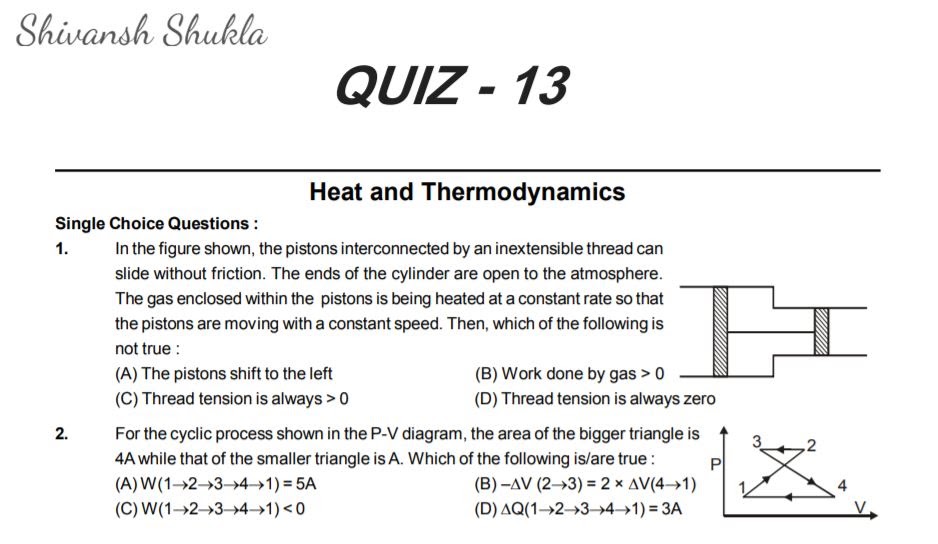
What is the net work done by the gas for the complete cycle 1→2→3→4→1?
Show answer
The net work done is .
Reasoning:
The total work done in a composite cycle is the algebraic sum of the work done in its constituent sub-cycles.
-
Work of the top loop: The cycle 1→2→4→1 is clockwise. Following our sign convention (work done by the gas), the work done for this part of the process is positive and equal to the area it encloses.
-
Work of the bottom loop: The cycle 2→3→4→2 is counter-clockwise. The work done for this part of the process is negative and equal in magnitude to the area it encloses.
-
Net Work: The question asks for the work done in the overall cycle 1→2→3→4→1. We can find this by adding the work done along each segment:
This seems complicated. A more elegant way, leveraging your familiarity with algorithms and decomposition, is to see the total work as the sum of the work of the constituent loops.
However, this is not quite right because the path 2->4 is traversed in the first loop and the path 4->2 is traversed in the second. Let's write it out:
Adding these two equations:
Since , these terms cancel out. We are left with:
This is exactly the expression for the net work of the outer cycle 1→2→3→4→1. This confirms that the net work is the algebraic sum of the areas of the loops.
Conclusion
Today, we've established a direct and powerful connection between the geometry of a P-V diagram and the physics of work.
Key Takeaways:
- The total work done by a gas in a cyclic process is equal to the area enclosed by the cycle on the P-V diagram.
- The sign of the net work is determined by the direction of the cycle:
- Clockwise → Positive Net Work (work done by the gas)
- Counter-clockwise → Negative Net Work (work done on the gas)
- Always be mindful of the sign convention used in a problem (Physics: ; Chemistry: ).
Preview of the Next Lesson:
We've mastered finding state variables at vertices and calculating the net work for a full cycle. In the next lesson, we will focus on calculating the work, heat, and internal energy change for processes that follow specific, non-standard paths, such as a straight line on a P-V diagram (e.g., ). This will complete your toolkit for analyzing any segment of a thermodynamic cycle you might encounter in the JEE.