Hello! Let's continue our journey through thermal expansion.
In the last lesson, we explored how liquids expand within containers, leading to concepts like apparent expansion and overflow. We saw that the observed effect was a result of the differential expansion between the liquid and the solid container. Today, we'll investigate a different consequence of thermal expansion: what happens when expansion is physically blocked or constrained? This is where thermal physics meets mechanics.
The learning outcome for this lesson is to tackle problems combining thermal expansion with mechanical equilibrium. We'll analyze how heating or cooling a constrained object generates internal forces and stresses. This is a crucial topic for JEE Advanced as it requires you to synthesize concepts from both thermal properties of matter and elasticity.
1. The Origin of Thermal Stress
When a material is heated, it expands. If it's free to do so, no internal stress is generated. However, if the material is constrained—for example, a metal rod fixed between two immovable walls—it cannot expand. This prevention of natural expansion induces a significant internal force, known as thermal stress.
To analyze this, we need to recall the basics of elasticity:
- Stress (): The internal restoring force per unit area ().
- Strain (): The fractional change in length ().
- Young's Modulus (): A material's measure of stiffness, defined as the ratio of stress to strain within the elastic limit ().
From these definitions, the elastic change in length due to a force is given by:
Now, let's see how this interacts with thermal expansion.
Class 11 Physics | Thermal Expansion | #7 Force Between a Rod and Rigid Walls | For JEE & NEET
This video from Physics Galaxy provides a clear, concise introduction to how a normal force develops in a rod constrained between rigid walls. It establishes the core principle we will be using throughout this lesson.
Watch the entire video (it's short, under 3 minutes). Focus on the central idea: the thermal expansion that would happen is exactly compensated by an elastic compression caused by the force from the rigid walls.
As the video explained, we can think of this as a two-step process:
- The rod tries to expand due to the temperature change . The potential, or "free," expansion is .
- The rigid walls push back on the rod with a compressive force , causing an elastic compression .
Since the rod's final length doesn't change, the magnitude of the thermal expansion must equal the magnitude of the elastic compression.
Cancelling from both sides and rearranging gives us the formulas for the force and stress developed:
- Thermal Force:
- Thermal Stress:
This concept is also clearly laid out in the following text resource.
[PDF] Elasticity, Thermal Expansion, Calorimetry & Heat Transfer
The following resource provides a written explanation and derivation of thermal stress. It's a good text-based complement to the video.
In the provided PDF, find the section titled 'Application of thermal Expansion in Solids'. Read subsection (c), which starts with 'When a rod whose ends are rigidly fixed...'. It directly derives the formulas for thermal strain, stress, and force.
A crucial point to remember:
- Heating () causes expansion, leading to compressive stress.
- Cooling () causes contraction, leading to tensile stress.
2. The Superposition Strategy for Composite Systems
This type of problem becomes more interesting when dealing with composite rods (multiple materials joined together). Your background in CS and algorithms will be useful here, as we can define a clear problem-solving strategy based on the principle of superposition.
The Strategy:
- Relax the Constraint: Mentally remove one of the supports.
- Calculate Free Thermal Expansion: Calculate the total expansion the composite rod would undergo if it were free: .
- Apply a Compressive Force: Now, calculate the total elastic compression caused by a single reaction force pushing the rod back to its original position. Since the rods are in series, the force is the same in each segment. The total compression is .
- Equate and Solve: Set the total free expansion equal to the total elastic compression () and solve for the unknown force .
The following video demonstrates this method perfectly. While it uses US customary units, the methodology is universal and exceptionally well-explained. Focus on the process, not the specific numbers or units.
Mechanics of Materials: Lesson 21 - Thermal Coefficient of Expansion, Axial Elongation
This video from Jeff Hanson walks through a detailed example of a three-segment composite bar constrained between walls. It's an excellent demonstration of the superposition strategy.
Watch the video from 03:08 to 20:05. Follow these steps: (03:08 - 04:14) Understand the problem setup. (04:14 - 09:30) See how he calculates the total free thermal expansion (our Step 2). (09:30 - 16:54) Observe how he sets up the equation for the total elastic compression due to the reaction force (our Step 3) and solves for the force (our Step 4). (16:54 - 20:05) Finally, see how he uses the calculated force to find the stress in each segment.
3. Application: Balancing Mechanical Load and Thermal Contraction
Another classic JEE Advanced problem involves a system where an initial elastic deformation from a mechanical load is counteracted by a subsequent thermal deformation.
Consider this problem from a past JEE paper:
Problem (JEE 2011): A steel wire of length ‘L’ at 40°C is suspended from the ceiling and then a mass ‘m’ is hung from its free end. The wire is cooled down from 40° to 30° C to regain its original length ‘L’. Find the value of ‘m’.
(Given: , , radius of wire = 1 mm).
You can find this problem in the resource LINK at section index 12. Let's solve it together.
Analysis:
- Initial State: The mass 'm' is hung, stretching the wire elastically.
The force is . The elastic extension is:
- Final State: The wire is cooled. This causes it to contract.
The temperature change is . The thermal contraction is:
- Equilibrium Condition: The problem states that the wire regains its original length. This means the elastic extension caused by the mass must be exactly equal in magnitude to the thermal contraction caused by cooling.
Now, we can solve for 'm'.
Let's plug in the values:
- Area
- (or 10 for easier calculation, common in JEE)
This demonstrates how balancing mechanical and thermal effects is key to solving these problems.
Test your understanding!
Consider the IIT JEE Advanced problem shown in the image below. A composite rod made of brass and steel is fixed between two rigid walls. When heated, a compressive force develops.
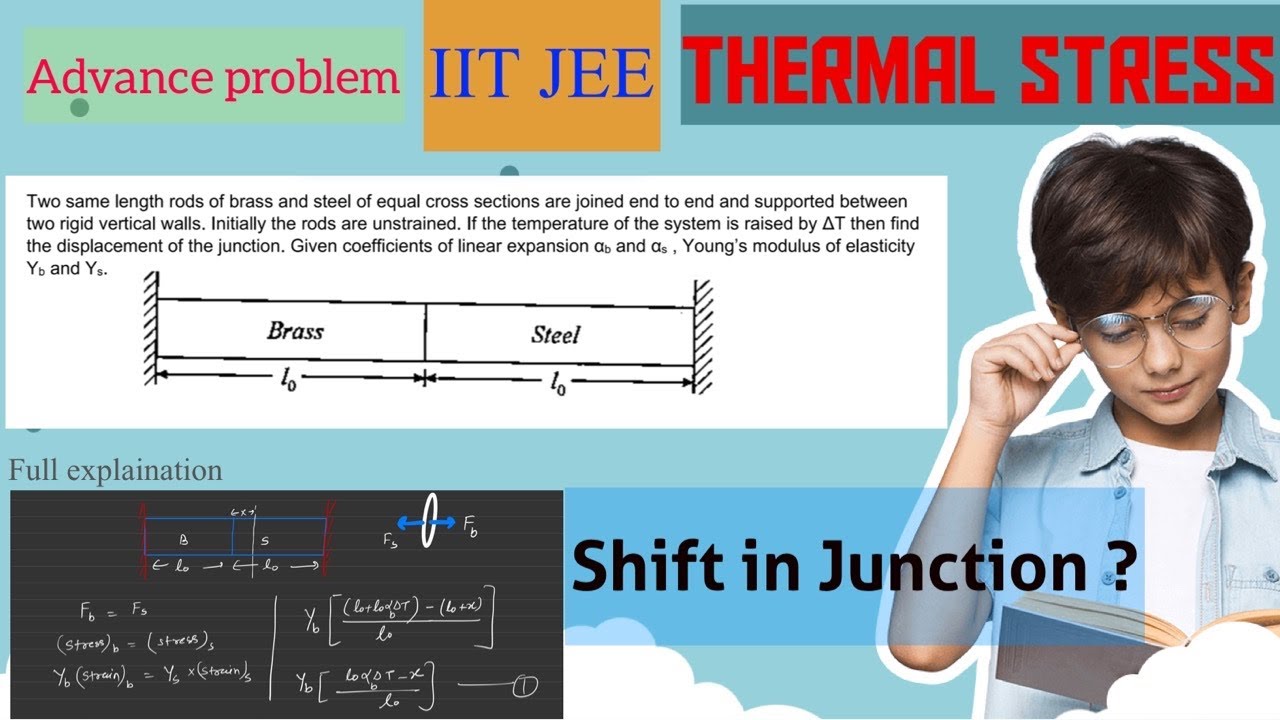
Question: How would you set up the equation to find the compressive force that develops when the system's temperature is raised by ? Don't solve it, just write down the final equation relating the known quantities () to the unknown force .
Show answer
Using the superposition strategy:
-
Free Thermal Expansion: The total expansion if the walls weren't there would be the sum of the expansions of the brass and steel rods.
-
Total Elastic Compression: The compressive force acts on both rods, causing them to compress. The total compression is the sum of the individual compressions.
-
Equilibrium Condition: Equate the total thermal expansion to the total elastic compression.
This is the equation you would use to solve for the force .
Conclusion
Today we've seen how to analyze systems where thermal expansion is mechanically constrained. The core concept is that a state of mechanical equilibrium is reached where the potential for thermal deformation is exactly counteracted by an elastic deformation from a resulting stress.
Key Takeaways:
- Thermal stress () only develops when an object's expansion or contraction is prevented.
- For a fully constrained rod, the thermal force is .
- Heating a constrained object causes compressive stress, while cooling causes tensile stress.
- Problems involving composite systems can be solved effectively using a superposition strategy: calculate the total free thermal expansion and equate it to the total elastic compression required to restore the original length.
Preview of the Next Lesson:
In our next lesson, we will look at a very specific and classic application of linear expansion: pendulum clocks. We will explore how a change in temperature alters the length of a pendulum, which in turn affects its period of oscillation, causing the clock to gain or lose time. This will nicely connect thermal physics with the mechanics of simple harmonic motion.