Hello! Welcome to our next lesson.
In the previous session, we analyzed how thermal stress develops in constrained systems, including composite rods fixed in parallel. We saw that differential expansion forces one material into tension and the other into compression, but their overall length remains straight. Today, we'll explore what happens when these materials are bonded together along their entire length.
This lesson directly addresses the learning outcome: Apply thermal expansion concepts to problems with bimetallic strips. We will investigate why these strips bend when their temperature changes and learn how to quantitatively analyze their curvature, a common topic in JEE Advanced problems.
1. The Bending Principle
A bimetallic strip is exactly what it sounds like: two different metals bonded together, typically by riveting or brazing, to form a single strip. The key is that the two metals have different coefficients of linear expansion ().
When heated, the metal with the higher wants to expand more. Since it's bonded to the other metal, it can't just get longer. The only way to accommodate this difference in length is for the entire strip to bend.
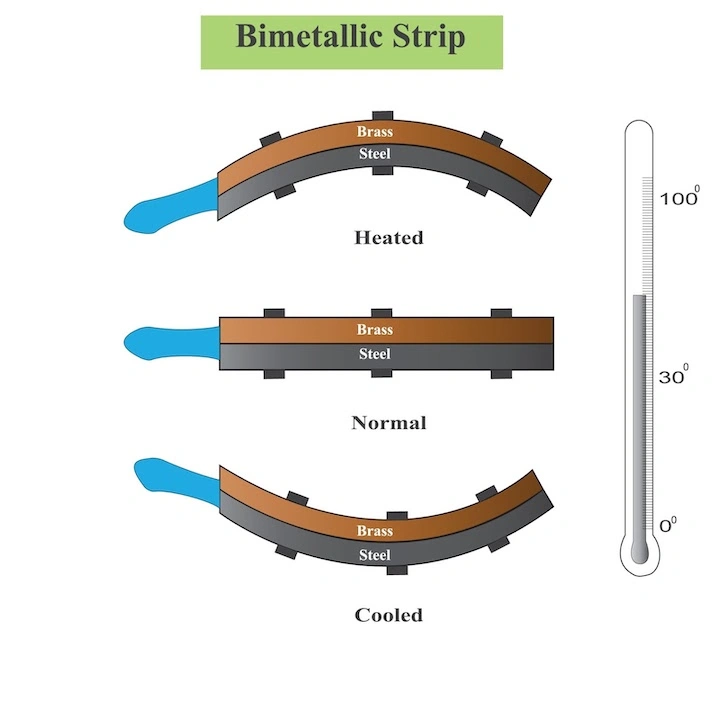
The rule is simple:
- On heating: The strip bends so that the material with the higher is on the outer side of the curve (the longer path).
- On cooling: The strip bends so that the material with the higher is on the inner side of the curve (it contracts more, so it takes the shorter path).
To see this principle explained clearly, let's watch a short, focused video.
Class 11 Physics | Thermal Expansion | #14 Effect of Linear Expansion on Bimetallic Strip|JEE & NEET
This video from Physics Galaxy provides a concise explanation of how a bimetallic strip is constructed and why the differential expansion causes it to bend into a circular arc upon heating.
Watch the first 1 minute and 37 seconds of the video. Focus on the core concept: the strip with the higher α (aluminum in this case) takes the outer, longer path when the temperature increases.
2. Quantitative Analysis: Radius of Curvature
For JEE Advanced, a qualitative understanding isn't enough. You'll often be asked to calculate the geometry of the bend, specifically the radius of curvature, .
Let's derive the relationship between , the temperature change, and the material properties. Consider two strips of initial length and thickness each, bonded together. Their coefficients of expansion are and . Let's assume .
When heated by , the strip bends into an arc as shown below.

The new lengths of the strips are:
- Inner strip (Copper):
- Outer strip (Brass):
From the geometry of the arc, if the angle subtended is , the arc lengths are:
- Inner strip:
- Outer strip:
Now, we can combine these equations. The following reading walks you through the derivation, which involves a binomial approximation—a common technique in physics problems.
A bimetallic strip is formed out of two identical strips - Thermal Expansion Problem
This webpage provides a solution to a past IIT JEE problem (1999) that derives the formula for the radius of curvature. This is a classic problem and the derivation is a fundamental skill.
Read the 'Solution' section carefully. Follow the steps from the initial length equations to the final expression for R. Pay close attention to how the binomial approximation is used to simplify the expression (1 + α_C ΔT)⁻¹.
The final result from the derivation is crucial:
Here, is the thickness of one of the strips (assuming they are identical). Some problems might define as the total thickness, so always check the problem statement.
This formula reveals two key inverse relationships:
- The radius of curvature is inversely proportional to . A larger temperature change causes a more pronounced bend (smaller ).
- The radius of curvature is inversely proportional to . A larger difference in expansion coefficients leads to a more pronounced bend.
Test your understanding!
A bimetallic strip is made of aluminum () and steel (). It is straight at 20°C.
- If it is heated to 120°C, which metal will be on the outside of the curve?
- If this heating causes it to bend with a radius of curvature , what would be the new radius of curvature if it were instead cooled from 20°C to -80°C?
Show answer
-
When heated, the material with the higher is on the outside. Since , aluminum will be on the outside of the curve.
-
Let be the radius when heated and be the radius when cooled.
The formula is . The term is a constant for the strip. Let's call it . So, .- For heating: . So, .
- For cooling: . The magnitude of the temperature change is the same.
Therefore, the radius of curvature when cooled, , will be the same as . The only difference is that the strip will bend in the opposite direction (with steel on the outside).
3. A Deeper Connection: Misfit Strain
While the JEE formula is simplified, it's useful to connect this topic back to the concepts of stress and strain from our last lesson. The bending is caused by what engineers call a "misfit strain."
- Misfit Strain (): This is the difference in the fractional expansion the two materials would have if they were not bonded.
The strip bends to accommodate this misfit. The resulting curvature () depends not only on this misfit strain but also on the thickness and stiffness (Young's Modulus) of the materials.
The following resource explores this more advanced perspective and provides an excellent worked example of using a bimetallic strip as a measurement device.
Thermal Expansion and the Bi-material Strip
This page from the University of Cambridge provides a more in-depth look at bi-material strips. We'll focus on the concept of misfit strain and a practical problem-solving example.
First, read the section starting with 'When thermal equilibrium is reached...'. Focus on Equation (5), which defines the misfit strain Δε. You don't need to memorize the complex formulas for curvature (Equations 4 and 6), but recognize that they depend on material stiffness (E) and thickness (h). This connects to our previous lesson on thermal stress. Next, review the section 'Results: Estimating the boiling temperature of nitrogen'. This is a superb example of a multi-step problem. Follow how they measure the deflection (δ), calculate the curvature (κ), then find the misfit strain (Δε), and finally use that to determine the temperature change (ΔT).
The example of finding the temperature of liquid nitrogen is a perfect illustration of the kind of reverse-logic problem that JEE Advanced favours. You're given the final state (the deflection) and asked to deduce the initial conditions (the temperature change).
4. Practice Problem
Let's conclude with a practice problem. This one has a small twist that tests whether you've truly understood the core principle.
Thermal Expansion in 1 Shot - All Concepts Covered | JEE Main & Advanced | Class 11 Physics
The eSaral '1 Shot' video contains an excellent practice problem on bimetallic strips. The question is based on a JEE Main 2021 problem.
Watch the video from 01:08:25 to 01:12:59. When the question is presented (at 01:09:00), pause the video and solve it on your own. Pay very close attention to the wording of the problem. Once you have an answer, resume the video to see the explanation.
The key to that problem was noticing that the strip was placed in a cold bath, not heated. As we discussed, this reverses the direction of the bend. It's a simple but effective way to trap students who have only memorized the "heating" scenario.
Conclusion
Today we've unraveled the behavior of bimetallic strips, moving from the simple intuition of bending to a quantitative formula for the radius of curvature.
Key Takeaways:
- Bimetallic strips bend because of the differential thermal expansion between two bonded materials.
- The direction of the bend depends on whether the strip is heated or cooled. The material with the higher always tries to be longer (on heating) or shorter (on cooling).
- The radius of curvature is given by , showing that the bend is more severe for larger temperature changes and larger differences in expansion coefficients.
- The underlying cause of the bending can be thought of as a misfit strain, connecting this phenomenon back to the core principles of mechanics.
Preview of the Next Lesson:
We've focused entirely on the expansion of solids so far. In the next lesson, we will shift our focus to liquids. We will tackle problems involving the expansion of liquids in containers that are themselves expanding, and learn to distinguish between the real and apparent expansion of a fluid.