Hello! Welcome back to our course on thermodynamics.
In the previous lessons, we've built up the First Law of Thermodynamics, , piece by piece. You've mastered the sign conventions for heat () and work (), and learned how to calculate the work done for various processes using P-V diagrams. The only piece of the puzzle remaining is the change in internal energy, .
Today's lesson focuses squarely on this term. For an ideal gas, calculating is governed by a simple yet powerful formula: . Our main goal is not just to learn this formula, but to understand why it holds true for any thermodynamic process (isobaric, isothermal, adiabatic, etc.), not just for constant-volume processes. This conceptual insight is a hallmark of the thinking required for JEE Advanced.
By the end of this lesson, you will be able to confidently determine the change in internal energy for an ideal gas in any situation, connecting it back to the gas's molecular properties.
1. The Nature of Internal Energy in an Ideal Gas
First, what is internal energy? It's the sum of all microscopic energies within a system: the kinetic energy of particles (translation, rotation, vibration) and the potential energy from intermolecular forces.
A key assumption of the ideal gas model is that there are no intermolecular forces. This means the potential energy term is zero. Therefore, for an ideal gas, the internal energy is simply the sum of the kinetic energies of all its molecules.
Since the average kinetic energy of gas particles is directly proportional to the absolute temperature, it follows that the internal energy of an ideal gas is a function of its temperature only.
Definition, Change in Internal Energy
Let's formalize this idea. This article from Aakash explains the fundamental concept: because ideal gas particles don't interact, their internal energy is purely the sum of their kinetic energies and thus depends only on temperature.
Read the sections 'Internal energy of a gas' and 'Internal Energy Change'. Focus on the reasoning that establishes the direct link between a gas's internal energy and its temperature.
2. Quantifying Internal Energy: Degrees of Freedom
To derive a concrete formula for , we need to know how many ways a molecule can possess kinetic energy. These are called degrees of freedom (f). The Law of Equipartition of Energy states that, at thermal equilibrium, the total energy is distributed equally among all degrees of freedom.
This short, animated video provides a clear and concise explanation of degrees of freedom and how they lead to the formula for internal energy.
Thermodynamics: Internal Energy and Degree of freedom (Animation)
To build a formula for internal energy, we need to count how gas molecules can store kinetic energy. This video introduces 'degrees of freedom' (f) and uses the 'law of equipartition of energy' to construct the formula for U.
Watch from 03:57 to 08:11. Pay close attention to: The link between internal energy and kinetic energy for an ideal gas. The definition of degrees of freedom. The resulting formulas for monatomic (f=3) and diatomic (f=5) gases at normal temperatures.
Let's summarize the key results. The energy associated with each degree of freedom per mole is . For moles of a gas with degrees of freedom, the total internal energy is:
For JEE problems, you should know these values of (ignoring vibrational modes, which are only active at very high temperatures):
- Monatomic gas (e.g., He, Ne, Ar): 3 translational d.o.f.
- Diatomic gas (e.g., O₂, N₂, H₂): 3 translational + 2 rotational d.o.f.
- Polyatomic non-linear gas (e.g., H₂O, CH₄): 3 translational + 3 rotational d.o.f.
- Polyatomic linear gas (e.g., CO₂): Same as diatomic.
3. The Universal Formula: ΔU = nCVΔT
Now we arrive at the central point of the lesson. The formula is often introduced in the context of an isochoric (constant volume) process. But its true power lies in its universality for ideal gases.
This often leads to confusion: how can a formula with (specific heat at constant volume) be used when the volume is changing? The answer lies in the fact that is a state function.
Let's tackle this crucial conceptual point head-on. This discussion on Physics Stack Exchange provides an excellent, rigorous explanation for why ΔU = nCvΔT is valid for any ideal gas process.
Read the top two answers. The first answer explains why the formula works for any process by linking internal energy directly to temperature and kinetic theory. The second answer introduces the crucial concept of a 'state function'. Grasping this idea is key to a deeper understanding.
Let's synthesize the argument:
- As we established, for an ideal gas, internal energy depends only on temperature T. It does not depend on pressure or volume independently.
- A state function is a property whose value depends only on the current state of the system, not on the path taken to reach that state. Since depends only on , it is a state function.
- This means the change in internal energy, , between an initial state (Tᵢ) and a final state (T) is always the same, regardless of the thermodynamic path (isobaric, adiabatic, anything) connecting them.
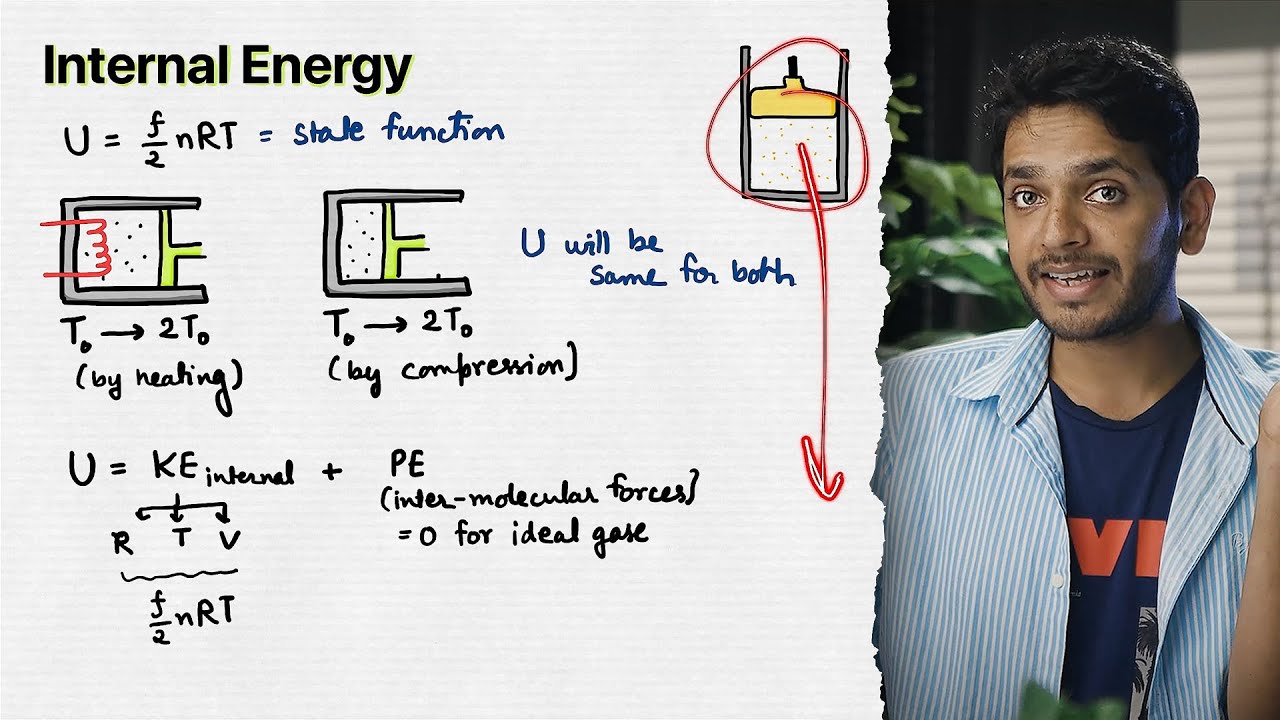
So, to calculate between two temperatures, we can choose the most convenient path for our calculation—an isochoric (constant volume) path.
For an isochoric process:
- From the First Law: . Since is constant, , so .
- By definition of molar heat capacity at constant volume, .
- Therefore, .
Since is the same for any path between the same initial and final temperatures, this formula is universally true for any process involving an ideal gas.
Connecting to Degrees of Freedom
We can link our two formulas for :
Comparing them immediately gives a fundamental relationship:
This is an extremely useful result for problem-solving, as it allows you to calculate (and by extension and ) just by knowing the atomicity of the gas.
Test your understanding!
1 mole of Helium (a monatomic gas) is taken from state A (300 K) to state B (600 K). Separately, 1 mole of Oxygen (a diatomic gas) is taken through the same temperature change (300 K to 600 K). The exact processes are not specified.
Calculate the change in internal energy, , for both gases. What is the ratio ? Use .
Show answer
The path taken doesn't matter; only the temperature change is important. We use the formula .
-
For Helium (monatomic, f=3):
-
For Oxygen (diatomic, f=5):
-
Ratio:
The ratio of the changes in internal energy is simply the ratio of their degrees of freedom.
4. Application in Problem Solving
Let's apply this theory to some JEE-style problems. The following video clips demonstrate how to calculate internal energy and its change in typical scenarios, including for a mixture of gases.
Degrees Of Freedom | Law of Equipartition of Energy & Internal Energy | Physics | JEE 2026 |Siva Sir
Let's put this theory into practice with some JEE-level problems. This video works through examples that require you to calculate the internal energy and its change for single gases and mixtures.
Watch the two problem-solving segments: From 01:13:30 to 01:16:17: This problem involves calculating the total internal energy of a mixture of Argon (monatomic) and Oxygen (diatomic). This is a classic JEE pattern. From 01:26:47 to 01:31:24: This problem asks for the change in internal energy (ΔU) when air is heated. Pay attention to the use of ΔU = mCvΔT and the handling of units.
The first problem with the gas mixture highlights an important point: the total internal energy of a mixture is the sum of the internal energies of its components.
Conclusion
Today we've demystified the internal energy term in the First Law for an ideal gas. By going back to first principles, you can now handle a wide variety of problems with confidence.
Key Takeaways:
- For an ideal gas, internal energy depends only on temperature, making it a state function.
- The formula is universally applicable for any process involving an ideal gas, because the change in a state function is path-independent.
- The most fundamental expression for internal energy change is , which directly links macroscopic energy changes to the microscopic structure (degrees of freedom, ) of the gas molecules.
- From these, we derived the crucial relationship .
Preview of the Next Lesson:
We have now mastered the calculation of both work done () and internal energy change (). In the next lesson, we will put everything together. You will learn to apply the full First Law equation, , to solve for any of the three unknown quantities (, , or ) in a single thermodynamic process, solidifying your problem-solving toolkit.