Hello! Welcome back.
In our last lesson, we established a crucial link between the macroscopic world of temperature and the microscopic world of molecular motion, finding that the average translational kinetic energy of a molecule is given by . However, this only accounts for energy stored in translational motion. Molecules can also rotate and vibrate, storing additional energy.
Today, we will introduce the Equipartition of Energy Theorem, a powerful principle that allows us to account for all these forms of energy. By applying this theorem, you will learn how to relate the total kinetic energy of a gas to its temperature and, most importantly, calculate the molar specific heats ( and ) for different types of ideal gases—a fundamental skill for solving a wide range of thermodynamics problems in the JEE Advanced.
1. Degrees of Freedom: The Ways a Molecule Stores Energy
Before stating the theorem, we need to understand the concept of degrees of freedom (). In this context, a degree of freedom is an independent mode in which a molecule can store energy. Think of it as a coordinate needed to specify the energy of the molecule.
Let's classify this for different types of ideal gases:
-
Monatomic Gas (e.g., He, Ne, Ar): These are single-atom molecules. They can only move in three-dimensional space.
- 3 translational degrees of freedom (along the x, y, and z axes).
- Thus, .
-
Diatomic Gas (e.g., H₂, N₂, O₂): These molecules are like two balls connected by a spring.
- 3 translational degrees of freedom (the center of mass moves in space).
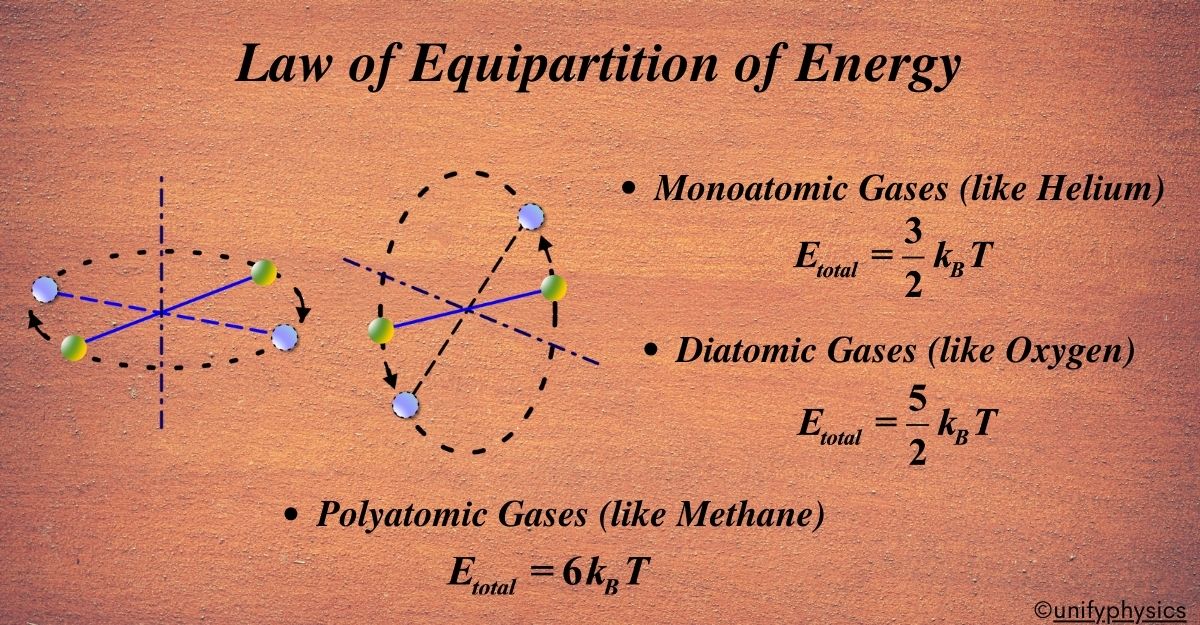
- 2 rotational degrees of freedom. The molecule can rotate about two axes perpendicular to the bond. Rotation about the axis connecting the two atoms is negligible because the moment of inertia is practically zero.
- At normal temperatures, we neglect vibrations. So, .
- At very high temperatures, the bond can vibrate. This vibration adds 2 more degrees of freedom: 1 for kinetic energy of vibration and 1 for potential energy stored in the bond. So, for a vibrating diatomic molecule, . Unless a problem specifies high temperatures or mentions vibrations, you should assume .
-
Polyatomic Gas:
- Linear (e.g., CO₂): Similar to a diatomic molecule in structure. It has 3 translational + 2 rotational degrees of freedom. So, .
- Non-linear (e.g., H₂O, CH₄): A non-linear molecule can rotate about all three axes. It has 3 translational + 3 rotational degrees of freedom. So, .
2. The Law of Equipartition of Energy
Now for the central idea of this lesson. The Law of Equipartition of Energy states:
In a system at thermal equilibrium, the total energy is distributed equally among all its degrees of freedom, and each degree of freedom contributes an average energy of per molecule.
This simple but profound statement is the key to calculating the total internal energy of a gas.
For a molecule with degrees of freedom, the average energy per molecule is:
The image below summarizes this relationship for different types of gases, assuming non-vibrational modes.
To see a detailed explanation of how these concepts are used to calculate molar heat capacities, please watch the following video.
Molar Heat Capacities of Gases, Equipartition of Energy & Degrees of Freedom
The following video from The Organic Chemistry Tutor provides a clear, step-by-step walkthrough. It connects degrees of freedom to the equipartition theorem and then uses it to calculate the molar heat capacity at constant volume (C_V) for various gases.
Watch the video from the beginning until 08:45. Pay close attention to how the formula for energy and heat capacity changes based on the number of degrees of freedom (f=3 for monatomic, f=5 for diatomic, etc.).
3. Deriving Internal Energy and Molar Specific Heats
Let's formalize the results from the video.
Internal Energy (U)
The total internal energy () of one mole of an ideal gas is the sum of the energies of all its molecules ( molecules).
Using the relationship , we get the fundamental formula for the internal energy of one mole of an ideal gas:
This equation tells us that for an ideal gas, internal energy is a function of temperature only.
Molar Specific Heat at Constant Volume ()
The molar specific heat at constant volume () is defined as the heat required to raise the temperature of one mole of a gas by 1K at constant volume. At constant volume, the first law of thermodynamics () simplifies to because work done () is zero.
In differential form, for one mole, . This gives us a direct way to calculate :
Substituting our expression for :
Molar Specific Heat at Constant Pressure () and Adiabatic Exponent ()
To find , we use Mayer's Relation, which you may recall from your previous studies:
Therefore:
Finally, the adiabatic exponent (or heat capacity ratio), , is a crucial parameter in thermodynamics, especially for adiabatic processes which we'll study later. It is defined as:
The following reading provides a concise summary of these derivations.
Specific Heat Capacity - Study Material for IIT JEE
This material from askIITians quickly recaps the derivations we just discussed, starting from the energy per molecule and arriving at expressions for C_V and C_P.
Please read the section titled 'Specific heat capacity of monoatomic, diatomic and triatomic gases'. It starts right after the definitions of molar specific heats. Focus on how the total energy E is first calculated and then used to find Cv.
4. Summary Table
These results are so fundamental to thermodynamics that it's worth summarizing them in a table.
| Gas Type | Degrees of Freedom () | Internal Energy per mole () | Adiabatic Exponent () | ||
|---|---|---|---|---|---|
| Monatomic | 3 | ||||
| Diatomic | 5 | ||||
| Polyatomic (non-linear) | 6 |
Note: The values for diatomic gases assume no vibration.
5. Application to Gas Mixtures: A JEE Advanced Scenario
A common type of problem in JEE Advanced involves mixtures of gases. The key principle here is that the total internal energy of the mixture is simply the sum of the internal energies of its components.
Let's consider a mixture of moles of gas 1 (with DOF) and moles of gas 2 (with DOF).
The total internal energy of the mixture is:
We can define an "effective" molar heat capacity for the mixture of total moles.
The specific heat of the mixture is the weighted average of the component specific heats. The same logic applies to .
Let's see this in action with a solved problem.
Specific Heat Capacity - Study Material for IIT JEE
This solved JEE Advanced problem demonstrates exactly how to apply the principles we've just learned to a mixture of a diatomic gas (oxygen) and a monatomic gas (argon).
Read the 'Problem (JEE Advanced)' and its solution. Notice how the total energy is calculated by first finding the total degrees of freedom of the entire system, which is an elegant and efficient method.
The method in the reading (summing total DOF first) is a clever shortcut. Let's verify it against our formula:
.
This matches the result. Both methods are valid.
Test your understanding!
A vessel contains a mixture of 1 mole of Helium (He) and 2 moles of Hydrogen (H₂) at temperature . Assuming the molecules have only translational and rotational modes, what is the total internal energy of the gas mixture?
Show answer
Helium (He) is a monatomic gas, so it has degrees of freedom.
Hydrogen (H₂) is a diatomic gas. With translational and rotational modes, it has degrees of freedom.
The total internal energy is the sum of the internal energies of Helium and Hydrogen.
Using the formula :
The total internal energy of the mixture is:
Conclusion
Today, you've added a powerful tool to your physics arsenal. The equipartition theorem provides a direct bridge from the microscopic degrees of freedom of molecules to macroscopic properties like internal energy and specific heats.
Key Takeaways:
- Degrees of freedom () represent the number of ways a molecule can store energy: 3 for monatomic, 5 for diatomic (at normal temps), and 6 for non-linear polyatomic gases.
- The Equipartition of Energy Theorem assigns an average energy of to each degree of freedom per molecule.
- This leads directly to the key formulas for one mole of an ideal gas:
- Internal Energy:
- Molar Specific Heat at Constant Volume:
- Molar Specific Heat at Constant Pressure:
- Adiabatic Exponent:
- For gas mixtures, properties like total internal energy and molar heat capacities are found by summing or taking weighted averages of the components.
Preview of the Next Lesson:
So far, our model of an ideal gas has ignored collisions between molecules. However, these collisions are the very mechanism by which energy is exchanged and thermal equilibrium is reached. In the next lesson, we will look closer at this process and introduce the concept of mean free path—the average distance a molecule travels between collisions. This will be crucial for understanding transport phenomena like diffusion and thermal conductivity.