Hello! Welcome to the final lesson of our first module on Calorimetry and Phase Change.
In our previous lessons, we've mastered energy balance in perfectly insulated systems, culminating in a robust strategy for tackling simultaneous phase changes. The core principle has always been Heat Gained = Heat Lost. Today, we'll remove that idealization and address a more realistic scenario often featured in JEE Advanced problems.
Our learning outcome is to apply energy conservation in calorimetry problems that include heat loss to the surroundings. This means our simple equality will be expanded to account for energy exchanged with the environment over time, adding a new layer of analysis to our problem-solving framework.
1. Beyond Isolated Systems: Introducing Heat Exchange with Surroundings
In all previous problems, we assumed our calorimeter was a perfect insulator, meaning no heat could escape or enter. In reality, any system will exchange heat with its environment. This exchange happens at a certain rate (energy per unit time, or power).
The fundamental principle of energy conservation still holds, but we must now account for this extra term. The general energy balance equation becomes:
Heat Supplied/Generated = Heat Absorbed by System + Heat Lost to Surroundings
Or, in terms of rates (Power):
Let's explore the two primary ways heat loss is modeled in physics problems.
2. Model 1: Constant Rate of Heat Loss
The simplest model assumes the system loses heat to its surroundings at a constant rate, given in units like Watts (J/s) or cal/s. This is common in problems involving powered devices like heaters.
Let's say a heater with power is used to heat a substance for a time , while the container loses heat at a constant rate . The total energy supplied by the heater is , and the total heat lost is . The net heat that actually goes into changing the substance's temperature or phase is the difference.
The energy balance equation for a time interval is:
where could be for a temperature change or for a phase change.
This video provides a perfect walkthrough of a JEE-level problem using this exact concept.
Thermal Physics IIT JEE | Calorimetry, Heat Transfer & Thermal Expansion Problems for JEE Mains 2019
This Vedantu JEE video solves a classic problem where a heater supplies energy to water in a container that simultaneously loses heat to the surroundings at a constant rate. This is an excellent demonstration of the modified energy balance equation.
Watch the segment from 08:58 to 17:15. Focus on how the instructor sets up the energy balance equation at 13:00, accounting for both the heater's power input and the rate of heat loss.
As you saw, the key was to calculate the net power delivered to the water, which was (1000 W - 160 W) = 840 W. This net power, when multiplied by time, equals the heat required to raise the water's temperature.
Test your understanding!
Problem: A 2 kW heater is used to heat a 1 kg block of a material. The block loses heat to the surroundings at a constant rate of 400 W. How long will it take to raise the temperature of the block from 25°C to 125°C? The specific heat of the material is 800 J/kg·K.
Show answer
-
Calculate the net power supplied to the block:
-
Calculate the total heat required by the block:
-
Find the time taken:
The total energy supplied is the net power multiplied by time.
3. Model 2: Newton's Law of Cooling
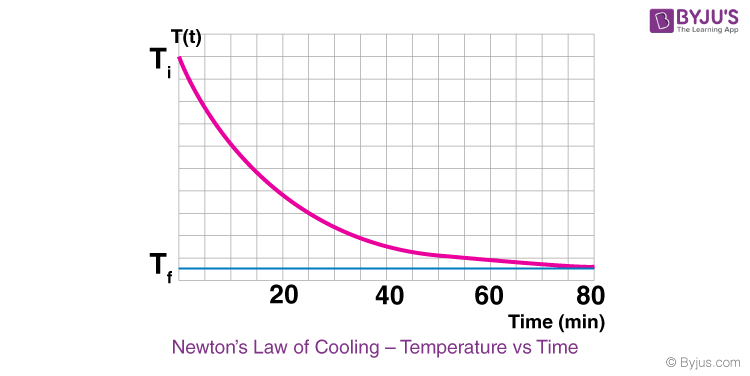
A more physically accurate model for heat loss is Newton's Law of Cooling. It states that the rate of heat loss of a body is directly proportional to the temperature difference between the body () and its surroundings ().
This is an intuitive idea: a very hot cup of coffee cools down much faster initially than when it's only lukewarm.
Since you have a strong math background, you'll appreciate that this is fundamentally a differential equation:
Since , where is the heat capacity, we can write the rate of temperature change as:
Here, is a positive constant that depends on the object's surface area and material properties. The negative sign indicates that the temperature decreases when .
Solving this first-order linear differential equation (by separation of variables) gives the temperature of the object as a function of time:
where is the initial temperature at .
For a concise summary of the law, its formula, and derivation, please review the following resource.
Newton's Law of Cooling: Formula, Examples & Applications - Vedantu
The article 'Newton's Law of Cooling' on Vedantu provides a clear, JEE-focused summary of the law, its mathematical formulation, and derivation.
Read the sections 'Statement of Newton's Law of Cooling', 'Mathematical Formulation', and 'Stepwise Derivation'. This will give you the essential equations and a quick look at the derivation logic.
Now, let's watch a detailed walkthrough of both the application and the derivation of the formula. Your background in calculus will make the derivation part particularly insightful.
Newton's Law of Cooling Calculus, Example Problems, Differential Equations
This video from The Organic Chemistry Tutor demonstrates how to solve a typical cooling problem and then provides a step-by-step derivation of the formula from the underlying differential equation.
First, watch from 00:00 to 07:55 to see how the formula is applied to a multi-step cooling problem. Then, watch the derivation from 12:32 to 23:00. Pay close attention to how the integration constant is found using initial conditions.
An Important Approximation for JEE Problems
While the exponential form is exact, many JEE problems use an approximate version of Newton's Law, valid for small temperature differences. It relates the average rate of cooling over a time interval to the average temperature during that interval.
If a body cools from to in time , the approximate form is:
Here, is the average rate of cooling, and is the average temperature of the body. is a different constant from the in the exponential formula. This linear approximation is extremely useful for solving problems involving cooling over distinct time intervals.
Test your understanding! (JEE Classic)
Problem: A body cools from 80°C to 70°C in 5 minutes. It cools from 70°C to 60°C in the next 6 minutes. Find the temperature of the surroundings ().
Show answer
We'll use the approximate form of Newton's Law of Cooling for each interval.
Interval 1: , , min.
Interval 2: , , min.
Now we have a system of two equations with two unknowns ( and ). The easiest way to solve is to divide equation (1) by equation (2):
The temperature of the surroundings is 15°C. This is a very common problem pattern in competitive exams.
4. Synthesizing the Concepts: A Comprehensive Problem
Let's conclude with a problem that requires you to set up a full energy balance equation involving multiple forms of heat transfer, similar to what you might see in a challenging JEE Advanced question.
Test your understanding! (Advanced Problem)
Problem: A solid body receives heat by radiation at a rate of 4 kW. Heat is lost from its surface to the surroundings via convection at a rate of 5.2 kW. Additionally, heat is generated internally within the body at a rate of 1.7 kW. The rate of change of the body's average temperature is observed to be 0.5 °C/s. Find the heat capacity of the solid in J/°C. (This problem is inspired by problem 24 in the "Elasticity, Thermal Expansion, Calorimetry & Heat Transfer" PDF).
Show answer
This problem is a direct application of the rate form of the energy conservation law. Let be the heat capacity of the solid. The rate at which the internal energy of the solid changes is given by .
The energy balance equation is:
Rate of heat in - Rate of heat out + Rate of heat generated = Rate of change of internal energy
Let's write this mathematically:
Now, we plug in the given values (first converting everything to consistent units, which they already are: kW = 1000 W = 1000 J/s).
- J/s (from radiation)
- J/s (from convection)
- J/s (internal generation)
- °C/s
Substituting these into the equation:
The heat capacity of the solid is 1000 J/°C (or 1 kJ/K). This problem demonstrates how to set up an energy balance for a dynamic system with multiple simultaneous heat transfer processes.
Conclusion
This lesson completes our journey through calorimetry by incorporating the realistic effect of heat exchange with the surroundings.
Key Takeaways:
- For non-isolated systems, the energy conservation principle is extended:
Heat In = Heat Absorbed by System + Heat Out. - Heat loss can be modeled at a constant rate (), where the total heat lost is .
- A more accurate model is Newton's Law of Cooling, where the rate of heat loss is proportional to the temperature difference with the surroundings.
- The solution to Newton's Law of Cooling is an exponential decay function, which can be approximated linearly for small temperature changes—a technique frequently used in exam problems.
With this, you have a comprehensive toolkit for nearly any calorimetry problem you might encounter.
Preview of the Next Module:
We now transition from studying how heat changes temperature and phase to how it affects the physical dimensions of objects. In our next lesson, we will begin Module 2: Thermal Expansion and Stress. Our first learning outcome will be to solve problems involving linear, areal, and volumetric thermal expansion with constraints.