Hello! Welcome to the first lesson in our course on Thermodynamics.
Today, we'll start with the foundational principles of calorimetry. Our goal is to master the technique for solving problems where different substances at various temperatures are mixed together. This is the first step towards building the robust problem-solving skills you'll need for the JEE Advanced. By the end of this lesson, you will be able to apply the principle of calorimetry to confidently solve these types of mixing problems.
Let's begin.
1. The Principle of Calorimetry: Conservation of Energy
When you mix substances at different temperatures in a thermally isolated container (a calorimeter), they exchange heat. The hotter substances cool down, and the colder substances warm up, until the entire system reaches a single, uniform temperature called the final equilibrium temperature ().
The core idea behind all calorimetry problems is the conservation of energy. In an isolated system, energy is not lost; it is simply transferred from one part of the system to another. This gives us the Principle of Calorimetry:
Heat lost by the hot substances = Heat gained by the cold substances
This is the most intuitive way to set up these problems.
A more formal, and often more powerful, way to state this is that the net heat change for the entire isolated system is zero:
where is the heat exchanged by each component in the system.
For processes without a change in phase (like melting or boiling), the heat exchanged is given by the formula:
where:
- is the mass of the substance.
- is the specific heat capacity of the substance (the heat required to raise the temperature of a unit mass by one degree).
- is the change in temperature.
A Quick Note on Sign Conventions
Your preference for clarity on sign conventions is important. Let's establish the two common methods for setting up the calorimetry equation. Let's say we mix a hot object (initial temp ) and a cold object (initial temp ) to reach a final temperature .
Method 1: Heat Lost = Heat Gained
This method uses positive values for all heat transfers.
- Heat Lost by hot object:
- Heat Gained by cold object:
Notice the order of temperatures in : we always subtract the smaller temperature from the larger one to ensure the result is positive. The final equation is:
Method 2:
This method is more systematic, especially for complex systems. We define consistently for all components: .
- For the hot object, , which is negative, making negative (heat is lost).
- For the cold object, , which is positive, making positive (heat is gained).
The equation becomes:
You can see that a simple rearrangement turns this into the "Heat Lost = Heat Gained" equation. Method 2 is often more robust as it naturally handles the signs for you, which will be very useful in later thermodynamics topics.
2. Simple Mixing Problems
Let's start by seeing this principle in action. The clearest way to begin is by mixing two samples of the same substance, like water.
The Final Temp after Mixing Two Amounts of Water
This article, 'The Final Temp after Mixing Two Amounts of Water' from ChemTeam, provides a clear, step-by-step guide to setting up and solving basic calorimetry problems. It's an excellent foundation for our work.
Please read through 'Example #1' to 'Example #5'. Pay close attention to how the change in temperature (\Delta t) is defined for the hot and cold substances to ensure the 'qlost = qgain' relationship holds. Notice how in Example #4 and #5, the same principle is applied to different substances (methanol, metals) by using their respective specific heat capacities.
As you saw in the examples, the core task is to correctly identify which substances lose heat and which gain heat, and then to set up the energy balance equation to solve for the final temperature, .
3. Mixing Different Substances: A Worked Example
Now, let's look at a common scenario: dropping a hot piece of metal into colder water. This involves different masses and different specific heat capacities.
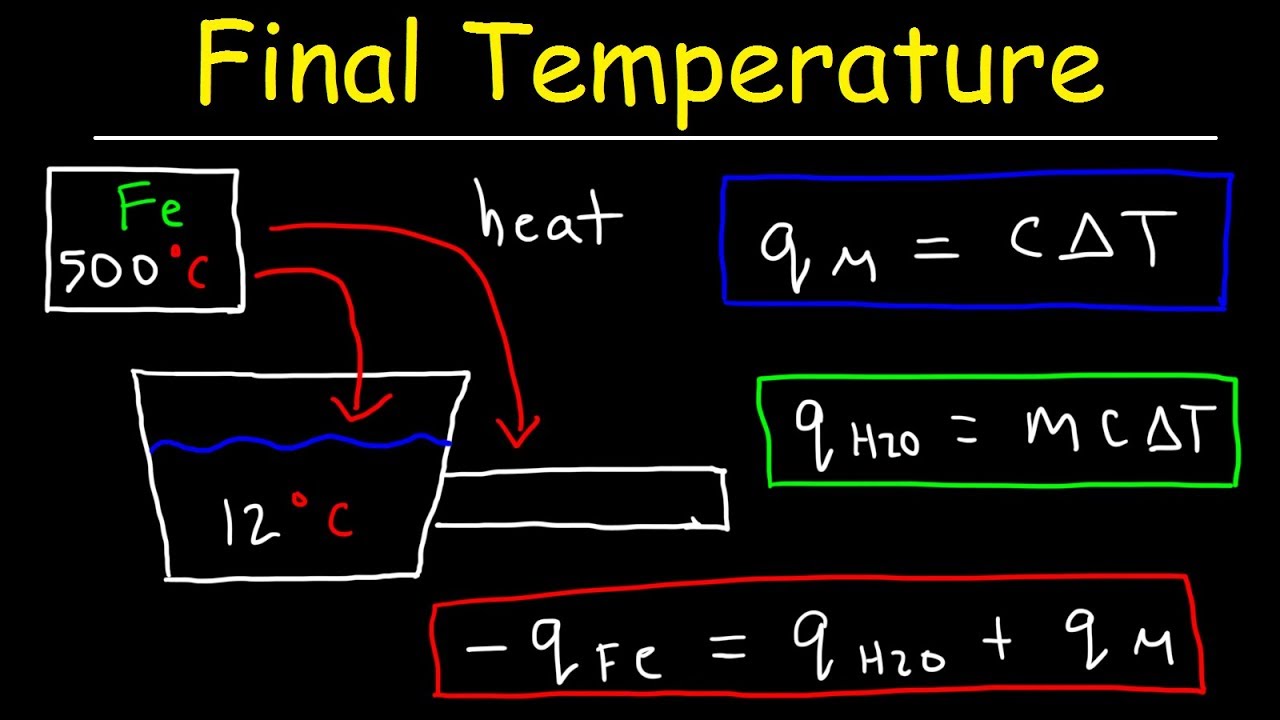
To see a detailed solution, let's watch a segment from a helpful video.
Calorimetry Problems, Thermochemistry Practice, Specific Heat Capacity, Enthalpy Fusion, Chemistry
This video from 'The Organic Chemistry Tutor' clearly explains how to solve a calorimetry problem involving a hot metal dropped into water. It reinforces the 'Heat Lost = Heat Gained' principle and the algebraic steps involved.
Please watch the segment from 03:44 to 07:34. The narrator solves for the specific heat capacity of the metal, but the setup is identical to a problem where you would solve for the final temperature. Notice his use of a negative sign on one side, which is another way of expressing \sum Q = 0.
Test your understanding!
A 150 g piece of an unknown metal is heated to 100°C and then dropped into an insulated container with 200 g of water at 20°C. The final equilibrium temperature of the mixture is 25°C. What is the specific heat capacity of the metal? (Specific heat of water, ).
Show answer
Let's apply the principle: Heat Lost by metal = Heat Gained by water.
- Heat Lost by metal:
- Heat Gained by water:
Now, we equate them:
4. Multi-Component Systems and JEE Problem Structure
JEE Advanced problems often involve more than two substances. A common setup includes the calorimeter itself, which also gains or loses heat. The heat capacity of the calorimeter is sometimes given as a single value (in J/°C), so the heat it exchanges is simply . If not, you treat it as just another object with its own mass and specific heat, .
Let's tackle a JEE-style problem that involves three components.
JEE Advanced Previous Year Questions on Calorimetry and Heat ...
The following problem is from a collection of JEE Advanced questions on the BYJU'S website. It's a classic example of a three-component system.
Focus on 'Question 10'. Read the problem statement carefully. Before looking at the solution, try to set up the 'Heat Lost = Heat Gained' equation yourself.
Let's break down the solution to Question 10 together:
- System Components: A hot copper ball, a copper calorimeter, and water.
- Initial State:
- Copper ball: g, cal/g°C, Temp = (unknown).
- Calorimeter: g, cal/g°C, Temp = 30°C.
- Water: g, cal/g°C, Temp = 30°C.
- Final State: The entire system is at °C.
Energy Balance: The hot copper ball is the only thing losing heat. The calorimeter and the water both gain heat.
- Heat Lost: By the copper ball.
- Heat Gained: By the calorimeter and the water.
- Calorimeter: cal.
- Water: cal.
- Total Gained: cal.
Equation:
This problem demonstrates the systematic approach needed: identify all components, separate them into "losing heat" and "gaining heat," and then sum the energies on each side.
5. Developing the JEE Advanced Mindset: Multi-Stage Problems
The true challenge in JEE Advanced often lies in problems that require multiple steps of reasoning. A single problem might contain several sequential calorimetry processes. Let's look at an example to understand this structure.
JEE Advanced Physics 2019 Paper 1 #17 (#7) Calorimetry
The following video by Michel van Biezen tackles a JEE Advanced problem. It involves concepts we haven't covered yet (like phase changes), but I want you to watch it for a specific reason: to see how a complex problem is broken down into two distinct parts. This is a key problem-solving strategy.
Watch from the beginning until 04:54. Do not worry about the 'latent heat' term for now; we'll cover that soon. Your goal is to observe how he identifies 'Part 1' and 'Part 2' of the problem. For each part, he sets up a separate 'Heat Gained = Heat Lost' equation. This decomposition of a complex scenario into simpler, solvable steps is the core skill we are building.
The key takeaway is that even the most daunting problems are built from the same fundamental principles. Your ability to dissect a problem statement and apply the correct principle at each stage is what leads to the solution.
Conclusion
In this lesson, we established the foundational principle of calorimetry based on the conservation of energy. We saw how to apply it to solve mixing problems by setting up the equation Heat Lost = Heat Gained.
Key Takeaways:
- In an isolated system, heat is transferred from hotter objects to colder objects until a final, uniform equilibrium temperature is reached.
- The fundamental equation is , which can be practically applied as .
- For temperature changes without phase change, .
- A systematic approach is crucial: identify all components, their initial states, the final state, and then build the energy balance equation.
In our next lesson, we will build upon this foundation to solve problems involving specific heat capacity that varies with temperature. This will introduce a new layer of complexity, requiring the use of calculus to find the total heat exchanged, a type of problem well-suited to your mathematical background.