Hello! In our last lesson, we saw how heat from a thermodynamic cycle could be used to drive phase changes in a separate calorimetric system. We will continue to explore these integrated problems, which are a hallmark of the JEE Advanced exam.
Today's lesson focuses on this learning outcome: Solve problems involving piston-cylinder systems under external mechanical forces like springs or friction. This is a classic integration of mechanics and thermodynamics. You'll need to combine the First Law of Thermodynamics with principles like force balance and work-energy from mechanics. The key to mastering these problems is a systematic and careful accounting of all forces and energy transfers.
1. The First Law and the Challenge of "Work"
As we've discussed, the First Law of Thermodynamics is a statement of energy conservation. In physics, it's typically written as:
where:
- is the change in the internal energy of the system.
- is the heat added to the system.
- is the work done by the system on its surroundings.
The diagram below provides a helpful visual recap of these sign conventions, which you've noted can be a point of confusion.
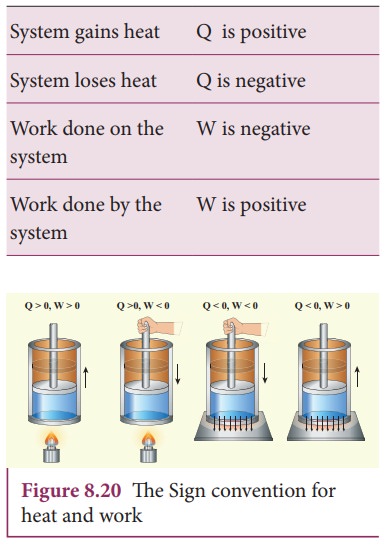
You raised a very important point about the different sign conventions used in physics and chemistry. Let's clarify that now.
Why is the sign convention just opposite in thermodynamics, physics ...
The confusion between physics and chemistry conventions is common. The core difference isn't in the physics, but in the definition of 'W'. This Quora discussion provides several excellent explanations of the differing perspectives.
Please read the answers by Ron Brown and the 'Assistant Bot'. Ron Brown's answer clearly states the two forms of the First Law and explains the reasoning: physicists are often interested in the output of an engine (work done by the system), while chemists focus on energy changes within the system. The 'Assistant Bot' answer provides a practical guide on how to translate between them: identify whether 'W' means work done on or by the system. The key relationship is W_{ ext{on}} = -W_{ ext{by}}.
The takeaway is that both conventions are self-consistent. The physics convention () defines as work done by the system. The chemistry convention () defines as work done on the system. Since doing work on something is the negative of the work done by it, the equations are physically identical. For this course, we will consistently use the physics convention: for work done by the system (expansion).
2. Systems with Springs: Where Does the Energy Go?
When a gas expands against a piston connected to a spring, it does work. A common mistake is to incorrectly partition the energy in the First Law. You might be tempted to write something like . This is wrong.
The correct approach is to recognize that the work done by the gas () is the total energy the gas expends to move the piston. This energy is then distributed to do work on the atmosphere, compress the spring, and overcome other external forces.
This work is then accounted for by the work-energy theorem applied to the piston and its attachments:
The First Law for the gas remains simply .
Let's see this in action with a sophisticated JEE Advanced-level problem.
[JEE ADVANCED] GAS PISTON CYLINDER WITH SPRINGS AND CAPACITOR [ ADVANCE PROBLEMS IN SCHOOL PHYSICS]
The channel INDIAN SCHOOL OF PHYSICS provides an excellent walkthrough of a problem involving a gas-piston system with springs. This example brilliantly illustrates the correct method for calculating the work done by the gas.
Please watch the following two segments from the video: Force and Volume Analysis (2:36 - 4:17): Pay attention to how the equilibrium condition (force balance on the piston) is used to determine the final pressure of the gas. Work Calculation (5:52 - 7:32): This is the most critical part. Observe how the work done by the gas is correctly calculated as the sum of the energy stored in the springs and the work done against the atmosphere. The instructor specifically highlights the common mistake I mentioned earlier.
Let's summarize the strategy demonstrated in the video:
- Analyze the States: Use mechanical force balance () on the piston at the initial and final equilibrium states to relate the gas pressure to external forces (atmospheric pressure , spring force ).
- Calculate Work Done by Gas (): Use the work-energy principle. The total work done by the expanding gas is converted into potential energy stored in the springs () and work done against the constant atmospheric pressure ().
- Calculate Change in Internal Energy (): For an ideal gas, this is always . As shown in the video, this can often be expressed in terms of P and V: .
- Apply the First Law: With , , and correctly defined, solve for the unknown using .
3. Systems with Friction: Dissipation and System Boundaries
Friction introduces an irreversible process where ordered mechanical energy is converted into disordered thermal energy (heat). How do we account for this? The key is to be precise about what constitutes your "system".
Let's consider a gas expanding in an insulated cylinder, pushing a piston against an external pressure and a kinetic friction force, .
Perspective 1: System = Gas only
- The gas does work against the total force resisting its expansion. This force is from the external pressure and friction.
- The work done by the gas is .
- The energy dissipated by friction () turns into heat at the piston-cylinder interface. This heat is then transferred back to the gas and the cylinder walls. We can treat this as a heat input to the gas, .
- The First Law becomes: .
Perspective 2: System = Gas + Piston + Cylinder
- This is often a cleaner perspective. Friction is now an internal process.
- The work term in the First Law, , is only the work that crosses the system boundary. For example, work done against external atmospheric pressure.
- The work done by friction is not lost from the system. It is converted into the internal energy of the system's components (the piston and cylinder walls get hotter).
- The First Law for this combined system is: .
For most problem-solving, it's effective to calculate the total work done by the gas against all opposing forces, including friction.
Dissipation and first law of thermodynamics
This Physics Stack Exchange thread provides a rigorous analysis of how to handle friction in thermodynamics. It's a perfect resource for formalizing our understanding.
Please read the answers provided by users 'Ari' and 'Bob D'. Ari's answer provides a clear, step-by-step analysis of a gas expanding against a weight and friction. Note how the work done by the gas is calculated against the sum of the forces: W_{gas} = (mg+F_k)h. Bob D's answer reinforces the importance of defining the system boundary. His key point is that "The friction work is not energy lost. It is retained by the system."
4. An Advanced Integrated Problem
Let's tackle one more complex problem that combines several of these elements. This problem involves two pistons, two springs, and the effect of gravity, requiring careful application of all the principles we've discussed.
[JEE ADVANCED] HEATER PISTONS & SPRINGS IN A THERMODYNAMIC SYSTEM [ ADVANCE PROBLEMS IN PHYSICS]
This second problem from INDIAN SCHOOL OF PHYSICS is an excellent capstone for this lesson. It will test your ability to apply force balance and energy accounting in a more complex geometry.
Watch the video from the beginning up to 9:45. Follow the logical steps: Initial & Final States: Notice how force balance is applied to each piston separately to find the initial and final gas pressures and the corresponding states of the springs. Change in Volume: The total volume change is the sum of the changes contributed by each piston's movement. Work Calculation: The work done by the gas is calculated by considering the work done on each piston against gravity, the atmosphere, and the springs. This is a very detailed and powerful application of the work-energy theorem. First Law Application: Finally, \Delta U is calculated and all terms are assembled into the First Law to find the heat supplied.
This problem demonstrates the power of a systematic approach. By breaking down a complex system into its components, applying fundamental principles (force balance, work-energy) to each, and then re-assembling them within the framework of the First Law, you can solve even the most intimidating problems.
Test your understanding!
A gas in a cylinder expands, pushing a piston of mass m upwards by a height h against gravity and a constant kinetic friction force f_k. The process is adiabatic. What is the change in the internal energy of the gas, ?
Show answer
- Identify forces on the piston: Gravity (
mg) acts downwards, and friction (f_k) acts downwards (opposing the upward motion). - Work done by the gas: The gas must push against both these forces. The total upward force it exerts on the piston is . The work done by the gas is .
- Apply the First Law: For an adiabatic process, .
The internal energy of the gas decreases by an amount equal to the increase in the potential energy of the mass plus the energy dissipated by friction.
Conclusion
Today we've tackled a crucial type of integrated problem that combines mechanics with thermodynamics. Mastering these requires moving beyond simple formulas and adopting a rigorous, first-principles approach to energy accounting.
Key Takeaways:
- Start with Mechanics: Always begin by analyzing the mechanical system. Use force balance () at equilibrium to determine the gas pressure.
- Correctly Calculate Gas Work: The work done by the gas, , is the central quantity. It represents the total energy the gas expends. This work is then distributed among external agents (lifting weights, pushing atmosphere) and stored as potential energy (in springs).
- Apply the First Law to the Gas: The First Law for the gas itself remains .
- Friction is Internal Energy: Energy "lost" to friction isn't truly lost; it's converted into thermal energy, increasing the internal energy of the system components (piston/walls). Understanding your system boundary is key to tracking this energy.
Preview of the Next Lesson:
In our next lesson, we will shift gears slightly to learn a powerful mathematical technique. We will learn how to apply the binomial approximation in thermal expansion and thermodynamic calculations for small changes. This is a valuable tool for simplifying complex expressions and is frequently required for solving certain types of JEE Advanced problems efficiently.