Hello! Welcome to the final lesson of our course on Thermodynamics.
Over the past few weeks, we've journeyed from the fundamentals of calorimetry to the intricacies of thermodynamic cycles and, in our last lesson, solidified your understanding of sign conventions to ensure accuracy in applying the First Law. You've built a strong toolkit of equations and principles.
Today, we'll focus on a capstone skill that distinguishes a good problem-solver from a great one, especially in the context of the JEE Advanced: detecting and handling hidden assumptions. These are the unstated conditions and clever traps that problems are designed with. Mastering this will involve using all the knowledge you've gained in a more strategic, detective-like manner.
Our learning outcome is to detect and handle problems with hidden assumptions, such as partial phase changes or heat loss. We'll break this down into a series of case studies, giving you a systematic approach to "read between the lines."
1. The "What If?" Mindset: Your Primary Tool
The most significant shift you can make when approaching a complex JEE problem is to move from immediate calculation to critical analysis. Before you write down Heat Lost = Heat Gained, pause and ask yourself:
- "What if not all the ice melts?" or "What if not all the steam condenses?" This leads to checking for partial phase changes.
- "What if the container isn't a perfect insulator?" This prompts you to look for clues about heat loss.
- "What if the problem happens in stages?" This forces you to parse the wording carefully and treat the process sequentially.
- "Is all the energy accounted for?" This helps you spot conversions from other forms of energy, like kinetic or potential energy, into heat.
Adopting this inquisitive mindset is the key to uncovering the problem's true structure.
2. Case Study 1: The Partial Phase Change Trap
This is the most frequent and important hidden assumption in calorimetry. A common mistake is to assume a final equilibrium temperature T and write an equation where, for example, all the ice melts and all the steam condenses. The calculated T might be physically nonsensical (e.g., below 0°C or above 100°C).
The robust strategy is the "Heat Budget" method.
The Heat Budget Method
- Identify Extremes: Pinpoint the phase change temperatures (e.g., 0°C for ice/water, 100°C for water/steam).
- Calculate Heat Required: Determine the heat needed for a substance to complete a phase change. For example, to melt all ice: .
- Calculate Heat Available: Determine the maximum heat that can be released by another substance to reach that same phase change temperature. For example, heat from steam condensing to water at 100°C: .
- Compare the Budget:
- If , the phase change is partial. The final temperature is the phase change temperature (e.g., 100°C if not all steam condenses, or 0°C if not all ice melts). You can then calculate exactly how much mass changed phase.
- If , the phase change is complete. The leftover heat () is then used to change the temperature of the entire mixture to a final equilibrium state.
Let's see this in action.
Thermal Physics IIT JEE | Calorimetry, Heat Transfer & Thermal Expansion Problems for JEE Mains 2019
The following clip from a Vedantu JEE video solves a classic problem of mixing ice and steam. Pay close attention to how the instructor calculates and compares the heat values to deduce that not all the steam will condense.
Watch from 23:49 to 29:38. The key moment is the comparison between the 900 calories required to melt the ice and bring it to 100°C, versus the 2700 calories available from condensing all the steam. This comparison is the core of the 'Heat Budget' method.
The logic is clear: since more heat is available than required, you can confidently conclude that the final temperature will be 100°C, but with a mixture of water and some remaining steam.
This same principle applies even in more complex scenarios. Look at the problem and solution below.
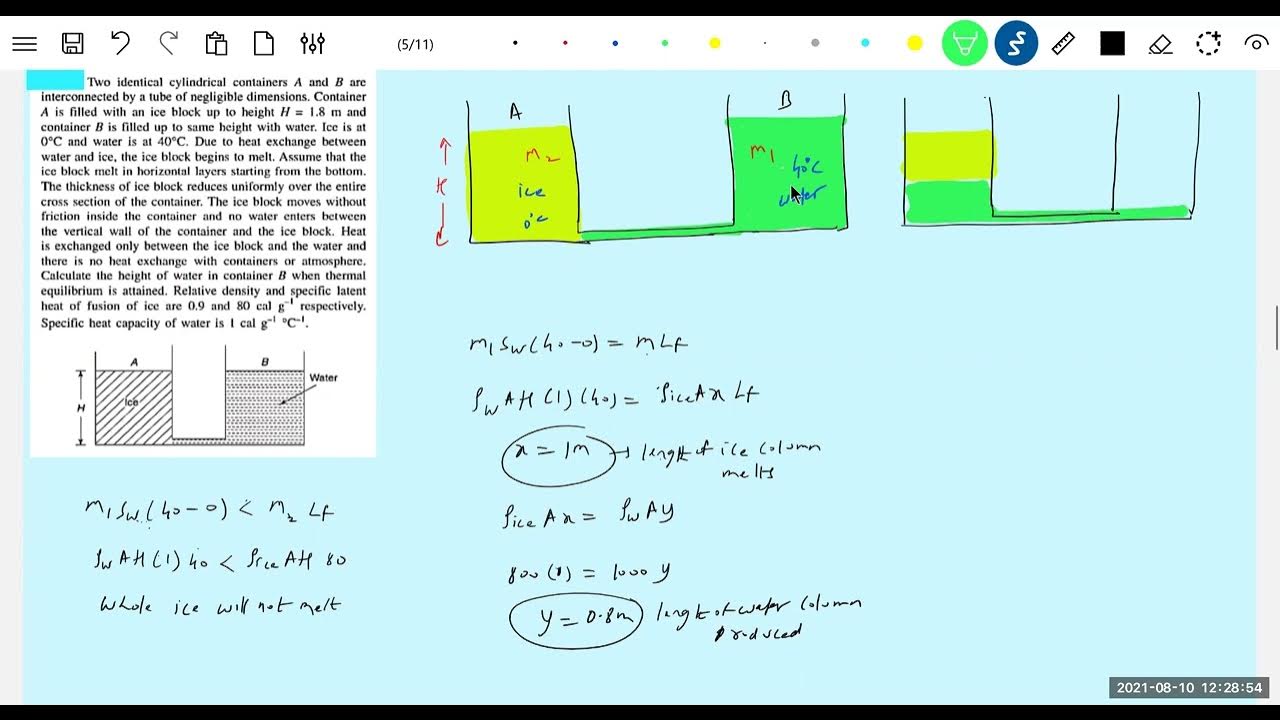
Test your understanding!
10g of ice at 0°C is mixed with 2g of steam at 100°C in an insulated container. What is the final temperature and composition of the mixture?
(Use cal/g and cal/g)
Show answer
Let's apply the Heat Budget method.
-
Heat Required to melt all ice:
. -
Heat Available from condensing all steam:
. -
Compare: Since , we know that all the ice will melt.
-
Calculate Leftover Heat: The heat remaining after melting the ice is cal.
-
Use Leftover Heat: This 280 cal will now heat the entire mixture, which consists of 10g of water (from melted ice) and 2g of water (from condensed steam), for a total of 12g of water, all currently at 0°C.
Wait, this is incorrect. The steam condensed at 100°C. Let's restart the heat balance more carefully from the point we know all ice melts.- Heat Lost = Heat released by 'm' grams of steam condensing + heat released by 2g of water cooling from 100°C to T.
- Heat Gained = Heat absorbed by 10g ice melting + heat absorbed by 10g of water warming from 0°C to T.
Let's check if there is enough heat to bring everything to 100°C.
- Heat to melt ice: 800 cal.
- Heat to raise 10g water from 0°C to 100°C: cal.
- Total heat required to bring ice to 100°C water: cal.
- Heat available from steam just condensing: 1080 cal.
Since the heat required (1800 cal) is more than the heat available from condensation (1080 cal), the final temperature will not reach 100°C. All the steam will condense, but the final temperature
Twill be between 0°C and 100°C.Now we set up the final balance equation:
Heat Lost by Steam Side = Heat Gained by Ice SideThe final mixture is 12g of water at 40°C. Notice how the heat budget method prevented us from making a wrong assumption and directly led to the correct setup.
3. Case Study 2: Accounting for Heat Loss
Problems often assume an "isolated system," but sometimes they introduce a rate of heat loss to the surroundings. This requires modifying the energy balance equation to include a power term.
The general form becomes:Energy Supplied = Energy Absorbed by System + Energy Lost to Surroundings
If rates are involved (e.g., a heater with power and a heat loss rate ):Net Power to System * time = Change in Thermal Energy(P_in - P_loss) \times t = mc\Delta T
This next video provides a clear, practical example.
Thermal Physics IIT JEE | Calorimetry, Heat Transfer & Thermal Expansion Problems for JEE Mains 2019
Here, the same Vedantu JEE instructor tackles a problem with a heater submerged in water that is also losing heat to the surroundings at a constant rate. This is a direct application of an energy balance that accounts for leaks.
Watch the segment from 08:58 to 18:09. Focus on how the net power supplied to the water is calculated as (Power of heater - Rate of heat loss). This net power is what causes the temperature to rise.
4. Case Study 3: Reading Between the Lines
Some problems hide their complexity not in physics but in language. A process might be described in multiple stages, and the key is to realize that the final state of one stage is the initial state for the next.
A classic JEE Advanced problem from 2019 illustrates this perfectly.
JEE Advanced Physics 2019 Paper 1 #17 (#7) Calorimetry
In this video, Michel van Biezen solves a JEE Advanced problem where a liquid is poured into a calorimeter in two distinct steps. The solution requires setting up two separate energy balance equations.
Watch the full video (around 7 minutes). Pay attention to how he separates the problem into 'Part 1' (the first 5g of liquid evaporates) and 'Part 2' (another 80g is added to reach equilibrium). At 05:54, he explicitly notes that the wording 'another 80 grams' was initially confusing. This highlights the importance of careful reading.
This problem is a masterclass in detecting hidden structure. By failing to recognize the two distinct stages, one would be unable to form the system of two equations needed to eliminate the unknown heat capacity of the calorimeter and solve for the required ratio.
5. Case Study 4: Other Hidden Assumptions
Finally, be on the lookout for other less common, but equally important, hidden assumptions.
-
Energy Conversion: Not all heat comes from a thermal source. Mechanical work or kinetic energy can be converted into thermal energy. A great example is a bullet hitting a target.
- In the EduRev resource "JEE Advanced (Subjective Type Questions)", Question 7 describes a lead bullet melting upon impact. The solution correctly equates 75% of the bullet's initial kinetic energy to the heat required to raise its temperature and then melt it:
This is a perfect example of combining mechanics with thermodynamics.
- In the EduRev resource "JEE Advanced (Subjective Type Questions)", Question 7 describes a lead bullet melting upon impact. The solution correctly equates 75% of the bullet's initial kinetic energy to the heat required to raise its temperature and then melt it:
-
Negligible vs. Non-negligible Objects: Does the container (calorimeter) have a heat capacity that must be included in the calculation? The problem will often state if it's "negligible" or "light". If not, you must assume it participates in the heat exchange, as seen in the video problem from Case Study 3.
Chemical Thermodynamics - Common Mistakes and Pitfalls
To reinforce this point, this compilation of common mistakes in thermochemistry explicitly warns against forgetting the calorimeter's heat capacity.
Quickly read the 'Thermochemistry Errors' section. Note the final point: 'Forgetting to account for calorimeter heat capacity.' This is a frequent oversight that can be easily avoided.
Conclusion and Course Wrap-Up
You have reached the end of our journey into heat and thermodynamics. Today's lesson was less about learning new formulas and more about cultivating a strategic mindset essential for success in the JEE Advanced.
Key Takeaways:
- Adopt a "What If?" Mindset: Always question the unstated assumptions in a problem before you begin solving.
- Use the "Heat Budget" Method: For phase change problems, always compare the heat required for a full phase change with the heat available. This will tell you whether the change is partial or complete and determine the final temperature.
- Account for All Energy: Your energy balance must include heat loss to the surroundings and heat generated from other energy forms (kinetic, potential, electrical) if the problem implies them.
- Deconstruct the Narrative: Break down multi-stage problems into a sequence of smaller, manageable steps.
You now possess a comprehensive understanding of calorimetry, thermal expansion, heat transfer, and thermodynamics, complemented by the advanced problem-solving strategies needed to tackle complex, integrated problems. You have the tools to analyze, deconstruct, and solve with confidence.
Thank you for your dedication throughout this course. I wish you the very best in your preparation for the JEE Advanced and all your future endeavors.