Hello! Let's continue our exploration of fundamental thermodynamic processes.
In the previous lesson, we analyzed isochoric and isobaric processes, where volume and pressure are held constant, respectively. We established the methods to calculate work, heat, and internal energy change for each, and importantly, we began our deep dive into the different sign conventions used in physics and chemistry.
Today, we move on to a slightly more complex but equally crucial process: the isothermal process. Your learning outcome for this lesson is to calculate work done and heat transfer in isothermal processes using the correct sign conventions. Mastering this is essential, as isothermal steps are key components of many thermodynamic cycles, including the famous Carnot cycle, which you'll encounter in JEE Advanced problems.
1. The Isothermal Process: Constant Temperature
An isothermal process is one that occurs at a constant temperature (, which implies ). To achieve this in practice, the process must be carried out very slowly to allow for heat exchange with a surrounding thermal reservoir, ensuring the system's temperature remains stable.
Internal Energy Change ()
This is the most important consequence of the definition. For an ideal gas, the internal energy is a function of temperature only. Therefore, the change in internal energy is given by:
Since an isothermal process has , the change in internal energy for an ideal gas is always zero.
Implication for the First Law of Thermodynamics (FLOT)
With , the First Law simplifies significantly:
- Using the physics/engineering convention ():
- Using the chemistry (IUPAC) convention ():
This reveals a profound characteristic of isothermal processes for ideal gases: any heat added to the system is entirely converted into work done by the system, and any work done on the system results in an equivalent amount of heat being expelled. The system's internal energy acts merely as a conduit for this energy transformation.
The following video introduces these core concepts.
Isothermal process Thermodynamics - Work, Heat & Internal Energy, PV Diagrams
This short segment from The Organic Chemistry Tutor clearly explains what an isothermal process is and why the change in internal energy is zero for an ideal gas.
Watch the first 1 minute and 10 seconds of the video. Focus on the direct link between constant temperature and zero change in internal energy.
2. Calculating Work Done in an Isothermal Process
Unlike an isobaric process, the pressure is not constant during an isothermal expansion or compression. As the volume changes, the pressure must adjust to keep the product constant (from the ideal gas law ). Therefore, to calculate work, we must use integration.
The general definition of work done by a gas is:
To solve this integral, we need to express pressure in terms of volume . Using the ideal gas law, . Substituting this into the work integral:
Since , , and are all constant for this process, we can pull them out of the integral:
Solving the integral , we get:
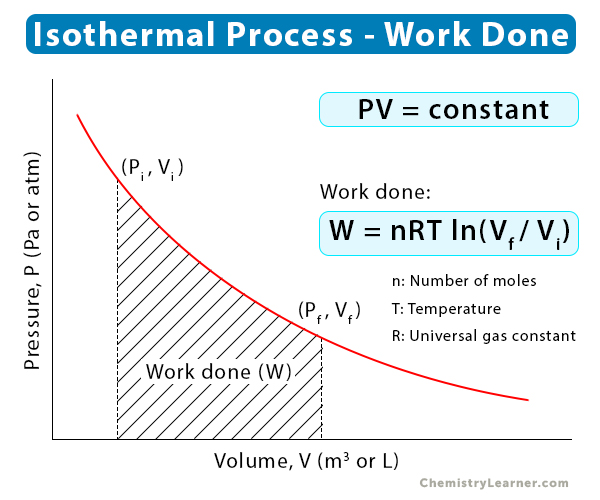
This gives us the final formula for work done in a reversible isothermal process:
Alternative Formula
Using Boyle's Law, which applies to isothermal processes (), we can find an equivalent expression in terms of pressure: . Substituting this gives:
This form is very useful when initial and final pressures are known.
The next video provides a clear walkthrough of this derivation. Given your background in mathematics, you'll find the application of calculus here straightforward.
Isothermal process Thermodynamics - Work, Heat & Internal Energy, PV Diagrams
To see the full derivation from first principles, please watch this segment. It connects the calculus directly to the P-V diagram.
Watch the segment from 06:52 to 10:43. Pay attention to how the ideal gas law is substituted into the work integral and how the final formulas (in terms of both volume and pressure) are derived.
On a P-V diagram, an isotherm is a hyperbolic curve (). The work done is the area under this curve.
3. A Deeper Look at Sign Conventions
This is the perfect opportunity to solidify your understanding of the different sign conventions, as you requested. The formulas we derived above are for the physics convention, where is "work done by the system".
Let's watch a video by Prof. H.C. Verma, who provides an excellent conceptual clarification on this topic. He explains that the physical reality is identical, and the difference in formulas arises purely from the definition of the symbol .
First Law of Thermodynamics : sign convention for WORK
This video from H.C. Verma is one of the best explanations for the sign convention dilemma. He clarifies that there's no ambiguity in the physics, only in the symbolic representation. This will be invaluable for you.
Watch from 03:41 to 18:21. The key insight is around the 13-minute mark, where he explains that the entire confusion boils down to whether your symbol 'W' stands for 'work done on the gas' or 'work done by the gas'.
Let's summarize this for the isothermal process:
| Convention | FLOT | Isothermal Work (W) | Sign for Expansion () |
|---|---|---|---|
| Physics | (Work done BY system) | ||
| Chemistry | (Work done BY system) |
Notice the magnitude is identical. The only difference is the sign, which is absorbed into the definition of the work term or .
The following PDF resource is written from the chemistry (IUPAC) perspective. It's an excellent way to see the other convention in action.
This PDF, 'THERMODYNAMICS-01', uses the IUPAC/chemistry convention. It provides a concise summary of formulas and solved JEE-level problems. Comparing its formulas to what we've derived will reinforce your understanding of how to translate between conventions.
Please read section 9.1, 'ISOTHERMAL EXPANSION OR COMPRESSION OF IDEAL GAS'. Notice how the formula for reversible work is given as w_{rev} = -nRT \ln(V_2/V_1). This minus sign is the key difference from the physics convention formula we derived.
4. Problem-Solving Examples
Let's apply these concepts to solve some problems. The following video examples use the physics convention ( for expansion).
Isothermal process Thermodynamics - Work, Heat & Internal Energy, PV Diagrams
These worked examples will walk you through the full calculation for both an isothermal expansion and compression.
Watch the two examples from 01:10 to 05:54. Isothermal Expansion (01:10 - 03:14): Notice that the work done by the gas is positive (W > 0), and because \Delta U=0, the heat transferred is also positive (Q > 0). This means heat flows into the gas. Isothermal Compression (03:14 - 05:54): Here, the work done is negative (W < 0), and so is the heat (Q < 0). This means heat flows out of the gas as it's compressed.
Now, let's analyze a JEE problem from the THERMODYNAMICS-01 PDF, which uses the chemistry convention.
Problem (JEE-MAIN-2013, from resource LINK):
A piston filled with 0.04 mol of an ideal gas expands reversibly from 50.0 mL to 375 mL at a constant temperature of 37.0°C. As it does so, it absorbs 208 J of heat. The values of q and w for the process will be?
Analysis:
- Identify the process: The problem states constant temperature, so it's isothermal. This immediately tells us .
- Identify given quantities with signs: The gas absorbs 208 J of heat. Heat added to the system is positive in both conventions. So, J.
- Apply FLOT (Chemistry Convention): .
- Solve for work:
- Interpret the result: The answer is J and J. The negative sign for in the chemistry convention signifies that work was done by the system on the surroundings, which makes perfect sense for an expansion.
This example is a perfect demonstration of how to navigate a problem statement and apply the correct convention consistently.
Test your understanding!
2 moles of an ideal monoatomic gas are compressed isothermally and reversibly at 300 K from a pressure of 1 atm to 10 atm. Using the physics convention (), calculate:
a) The work done during the process.
b) The heat transferred.
c) The change in internal energy.
(Use J/mol·K and )
Show answer
a) Work Done (W):
This is a compression, so we expect the work done by the gas to be negative. We use the pressure formula:
Since :
The work done is approximately -11.5 kJ. The negative sign correctly indicates that work is done on the gas.
b) Heat Transferred (Q):
For an ideal gas in an isothermal process, .
The negative sign means heat is transferred out of the system to the surroundings to keep the temperature constant during compression.
c) Change in Internal Energy ():
For any isothermal process involving an ideal gas, the temperature is constant (), so the change in internal energy is zero.
Conclusion
This lesson has equipped you with the tools to analyze isothermal processes, with a special focus on the nuances of sign conventions that are critical for JEE Advanced.
Key Takeaways:
- Isothermal Process: Defined by , which means .
- Internal Energy: For an ideal gas undergoing an isothermal process, .
- First Law: Simplifies to (physics convention) or (chemistry convention). All heat exchanged is converted to work, or vice-versa.
- Work Calculation: Requires integration, leading to the formulas and .
- Sign Conventions: The sign of your final answer for work depends on whether the question (and the convention you choose) defines work as being done by or on the system. Being mindful of the wording is key.
Preview of the Next Lesson:
We will tackle the last of the four fundamental processes: the adiabatic process, where no heat is exchanged (). This leads to a different set of P-V-T relationships () and a different work calculation. We will conclude by comparing the slopes of isothermal and adiabatic curves on a P-V diagram, a classic analytical problem in thermodynamics.