Hello! Welcome back to our study of thermodynamics.
In the last lesson, we did the foundational work of deriving the three key process equations for a reversible adiabatic process: , , and . You saw how these emerge from combining the first law of thermodynamics with the ideal gas law.
Today, we'll put that theoretical groundwork into practice. Your learning outcome is to apply these P-V-T relationships to calculate work done and changes in state variables. This lesson is all about application and problem-solving, moving from the derivation to the calculation. We will:
- Derive the formula for work done () during an adiabatic process.
- Apply the P-V-T relations to find the final state of a gas after an adiabatic change.
- Combine these concepts to solve multi-step problems of the type you'll encounter in the JEE Advanced exam.
Let's begin.
1. Calculating Work Done in an Adiabatic Process
The work done by a gas during a volume change is given by the integral of pressure with respect to volume. For an adiabatic process, we can now solve this integral.
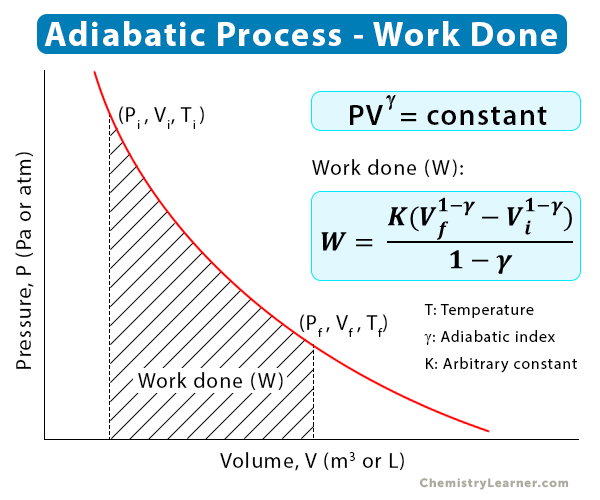
Let's derive the formula for this work. We'll use the physics sign convention, where .
-
Start with the definition of work and the process equation:
From our previous lesson, we know (a constant), so we can write . -
Substitute and integrate:
-
Re-substitute the constant K:
The constant can be expressed as or . Let's substitute these back into the expression to get a more useful form. We substitute into the first term and into the second term.
This is our primary result for work done in an adiabatic process.
Alternative Form and Connection to Internal Energy
We can express this formula in terms of temperature using the ideal gas law, .
This form reveals a crucial connection. Recall from the first law that for an adiabatic process, , so the work done is equal to the negative change in internal energy: . We also know that for an ideal gas, .
Does our formula for work match this?
This holds true if , which simplifies to . This is Mayer's relation, confirming our derivation is consistent with the first law. This consistency check is a powerful tool in solving complex problems.
The following resource provides a clear, step-by-step derivation of these work formulas.
Adiabatic process - Study Material for IIT JEE
Please read the section 'Work done in an adiabatic expansion' from the article on askiitians.com. This will reinforce the derivation we just completed.
Focus on the derivation under the heading 'Work done in an adiabatic expansion'. Follow the steps from the integral W = ∫PdV to the final forms W = (1/(1-γ))[P2V2 – P1V1] and W = (R/(1-γ))[T2 – T1].
A Note on Sign Conventions
The formulas we derived, and , are for work done by the gas (the physics/engineering convention).
- For an expansion (), the gas cools down (). The numerator is negative, and since , the denominator is also negative. Thus, is positive.
- For a compression (), the gas heats up (). The numerator is positive, and the denominator is negative. Thus, is negative.
This is consistent: work done by the gas is positive, and work done on the gas is negative.
If a problem uses the chemistry convention, remember that work done on the system is positive (). You can simply flip the sign of our result or use the equivalent formula:
2. Solving Problems with P-V-T Relations and Work
Now let's apply these tools. The typical JEE Advanced problem won't just ask for work; it will require you to first find the final state variables.
General Strategy:
- Identify the knowns (e.g., ) and the target final variable (e.g., ).
- Choose the appropriate adiabatic relation (, , or ) to find the other unknown final state variables ().
- Once the initial and final states are fully known, use one of the work formulas to calculate .
The following video walks through several examples of this process.
Adiabatic Process - Work, Heat & Internal Energy, Gamma Ratio, Thermodynamics & Physics
Watch these segments from The Organic Chemistry Tutor. He solves problems where you need to calculate work and internal energy change for adiabatic processes. Pay close attention to the step-by-step application of the formulas.
Watch the video from 02:26 to 10:40. The first part (02:26-05:15) calculates ΔU and W from a temperature change. The second part (05:15-08:21) calculates W using the P,V formula. The third part (08:21-10:40) calculates W using the gamma ratio. Notice how in each case, the problem provides enough information to define the initial and final states, which is the key first step.
3. Tackling JEE Advanced Level Problems
Let's analyze a problem that integrates concepts, which is typical for the JEE Advanced exam.
Example 1: Adiabatic Process and Kinetic Theory
Consider this problem from the askiitians resource:
RMS speed of a monoatomic gas is increased by 2 times. If the process is done adiabatically then the ratio of initial volume to final volume will be?
Analysis:
- Connect RMS speed to Temperature: From the kinetic theory of gases, we know , which means . If increases by a factor of 2, the temperature must increase by a factor of . So, .
- Identify the Gas Type and : The gas is monoatomic. For a monoatomic gas, there are 3 translational degrees of freedom, so and . Therefore, .
- Select the Adiabatic Relation: The problem connects Temperature and Volume. The correct relation is , or .
- Solve for the Volume Ratio:
Substitute the known values:
To solve for , raise both sides to the power of :
The ratio of initial to final volume is 8. This implies an adiabatic compression.
You can review the concise solution to this problem in the resource you read earlier.
Adiabatic process - Study Material for IIT JEE
Revisit the askiitians.com article and scroll down to the 'Problem (JEE Advanced)' section to see this solution laid out.
Read the solved JEE Advanced problem and its solution. Notice how it combines knowledge from two different topics (Kinetic Theory and Thermodynamics) to arrive at the answer.
Example 2: Adiabatic Stage in a Thermodynamic Cycle
Advanced problems often feature cycles with multiple stages. Let's look at how to handle the adiabatic part of such a problem using a high-quality example from IIT Kanpur's SATHEE platform.
Problem Context: An ideal diatomic gas undergoes a three-stage process. Stage 2 is an adiabatic expansion from state B () to a final volume . We need to find the final state and the work done in this stage.
Analysis:
- Identify Gas Type and : The gas is diatomic (with rotational modes). , , so .
- Find Final Temperature : We have initial state (B) and final volume (C). Use the T-V relation.
- Find Final Pressure : We can use the ideal gas law now that we have and . Assuming 1 mole of gas:
- Calculate Work Done : We have initial and final temperatures, so that formula is efficient.
The source problem calculates , which is algebraically equivalent to our formula but less prone to sign errors. Let's use it:
The work is positive, which makes sense for an expansion.
This example demonstrates the standard procedure for analyzing an adiabatic leg within a larger problem, a common task in cycle analysis.
Advanced Thermodynamics Problem - SATHEE - IIT Kanpur
Take a look at the 'Advanced Thermodynamics Problem' from SATHEE. It's a complex, multi-stage problem perfect for your level. We are only focusing on the adiabatic part for now.
First, read the problem setup in section 0 to understand the context. Then, focus on the calculations under 'Stage 2: Adiabatic Expansion (B → C)' in section 1. Finally, look at the 'Essential Formulas' list in section 3 to see the tools used. Note the resource uses W = nR(T_initial - T_final)/(γ-1), which is a safe way to write the work formula for expansion.
Test your understanding!
One mole of an ideal diatomic gas () at an initial temperature of 300 K is compressed adiabatically to one-fourth of its original volume.
- What is the final temperature of the gas?
- What is the work done on the gas during this process? (Use R = 8.314 J/mol·K)
Show answer
-
Find the final temperature:
We are given and . We use the T-V relation: .
To calculate , we can use logs or note . A more direct calculation gives .
The temperature increases, as expected for adiabatic compression. -
Calculate the work done:
We will calculate the work done by the gas () first, using the physics convention formula:
The work done by the gas is negative. The question asks for the work done on the gas, which is the positive equivalent of this value.
Work done on the gas = .
Conclusion
In this lesson, you've moved from the abstract derivation of adiabatic laws to their concrete application in solving problems. This is the exact skill needed to excel in JEE Advanced thermodynamics questions.
Key Takeaways:
- The work done in an adiabatic process can be calculated using or .
- These formulas are fully consistent with the first law of thermodynamics, .
- Solving adiabatic problems is a two-step process: first, use the P-V-T state relations to find all unknown state variables; second, use the work formula to calculate the work done.
- Advanced problems often link adiabatic processes with concepts from other topics like kinetic theory, or embed them within larger thermodynamic cycles.
Preview of the Next Lesson:
We have now studied two key reversible processes: isothermal and adiabatic. A classic conceptual question for JEE Advanced is to compare their behavior. In the next lesson, we will focus on comparing the slopes of isothermal and adiabatic curves on a P-V diagram. This will deepen your graphical understanding of these processes and sharpen your analytical skills.