Hello! In our last lesson, we introduced the universal quantifier (∀, "for all") and the existential quantifier (∃, "there exists"). Now, we'll focus on how to use them correctly to translate English sentences into the precise language of predicate logic.
This is a skill much like programming. Simply knowing the keywords isn't enough; you need to understand the syntax and common idioms to build something that works correctly. Today, you'll learn the essential "recipes" for combining quantifiers with the logical connectives we've already covered (like AND, OR, and IMPLIES). We'll focus on identifying the main structure of a statement and breaking it down into logical parts, a process that should feel familiar from your software development experience.
The Golden Rules of Quantifier Combination
A frequent point of confusion when translating is knowing which connective—implication (→) or conjunction (∧)—to pair with which quantifier. Getting this right is fundamental. An incorrect pairing doesn't just sound awkward; it produces a statement with a completely different, and usually wrong, meaning.
- Universal Quantifier (∀) typically pairs with Implication (→).
- Existential Quantifier (∃) typically pairs with Conjunction (∧).
To see why this is the case, the following video provides an excellent, intuitive explanation. As you watch, focus on how using the wrong connective leads to a statement that claims far more than the original English sentence intended.
Translating ENGLISH into PREDICATE LOGIC
This video from TrevTutor clearly explains the critical pairing of quantifiers with connectives.
First, watch the segment explaining why the universal quantifier goes with implication, using the example "Every dog is happy" (universal quantifier). Then, watch the next segment which explains why the existential quantifier goes with conjunction, using "Some dog is happy" (existential quantifier).
The Four Fundamental Patterns
The video gave you the intuition behind the two most common translation patterns. These, along with their negations, form the four "Aristotelian Forms," which are the basic building blocks for more complex sentences. Think of them as the "for loop" or "if-else" patterns of logic—idiomatic structures you should eventually recognize on sight.
| English Statement | The Pattern | Logical Translation |
|---|---|---|
| "All P are Q" | Universal Affirmative | |
| "Some P are Q" | Existential Affirmative | |
| "No P are Q" | Universal Negative | |
| "Some P are not Q" | Existential Negative |
Memorizing these four patterns will make the process of translation much more systematic.
A Methodical Approach to Translation
Let's put these patterns to use. The key is not to write the entire formula at once, but to work from the outside in, progressively refining the translation.
Consider the statement: "Every orange cat is fluffy."
- Identify the main logical structure. The word "Every" signals a universal statement. It fits the "All P are Q" pattern.
- Define P and Q.
- P is the property of being an "orange cat".
- Q is the property of being "fluffy".
- Write the template. Based on our pattern, the structure is: .
- Translate the simpler parts. "x is fluffy" is simply .
- Translate the complex parts. "x is an orange cat" means that x has two properties: it is orange AND it is a cat. So, this translates to .
- Substitute everything back into the template.
This step-by-step process of parsing, templating, and substituting avoids common errors. The following guide from a Stanford CS course walks through this exact methodology.
Guide to First-Order Logic Translations
This guide formalizes the translation process, presenting it as a skill akin to programming. It establishes the core patterns and demonstrates how to apply them.
First, read the section that introduces the four Aristotelian Forms. This reinforces the table above. Then, follow the detailed, step-by-step translation of the "orange cat" example. Notice how it breaks the problem down methodically.
Handling Nested Quantifiers
Many English sentences involve multiple quantifiers, often of different types. The order in which they appear is critical.
Consider the sentence: "There is a fox that is faster than all snails."
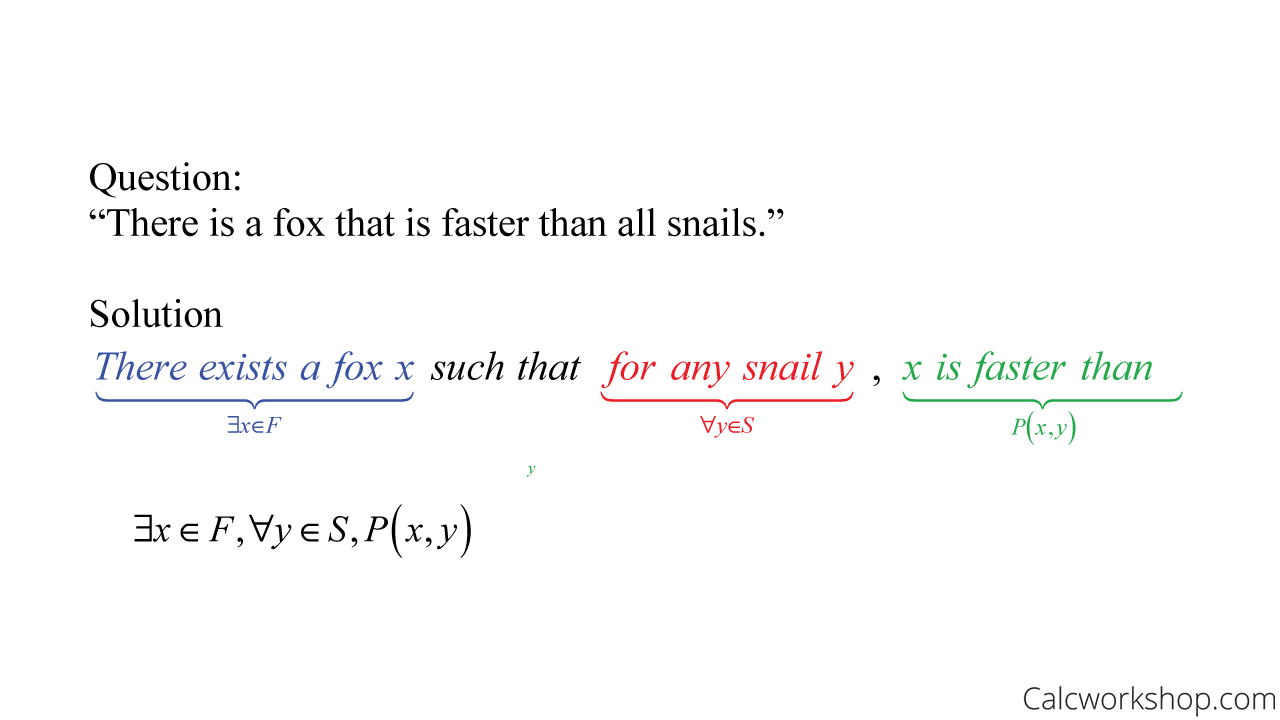
Let's deconstruct this:
- The phrase "There is a fox..." tells us the primary quantifier is existential: . Let be "x is a fox".
- This is followed by "...that for any snail y...". This introduces a nested universal quantifier that applies to the snail: . Let be "y is a snail".
- The relationship between them is "x is faster than y", which we can write as .
Combining these according to the sentence structure, we get:
Or, using the implication and conjunction patterns:
Notice how the main structure is ∃x(P(x) ∧ Q(x)), where P(x) is F(x) and Q(x) is the entire complex predicate ∀y(S(y) → P(x,y)). The "corgi" example in the Stanford guide provides another excellent walkthrough of this process.
Guide to First-Order Logic Translations
This section of the guide demonstrates how to tackle a more complex sentence with nested quantifiers.
Read the example that translates the sentence "There's a corgi that loves everyone." Pay close attention to how the outer existential statement ("There's a corgi...") is identified first, and then the inner universal statement ("...loves everyone") is translated within that structure.
Conclusion
In this lesson, we moved from knowing what quantifiers are to knowing how to use them. You've learned the critical "recipes" for translating the most common quantified statements and a methodical process for dissecting and translating more complex sentences.
Key Takeaways:
- Translations follow common patterns or "recipes".
- The universal quantifier (∀, "all") is typically paired with implication (→). The statement
∀x(P(x) → Q(x))restricts the claimQto only the things that areP. - The existential quantifier (∃, "some") is typically paired with conjunction (∧). The statement
∃x(P(x) ∧ Q(x))asserts the existence of something that is bothPandQ. - A methodical, step-by-step translation process—identifying the main structure, breaking down predicates, and substituting—is more reliable than trying to write the entire formula at once.
- The order of quantifiers in nested statements is crucial and changes the meaning of the statement.
Now that you can translate English sentences into predicate logic, the next logical step is to determine their truth value. In our next lesson, we will be given a small, defined "universe of discourse" and several quantified statements. Your task will be to analyze these statements within that universe to determine if they are true or false, much like running unit tests on your logical expressions.