Welcome to the third lesson in our module on Logic and Proof Fundamentals. In the previous lesson, we established a systematic method for evaluating complex logical expressions by constructing truth tables for the five basic connectives. You learned how to methodically build a table, column by column, to determine the truth value of a statement under all possible conditions.
Today, we will leverage that skill to explore one of the most powerful ideas in logic: logical equivalence. We will learn how to use truth tables to prove that two statements, which may look entirely different, are in fact identical in their logical meaning. This concept is not just an abstract rule; it's the foundation for simplifying complex code, optimizing database queries, and designing efficient digital circuits. We will also examine two special types of propositions: tautologies, which are always true, and contradictions, which are always false.
By the end of this lesson, you will be able to use truth tables to rigorously test whether any two compound propositions are logically equivalent.
From Evaluation to Verification
In the last lesson, we focused on building a truth table for a single compound proposition to see when it was true or false. This is the "evaluation" part of today's learning outcome. Let's start with a quick refresher on that process, which involves breaking a complex statement into its smallest parts and evaluating them step-by-step.
Discrete Math - 1.1.3 Constructing a Truth Table for Compound Propositions
This video from Kimberly Brehm, "Constructing a Truth Table for Compound Propositions," offers a clear, structured walkthrough of the process we're refining today.
Please watch the following segments to review the core mechanics: Setup and Structure: This explains how to determine the number of rows (2^n) and the necessary columns for your table. Order of Operations: A crucial point, similar to arithmetic, logic has a precedence of operators (negation first, then conjunction/disjunction, then implication). Parentheses always take priority. Worked Example: Follow along as a complete truth table is built for the expression (P \lor Q) \to \neg R. Pay attention to how each column is derived from previous ones.
The key is methodical construction. You create columns for each atomic proposition, then for each sub-expression inside parentheses, gradually building outwards until you have a column for the entire statement.
Consider the following completed truth table for the proposition .

Notice the structure:
- The first three columns () list all possible combinations of truth values.
- Intermediate columns are built for sub-expressions: , then , then , then .
- The final column evaluates the main connective (the final ) using the results of the intermediate columns.
As you can see, the final column contains only 'T' values. This tells us something special about this proposition, which we'll return to shortly.
The Concept of Logical Equivalence
Now we arrive at the central theme of this lesson. What if we construct truth tables for two different propositions and find that their final columns are identical? This would mean that under all possible conditions, the two propositions have the exact same truth value. In logic, this means they are effectively the same statement.
This is the definition of logical equivalence.
Truth Tables, Tautologies, and Logical Equivalences
This section from the Millersville University page you saw previously provides the formal definition of logical equivalence.
Please read the paragraph that begins with the definition. Then, review the worked example showing that P \to Q is logically equivalent to \neg P \lor Q. Notice how the columns for these two different statements are identical.
The symbol for logical equivalence is . So, from the reading, we can state that .
This is an incredibly useful tool. It means we can substitute one expression for another in a logical argument or a line of code, perhaps to make it simpler or more efficient, with full confidence that we haven't changed its underlying meaning.
Proving Equivalence with Truth Tables
Using truth tables to prove equivalence is a direct and mechanical process. You build one large table that includes columns for both final propositions and then compare those two columns.
PROOFS with TRUTH TABLES - DISCRETE MATHEMATICS
The video "PROOFS with TRUTH TABLES" by TrevTutor frames this process as a form of mathematical proof, which is a great way to think about it.
Watch these key segments: What is Logical Equivalence?: This provides a concise definition, reinforcing the concept. Proving Non-Equivalence: Watch how the truth tables for P \land Q and \neg(P \lor Q) are constructed. Since their final columns are not identical, they are not logically equivalent. Proving Equivalence: This is a critical example. It proves that \neg(P \land Q) \equiv (\neg P \lor \neg Q). This is one of De Morgan's Laws, a topic we'll explore in the next lesson. Notice that the final columns for both expressions are identical (F, T, T, T), which serves as the proof.
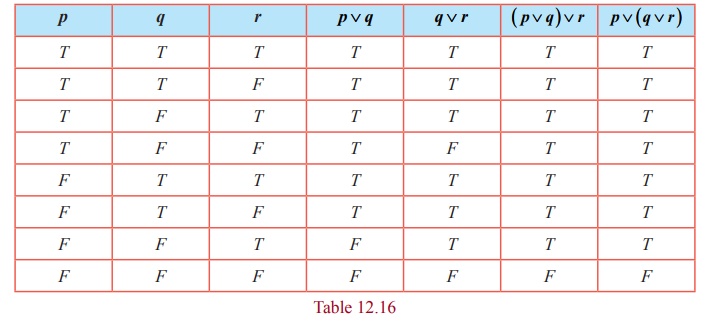
As a static example, consider the associative property of disjunction, which states that the order of 'OR' operations doesn't matter: . The truth table below proves this equivalence.
Tautologies and Contradictions
Let's return to the first truth table we saw, for the proposition . We noted its final column contained only 'T' values.
- A proposition that is true for every possible assignment of truth values is called a tautology. It represents a fundamental rule of logic. The statement ("P is true or P is not true") is the most famous example.
- The opposite is a contradiction, a proposition that is false in every case, like . Finding a contradiction in an argument proves the argument is flawed.
Truth Tables, Tautologies, and Logical Equivalences
Let's refer back to the Millersville University resource for formal definitions.
Read the two short paragraphs that define tautology and contradiction. Then look at the example truth table showing that (P \land (P \to Q)) \to Q is a tautology.
In your work as a developer, you can think of a tautology as an expression that always evaluates to true, like x > 10 || x <= 10. A contradiction always evaluates to false, like is_user_active && !is_user_active. While simple here, these principles allow automated tools to identify redundant or impossible conditions in complex code.
Conclusion
In this lesson, we've transformed the truth table from a simple evaluation tool into a powerful instrument for logical analysis. You now have a definitive method to check if two logical expressions are interchangeable, a concept with deep implications in both mathematics and computer science.
Key Takeaways:
- Logical Equivalence (): Two propositions are logically equivalent if their truth tables have identical final columns. This means they have the same truth value under all circumstances.
- Proof by Truth Table: We can prove or disprove logical equivalence by constructing a single truth table for both propositions and comparing their results.
- Tautology: A compound proposition that is always true, regardless of the truth values of its atomic components. Its truth table column is all 'T's.
- Contradiction: A compound proposition that is always false. Its truth table column is all 'F's.
You've now proven one of De Morgan's laws using a truth table. In our next lesson, we will focus on applying logical equivalences, including De Morgan's laws, to simplify complex logical expressions directly, without having to build a truth table every time. This moves us towards a more algebraic and often faster way of manipulating logic.