Welcome back. In our previous module, we concluded by designing a detailed homecoming sequence for the couple, a critical process for recalibrating the relationship system after the planned disruption of the tour. This plan, like the ones we've developed for the tour and the photoshoot, is composed of numerous decision variables: timing, attire, communication, specific actions, and environmental details.
The question an efficiency expert must ask is: which of these variables truly matter? In any complex system, not all inputs are created equal. Some are minor details, while others are powerful levers that can dramatically alter the final outcome. This lesson introduces the formal thinking tool for finding them.
Your learning outcome is to define sensitivity analysis in a practical, non-mathematical context as a tool for identifying high-leverage decision variables. We will treat your detailed plans for the tour and photoshoot as models, and explore how to test their assumptions to discover where your focus will yield the greatest return.
What is Sensitivity Analysis?
At its core, sensitivity analysis is a structured "what-if" game. It's a method for systematically testing how much your final outcome changes when you tweak one of your initial assumptions or decision variables. Given your background in simulations and modeling, you can think of it as changing a single input parameter in a model and observing the magnitude of the change in the output, but applied here to strategic and emotional systems rather than stochastic processes.
The goal is to move beyond a single, static plan and understand the dynamics of the system you've designed. Instead of just having one "optimal" plan, you develop a feel for which parts of the plan are fragile and which are robust.
Sensitivity Analysis Framework - Meaning, Steps, and Uses
This article from CaseBasix provides a clear, non-technical definition of sensitivity analysis and its purpose in strategic decision-making.
Read the introduction to understand the framework's role in evaluating how results change when assumptions vary. Pay close attention to the core concept, which boils it down to a simple process: change one assumption and observe the result. Also, review the section Why the framework matters, as it explains the shift from relying on a single forecast to understanding a range of possible outcomes.
The key insight is that by isolating variables one at a time, you can measure their individual impact. A variable that causes a large swing in the outcome is considered "sensitive" or, in our practical terms, a high-leverage decision variable. A variable that causes little to no change is a low-leverage point, meaning you don't need to spend as much energy optimizing it.
The 'Pareto Principle' of Planning: Focusing on What Matters
This process is invaluable because it helps you apply the Pareto principle (the 80/20 rule) to your strategic planning. In most systems, a small number of inputs drive the vast majority of the results. Your goal as an efficiency expert is to identify and master that vital few. Wasting time and resources fine-tuning a low-leverage variable is inefficient, whereas a small, smart adjustment to a high-leverage variable can transform the outcome.
This article from the Project Management Institute frames sensitivity analysis in a project context, which aligns perfectly with our goal of "engineering" future events.
Read the section titled SENSITIVITY ANALYSIS. The author explicitly states that the purpose is to "identify key variables warranting special attention." Note the crucial empirical observation: "Typically, two to five input variables are the cause of 95 percent of the uncertainty in a problem analysis." This is the quantitative justification for our focus.
By identifying these 2-5 critical variables, you can allocate your attention effectively. For the tour, is it the frequency of intimate encounters or the brand of champagne you choose? For the photoshoot, is it the exact shade of the saree or the model's confidence in her final pose? Sensitivity analysis provides the framework to answer these questions systematically.
The Practical Process
So, how do you conduct a sensitivity analysis without complex equations? You follow a simple, structured process of inquiry.
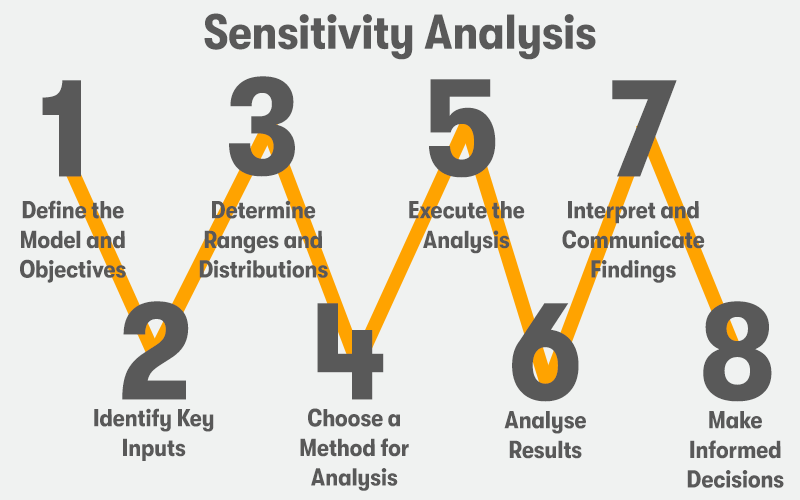
Let's walk through the steps from the diagram above, applying them conceptually to our scenarios:
-
Define the Model and Objectives: Our "models" are our detailed plans for the tour and the photoshoot. Our objectives are the success criteria we defined earlier (e.g., for the tour: maximizing satisfaction, discretion, and trust; for the photoshoot: maximizing visual impact, product showcase, and narrative surprise).
-
Identify Key Inputs (Variables): This is a brainstorming step. We list the decision variables we can control.
- Tour: Duration, frequency of wife-bull encounters, specific reunion ritual, budget for activities, rules for communication with the husband.
- Photoshoot: Modesty level of the "before" outfit, number of shots in the sequence, choice of "tipping point" image, background set design, model's facial expressions.
-
Determine Ranges and Distributions: For each key variable, we define a plausible range of values.
- Encounter Frequency: Low (once), Medium (3 times), High (5 times).
- 'Before' Outfit Modesty: Very Conservative (high-neck blouse, opaque saree), Baseline (current plan), More Revealing (lower-cut blouse, sheerer saree).
-
Choose a Method: Our method is qualitative "what-if" analysis. We don't need software; we use our causal understanding from the previous courses.
-
Execute the Analysis: We mentally run the scenarios. "Holding all else constant, what happens to our objectives if we change the encounter frequency from 3 to 1?" We would hypothesize a decrease in the wife's satisfaction but perhaps an increase in anticipation and less risk of emotional fatigue. "What if the 'before' saree is already somewhat revealing?" We would hypothesize that this weakens the 'persona subversion' mechanism and reduces the final impact of the reveal.
-
Analyse Results: We compare the outcomes. The variable that created the most significant change (positive or negative) in our success metrics is the highest-leverage one. For instance, we might find that the choice of reunion ritual has a far greater impact on reinforcing trust than the budget for dates.
-
Interpret and Communicate: We articulate our findings. "The single most sensitive variable in the photoshoot plan is the degree of contrast between the starting and ending look. This is our primary leverage point."
-
Make Informed Decisions: We use this knowledge to focus our planning. We double down on getting the high-leverage points right and allow more flexibility on the low-leverage ones.
Finding the Leverage Points
The output of this thinking process is the identification of "leverage points"—places in a system where a small change can lead to a large shift in behavior.

In this diagram, a 'Bottleneck' might be a hard constraint (like the tour duration). An 'Intervention Point' might be a low-leverage variable (like the choice of restaurant for a date). A 'Leverage Point' is a high-leverage variable where a small, targeted action produces a disproportionately large effect on the outcome. Our entire goal with sensitivity analysis is to find these leverage points in our plans.
For the tour, the friendship between the husband and bull is a foundational leverage point. For the photoshoot, the model's ability to project a radical shift in persona is another. Sensitivity analysis allows us to discover the more subtle, operational leverage points within the execution of the plan itself.
Conclusion
You now have a conceptual framework for sensitivity analysis as a practical tool for strategic planning. It is not about mathematics; it is about a disciplined way of thinking to identify where your efforts will have the most impact. By systematically asking "what if...?", you can distinguish between the trivial many and the vital few decision variables that will determine the success of your engineered events.
Key Takeaways:
- Sensitivity analysis is a structured "what-if" process to test how changes in input variables affect the final outcome.
- Its primary goal is to identify high-leverage decision variables: the inputs that cause the most significant swings in your results.
- This approach allows you to apply the Pareto principle to planning, focusing your energy on the few variables that drive the majority of the outcome.
- The process involves defining your plan, identifying controllable variables, mentally testing the impact of changing each one individually, and interpreting which ones matter most.
In our next lesson, we will put this theory directly into practice. You will select the top candidate variables from both the tour and photoshoot plans and perform this "what-if" analysis, articulating the specific consequences of varying them to pinpoint the true leverage points for optimization.