Welcome back. In our previous module, we established the foundational parameters for our two scenarios. For the husband's tour, we identified the decision variables, defined success, and mapped the constraints. For the photoshoot, we completed a similar process, focusing on the external constraints imposed by the brand, budget, and culture. We now have a well-defined "solution space" for both projects.
With these boundaries in place, we can now shift from defining the problem to designing the solution. This module is dedicated to strategic sequencing—architecting the flow of experience over time to maximize our desired outcomes. Your expertise in analyzing dynamic systems and processes will be invaluable here as we move from static parameters to a dynamic design.
This lesson focuses on the tour scenario. Our goal is to engineer the emotional journey of the wife and bull from the moment the husband leaves to the moment he returns. We will design the overall emotional arc of the tour across four distinct phases—anticipation, immersion, culmination, and wind-down—and specify the target experiential state for each phase.
1. The Architecture of Experience: Emotional Arcs
An experience is more than a simple sum of its parts. The sequence of events and the emotional transitions between them are what create a memorable and impactful journey. Just as a project manager sequences tasks to optimize a workflow, an experience designer sequences emotional states to optimize a journey.
Consider the "Customer Journey Emotional Curve" used in marketing.
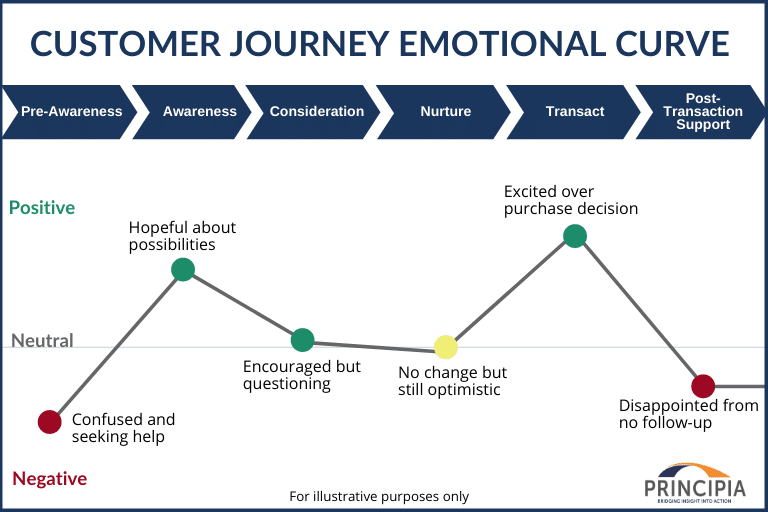
This concept of a designed trajectory is our starting point. We aren't just scheduling activities; we are engineering an emotional arc. To do this effectively, we need a guiding principle.
The Peak-End Rule
A fundamental principle in behavioral science that will guide our design is the Peak-End Rule. It states that people's retrospective evaluation of an experience is not based on an average of every moment, but disproportionately on two key points: the most emotionally intense moment (the peak) and the final moment (the end).
The following short video from the Nielsen Norman Group provides a concise explanation of this crucial concept.
Peak–End Rule: Use to Your Advantage
This video, "Peak–End Rule: Use to Your Advantage," explains the core psychological principle that will anchor our design for the tour.
Watch the segment from the beginning to understand the rule. Then, focus on the definitions of the peak and the end. Finally, note the key takeaway about ending on a positive peak.
The implication for our tour design is clear: to optimize the overall memory and success of the experience, we must disproportionately focus our efforts on engineering a powerful peak (culmination) and a satisfying and positive end (wind-down).
2. The Four Phases of the Tour's Emotional Arc
To structure our design, we will partition the tour into four distinct phases. This framework is grounded in research on how different types of positive emotions are generated. A key academic paper on engineering consumer emotions provides us with a robust model, distinguishing between different forms of excitement and relaxation.
On the Experience and Engineering of Consumer Pride, ...
This paper from the Marketing Science Institute offers a systematic deconstruction of positive emotions. We will use its framework to structure our emotional arc.
Read the section titled "Excitement," starting from this paragraph, which introduces the three distinct forms of excitement: anticipatory, immersive, and outcome. This provides the theoretical basis for the first three phases of our tour design.
Based on this, we will structure the tour's emotional arc around these four phases, each with a specific target emotional state:
- Anticipation: The period leading up to and including the bull's arrival.
- Immersion: The core period of the tour where the wife and bull are together.
- Culmination: The planned "peak" of the experience.
- Wind-down: The period following the peak, leading to the bull's departure and the husband's return.
Now, let's define the specific target state for each phase, drawing on the drivers of emotion identified in the research.
3. Designing the Target State for Each Phase
For each phase, we will define the goal and identify the key levers we can use to achieve it. This process translates your causal findings from the previous course into an actionable engineering plan.
Phase 1: Anticipation
- Target Emotion: Anticipatory Excitement. This is defined as an intense eagerness and impatience for an upcoming pleasurable experience.
- Goal: To build positive tension and desire, leveraging the "dangling cause" of the husband's departure and the pending arrival of the bull. The goal is not just to wait, but to actively cultivate a state of hopeful expectation.
The following video discusses the screenwriting technique of the "dangling cause," which is directly applicable here.
How To Keep The Audience In Anticipation - Paul Joseph Gulino
This video from Film Courage on anticipation tools in screenwriting will help us frame the beginning of the tour.
Watch the first minute to understand the concept of the dangling cause. The husband's departure and the setup of the encounter is a powerful dangling cause. Then, watch the examples from boy likes girl, which illustrate how stating an intention creates anticipation.
To engineer this state, we need to activate its primary drivers.
On the Experience and Engineering of Consumer Pride, ...
This reading will give us the specific levers for building anticipatory excitement.
First, read the section Anticipatory Excitement to understand its drivers, such as tension build-up, positive expectations, novelty, and shared experience. Then, read the section Engineering Anticipatory Excitement to see how these drivers can be manipulated. Focus on tactics like making expectations concrete, building psychological tension, and leveraging "specialness."
Target State for Anticipation:
The target is a state of high eagerness and positive tension. Key experiential dimensions should be:
- Narrative: Strong focus on the story being created—the trust, the permission, the shared secret. Communications from the husband should reinforce this frame.
- Emotion: A building sense of excitement and eagerness, not anxiety.
- Novelty (Uniqueness): Emphasize the "specialness" of the occasion. This isn't a routine event; it's a planned, sanctioned experience.
- Intensity: Low but steadily increasing. The goal is to build tension, not release it.
Phase 2: Immersion
- Target Emotion: Immersive Excitement. This arises from an ongoing, highly enjoyable, and absorbing experience.
- Goal: To create a "bubble" of thrilling and enjoyable shared experience for the wife and bull, where outside-world concerns fade away.
On the Experience and Engineering of Consumer Pride, ...
Now, let's explore the drivers of in-the-moment excitement.
Read the section Immersive Excitement to understand its core components, such as high energy, novelty, a degree of uncertainty (indeterminacy), and a sense of communion. Then, read the section on Engineering Immersive Excitement, paying attention to strategies like focusing attention, leveraging unpredictability, and fostering a "consummatory mindset."
Target State for Immersion:
The target is a state of deep engagement and shared pleasure. The experiential profile should shift to:
- Exploration: High. This is the time for exploring new activities, locations, and facets of their dynamic.
- Intensity: High and sustained. The experience should be stimulating and consistently engaging.
- Novelty (Uniqueness): High. Introduce varied activities and surprises to prevent habituation and maintain arousal. The "indeterminacy" or unpredictability is a key lever here.
- Narrative: Lower than in the anticipation phase. The focus shifts from the idea of the story to the living of the experience.
Phase 3: Culmination
- Target Emotion: Outcome Excitement. This is the intense happiness and satisfaction derived from the materialization of a deeply desired outcome. This is our "peak."
- Goal: To engineer the most intense and satisfying moment of the tour, directly fulfilling the wife's "unmet needs"—the core causal driver identified in your previous analysis.
On the Experience and Engineering of Consumer Pride, ...
This is the peak of our emotional arc. Let's look at how to engineer it.
Read the section Outcome Excitement to see how it's linked to fulfilling a preexisting, unfulfilled desire. Then, study the section on Engineering Outcome Excitement. Focus on the tactics of orchestrating surprise, leveraging expectation violation, and increasing the perceived "perfect fit" between the outcome and the desire.
Target State for Culmination:
This is the designed peak of the entire experience.
- Emotion: Maximum. This should be the most emotionally intense point of the arc.
- Intensity: Maximum. This is the moment of highest erotic charge and fulfillment.
- Narrative: High. The event should feel like the climax of the story that was set up in the anticipation phase—the resolution of the "dangling cause."
- Novelty/Exploration: Potentially lower. The focus is on the intensity of a singular, fulfilling experience rather than broad exploration.
Phase 4: Wind-down
- Target Emotion: Relaxation and Contentment. This is a state of calm, safety, and peacefulness. According to the Peak-End rule, ending on a positive note is critical for the overall memory of the experience.
- Goal: To safely transition from a state of high arousal to one of positive, low-arousal contentment, reinforcing the trust between all three parties and solidifying the positive memory of the tour.
On the Experience and Engineering of Consumer Pride, ...
The end of the journey is as important as the peak. Let's examine how to engineer a positive, relaxing conclusion.
First, read the introduction to Relaxation and the breakdown of its three pillars: safety, peacefulness, and physical comfort. Then, review the process of relaxing, including stages like disengagement and appreciation. Finally, scan the practical strategies under Additional Means, noting the importance of a sense of safety, trust, and appreciation.
Target State for Wind-down:
The goal is a gentle descent into a state of positive calm and security.
- Emotion: A feeling of contentment and calm, not sadness or anxiety about the end.
- Intensity: Low. This is a deliberate de-escalation.
- Narrative: High. The focus returns to the story, but now it's about reinforcing what it means: the strength of the marriage, the trust in the friend, and the positive fulfillment of the wife's needs. This is the debrief and integration phase.
- Safety/Trust: This becomes the primary experiential dimension. All actions should be geared towards reinforcing psychological safety and reaffirming the bonds of trust between all three parties.
4. Synthesizing the Arc: A Design Framework
To bring this together in a format that aligns with your quantitative background, we can adapt a framework used in game design to analyze mission pacing. This will allow us to visualize the emotional arc as a series of shifts in experiential focus.
A Thematic Analysis Using an Action-Block Framework
This paper offers a powerful framework for quantifying and visualizing experiential flow. We will adapt its core concepts for our design.
First, review the definitions of the six MAQV dimensions in Table 1. We will adapt these to our context. Next, read the sections describing Foundational Pillars and Dimensional Balance. This discusses the importance of a balanced baseline with a highlighted peak. Finally, review the concepts of Peak-Valley Grammar and the design heuristic of a balanced baseline.
By adapting these dimensions, we can create a target profile for each phase of the tour. This gives us a concrete, structured specification for our design.
| Phase | Primary Emotion | Uniqueness (Novelty) | Intensity (Erotic Charge) | Narrative (Story Focus) | Exploration (Discovery) | Emotion (Affective Load) |
|---|---|---|---|---|---|---|
| 1. Anticipation | Anticipatory Excitement | Moderate | Low (Building) | High | Low | Moderate |
| 2. Immersion | Immersive Excitement | High | High | Low | High | High |
| 3. Culmination | Outcome Excitement | Low | Peak | High | Low | Peak |
| 4. Wind-down | Relaxation | Low | Low | High | Low | Moderate (Contentment) |
This matrix is our blueprint. It operationalizes the emotional arc, moving from a high-level goal to a phase-by-phase specification. Each cell represents a target we are aiming to hit through the specific activities, environmental choices, and communication protocols we will design in subsequent lessons.
Conclusion
In this lesson, we have moved from defining constraints to designing the experience itself. We established the importance of architecting an emotional arc, guided by the Peak-End Rule. By dividing the tour into four distinct phases—Anticipation, Immersion, Culmination, and Wind-down—we were able to define a specific target emotional state for each. Finally, using a structured framework, we created a tangible blueprint that specifies the desired experiential profile for each phase. This structured approach transforms the art of experience design into a problem of applied engineering.
In our next lesson, we will pivot to the photoshoot scenario. We will apply this same logic of sequencing to design the complete narrative sequence for the photoshoot, specifying the exact state of the garments and the model's persona at each stage to maximize the impact of the transformation.