Welcome back. In our previous lesson, we engineered a robust alternative narrative—"Boardroom to Boudoir"—to adapt to a creative constraint. This demonstrated how to isolate a core causal mechanism (persona subversion) from its initial vehicle (the saree) and find a new, equally potent expression.
Today, we confront a different, and very common, type of crisis: a drastic reduction in time. Imagine the photoshoot, meticulously planned for a half-day, is suddenly cut to a single hour due to an unforeseen logistical failure. The 20-shot sequence we designed is no longer feasible. Your objective in this lesson is to design a contingency plan for this limited-time photoshoot by prioritizing a minimal set of 'must-have' shots that preserve the core narrative.
This challenge moves us from creative adaptation to operational triage. It is a classic problem of optimization under severe constraints. Our goal is to salvage the entire narrative, not just capture a few random good images. We will use a systematic prioritization framework to distill our 20-shot plan down to a "minimal viable narrative"—the absolute essentials required to make the campaign work.
From Shot List to Priority Matrix
In a time-unconstrained scenario, we can afford to build a story with nuance, including multiple shots to establish each phase. When time becomes the primary constraint, we must think like an efficiency expert. We cannot simply do everything faster; that leads to rushed, poor-quality work. Instead, we must ruthlessly decide what not to do.
This requires converting our linear shot list into a priority matrix. The foundational idea is that not all shots are created equal. Some are structurally critical to the narrative, while others add valuable texture or detail but are ultimately expendable. Professional photographers plan for this reality by creating prioritized shot lists.
How to organise a flawless shoot day for your next brand ...
This article from a professional brand photographer, Weronika Karczewska, discusses practical planning. We will focus on the section concerning shot lists, which directly addresses the need for prioritization.
Please read the section Have your moodboards & shot list ready. Pay close attention to the advice to create a "priority list that you absolutely need to get on your day." This is the core principle of our contingency plan.
How to prepare for a product photoshoot for your brand
This guide by Karen Young Photography offers another perspective on shoot preparation, emphasizing an inventory-based approach that also relies on identifying the most critical shots first.
First, review the section on creating an inventory list, specifically the sentence regarding 'money shots'. Then, scroll down to the section "Create a shot list" and read the paragraph starting with This is such a handy tip. The concepts of "money shots" and "absolute essentials" are synonymous with the 'must-have' items we are about to define.
The MoSCoW Framework for Ruthless Prioritization
To bring a systematic approach to defining these "absolute essentials," we will use a classic prioritization technique from software development and project management: the MoSCoW method. Given your background in operations research, you can view this as a heuristic for classifying tasks to maximize the value delivered within a fixed resource budget (in this case, time).
The acronym stands for:
- Must Have
- Should Have
- Could Have
- Won't Have (this time)
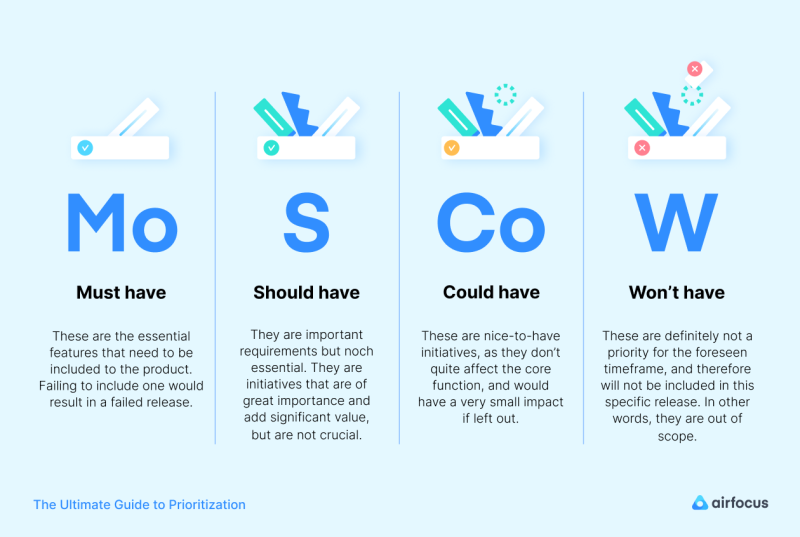
Our task is to categorize every shot from our "Boardroom to Boudoir" narrative into this framework. The 'Must Have' shots will form our contingency plan—the minimal sequence we execute if time is critically short.
Applying MoSCoW to the "Boardroom to Boudoir" Narrative
Let's revisit the five phases of our narrative and assign a priority to the shots within each.
1. Must Have: The Minimal Viable Narrative
This is our emergency protocol. This sequence of just five shots contains the entire causal logic of the transformation. Each shot serves as a critical piece of evidence in our narrative arc.
-
Shot M1 (from Phase 1): The 'Establish Persona' Shot.
- Description: The definitive "Boardroom" look. Full suit, buttoned up, severe hair, power pose (e.g., arms crossed), direct and unsmiling gaze.
- Narrative Function: This is a hoop test for our story. Without clearly establishing the 'before' state of a closed-off professional, the 'after' state has no contrast and thus, no impact.
-
Shot M2 (from Phase 3): The 'Tipping Point' Shot.
- Description: Jacket is off. Her hands are on the hem of her camisole, about to lift it. The expression is a private, knowing look at the camera.
- Narrative Function: This is the narrative's smoking gun. It provides irrefutable evidence of the decision to transform, creating maximum suspense and anticipation for the reveal. For efficiency, we leap directly from the established persona to the moment of decision, creating a more jarring and dramatic jump.
-
Shot M3 (from Phase 4): The 'Climactic Reveal' Shot.
- Description: The camisole is gone. This is the first, powerful shot of the model in the plunge bra. The pose is confident, chest out, showcasing the product and the transformed persona.
- Narrative Function: This is the payoff. The tension from Shot M2 is released, and the persona subversion is complete. It delivers the campaign's core 'surprise' value.
-
Shot M4 (from Phase 4 or 5): The 'Product Showcase' Shot.
- Description: A pose specifically designed to highlight the technical features of the plunge bra—the deep V, the fit, the fabric. This could be a three-quarter angle or a shot where she is leaning forward slightly.
- Narrative Function: This ensures the commercial objective is met. While the narrative sells the feeling, this shot sells the product itself.
-
Shot M5 (from Phase 5): The 'Embodied Persona' Shot.
- Description: The final state. A relaxed, fully confident, and sensual pose (e.g., lounging on a chair, running a hand through her hair). The expression is one of unapologetic self-possession.
- Narrative Function: This confirms the transformation is stable and embraced. It provides the "happily ever after" for our mini-story, solidifying the brand message of empowerment.
This five-shot sequence is our contingency plan. It is the shortest path to a complete and compelling story.
2. Should Have: The Enhanced Narrative
If, after securing the 'Must Haves', we find we have a small amount of extra time (e.g., an extra 15-20 minutes), these are the next shots to prioritize. They add emotional depth and smooth the narrative transitions.
- Shot S1 (from Phase 2): The 'Vulnerability' Shot. Slotted between M1 and M2, this shot (jacket unbuttoned, softened expression) makes the transition less abrupt.
- Shot S2 (from Phase 4): An alternative angle of the reveal. This gives more options in post-production.
- Shot S3 (from Phase 5): The full lingerie set. Replacing the suit trousers/skirt with the matching thong completes the look and provides a higher-value final image.
3. Could Have & Won't Have
- Could Have: All other variations in posing, creative detail shots, and wider environmental shots. These are nice but have the lowest impact on the core narrative.
- Won't Have: Any shot that requires a significant change in lighting or set dressing beyond what's needed for the 'Must Have' sequence. In a time crunch, these introduce too much risk and delay.
The Contingency Protocol
Your contingency plan is now clear and actionable:
- Assessment: At the start of the shoot, confirm the available time.
- Decision: If time is less than the planned duration, immediately declare a switch to the "Minimal Viable Narrative" protocol.
- Execution: Brief the model and crew. Execute the five 'Must Have' shots (M1-M5) in order. Focus on getting each one perfect. Do not rush.
- Re-assessment: If the 'Must Have' shots are completed with time to spare, proceed to the 'Should Have' list (S1-S3).
- Conclusion: Do not attempt 'Could Have' shots until all 'Should Haves' are satisfactorily completed.
This approach ensures that no matter how little time you have, you leave with a complete, usable narrative that achieves the campaign's strategic goals.
Conclusion
In this lesson, you designed a robust contingency plan by applying the logic of constrained optimization to a creative project. By reframing a shot list as a portfolio of assets with varying value, you were able to systematically prioritize the most critical elements needed to preserve the core narrative.
Key Takeaways:
- Prioritization is the Core of Contingency Planning: When resources are cut, you must choose what not to do. A framework like MoSCoW provides a logical, defensible way to make those choices.
- Preserve the Causal Chain: The 'Must Have' shots are not just the "prettiest" ones; they are the key plot points in the causal story of transformation. Each one is a necessary link in the chain.
- Minimal Viable Narrative: In an emergency, the goal is to execute a perfect version of a minimal plan, not a rushed version of the full plan. This guarantees a high-quality, coherent output.
- From List to Protocol: A simple shot list is a hope. A prioritized list combined with an execution protocol is a plan.
In the next lesson, we will tackle another common logistical challenge: delays in set or wardrobe changes. You will design a contingency plan focused on minimizing downtime by scheduling parallel tasks for the model and crew, another exercise in operational efficiency.