Welcome back. In our previous module, we focused on engineering the environments for your two target scenarios. You designed a sensory kit to shape the emotional arc of the tour and a sequence of visual sets to drive the narrative of the photoshoot. You now have a clear understanding of how to use physical and sensory elements as active causal levers.
We now pivot from the physical to the social, from engineering spaces to engineering interactions. This module, "Human Systems: Trust & Boundary Protocols," focuses on designing the structured social dynamics that will ensure your optimized plans succeed. Today's lesson addresses the learning outcome: Design the husband's departure-day 'handoff ritual' to formally establish the caretaker frame for the tour.
Your goal is to design a specific, repeatable series of actions and words that occurs just before the husband leaves. This is not merely a goodbye; it is a high-leverage intervention designed to set the initial conditions for the entire tour. It must formally transfer responsibility, manage emotional risks, and explicitly sanction the arrangement, all in a way that reinforces the foundational trust between all three parties.
1. Rituals as Social Engineering Tools
In your work as an efficiency expert, you know that ambiguity is the enemy of smooth operations. A well-defined process minimizes friction and ensures all actors understand their roles and objectives. In complex human dynamics, a ritual serves this exact function. It is a tool for social engineering.
While often used interchangeably, it's useful for our purposes to distinguish between protocols and rituals. A protocol is an "if-then" algorithm for behavior, whereas a ritual is a more symbolic act focused on embedding meaning and reinforcing roles.
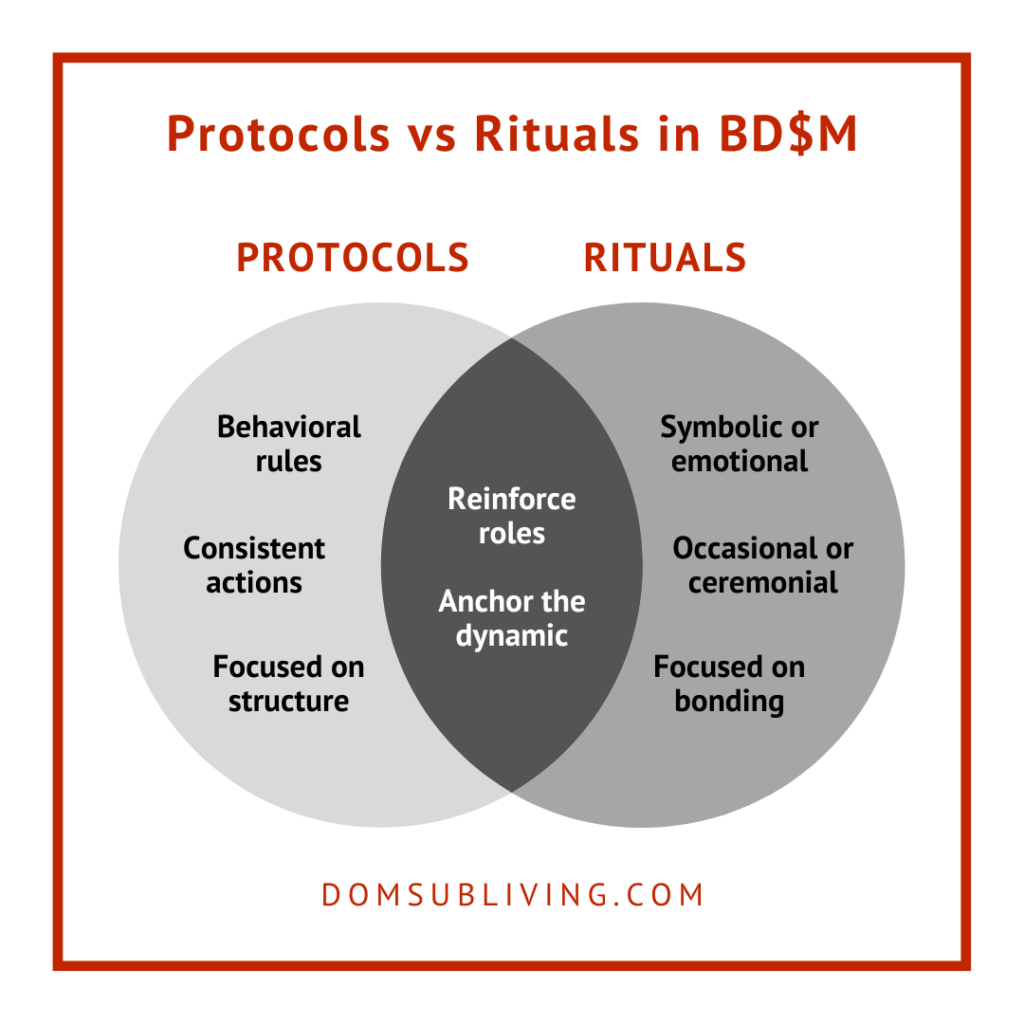
Let's refine this distinction with a short video.
The Secrets of Rituals and Protocol in BDSM (better contracts!)
In this video, creator Evie Lupine offers a clear and practical way to differentiate these concepts. This will help you understand why a ritual, not just a protocol, is the right tool for this specific task.
Watch the section from the beginning, where she defines a protocol as an "algorithm of what to do in a specific situation." Then, watch her explanation of how rules provide the baseline structure, while protocols add more flavor and clarity. Finally, listen to her definition of a ritual as the "heart" of a dynamic, an action performed with meaning and intention to connect with deeper emotions and purpose.
The handoff is a "threshold moment"—a transition from one state (the couple's normal life) to another (the temporary arrangement). Such moments are high-stakes and ripe for misunderstanding. A ritual formalizes this transition, making the roles and permissions explicit and reducing the potential for future conflict. It is an act of optimization, front-loading the emotional and social work to ensure the system runs smoothly.
2. The Strategic Objectives of the Handoff Ritual
To design an effective ritual, we must first define its objectives. From an operational perspective, the departure-day handoff ritual must achieve three specific outcomes:
- Formally Establish the Caretaker Frame: The ritual must visibly and verbally transfer temporary 'guardianship' of the wife and home from the husband to the bull. This leverages the 'best friend trust' factor by making it the explicit foundation of the arrangement. The bull is not a rival; he is a deputized caretaker.
- Sanction the Intimate Activities: It must provide an unambiguous 'green light' from the husband for the wife and bull to pursue intimacy. This directly addresses the 'unmet needs' factor, framing its fulfillment as a sanctioned, positive outcome, thereby mitigating potential guilt for the wife or hesitation for the bull.
- Reinforce the Primacy of the Marital Bond: The ritual must be structured in a way that it originates from and returns to the couple's relationship. It must be clear that this is a temporary state, authorized by the husband, and that the primary partnership remains the central, unbreakable unit.
Meeting these three objectives will set the correct initial parameters for the tour, guiding the actions of all three individuals toward the desired outcome of mutual satisfaction, discretion, and strengthened trust.
3. A Framework for Ritual Design
Designing a ritual is similar to designing any other structured process. It requires defining the core meaning, the sequence of operations, the key inputs (symbols), and the communication protocols (script). The article "BDSM Rituals" by Brandon The Dom provides an excellent framework for this.
BDSM Rituals: Transforming Rules and Protocols Into Sacred ...
This article provides the theoretical and practical foundation for our design task. It distinguishes rituals from other components of a dynamic and offers a step-by-step creation process.
First, read the section that distinguishes rituals from other tools within a "Code of Conduct." This will solidify your understanding of a ritual's unique function. Next, focus on the "How to Create Rituals" section, paying close attention to the five common elements: Sequence, Collective, Sacred Space, Symbols, and Emotions. This is your design checklist. Finally, review the list of "Common types of rituals." Note the category of "Greeting and departure rituals," which is exactly what we are designing.
This framework gives us the architectural plan. Now, we will use it to build the specific handoff ritual for our scenario.
4. Blueprint for the Departure-Day Handoff Ritual
Here is a concrete, operational blueprint for the ritual. This is a template you can use and adapt.
- Objective: To formally establish the caretaker frame for the husband's tour.
- Participants: Husband, Wife, Bull.
- Timing (Trigger): The final 30 minutes before the husband must leave for his trip.
- Location (Sacred Space): A neutral, shared space in the home, such as the living room. This is deliberate—it's not the bedroom (too intimate) or the doorway (too rushed). It is a space of calm, deliberate action.
The Ritual Sequence:
Phase 1: The Convening (0-2 minutes)
- The husband initiates the ritual. He asks his wife and his best friend to join him in the living room, indicating that he wants to speak with them both before he leaves.
- Action: All three stand or sit in a triangular formation, with the husband positioned to address both the wife and the bull easily. The atmosphere is calm and serious, but not somber.
Phase 2: The Statement of Trust & The Charge (2-5 minutes)
- The husband addresses the bull directly. This is the critical step that operationalizes the 'best friend trust' mechanism.
- Husband's Script (Example): "[Bull's Name], you're my best friend, and there's no one else in the world I trust more. While I'm away, I'm entrusting you with the two most important things in my life: my home and my wife. I'm asking you to be the caretaker here. Look after her, keep her safe, and make sure the house is secure."
- Bull's Script (Acceptance): "I understand. I accept this responsibility. You can count on me."
Phase 3: The Sanctioning & The Blessing (5-8 minutes)
- The husband now turns to his wife. This step directly addresses the 'unmet needs' mechanism by framing it as a positive, sanctioned activity.
- Husband's Script (Example): "[Wife's Name], my love. I want you to be happy while I'm gone. I know your needs, and I want them to be met. I give you my full, enthusiastic blessing to explore and enjoy yourself with [Bull's Name]. This is my gift to you. Your pleasure is important to me."
- Wife's Script (Acknowledgment): "Thank you. I understand. I love you."
Phase 4: The Symbolic Transfer (8-10 minutes)
- A physical action is needed to make the transfer of responsibility tangible.
- Action: The husband takes a spare house key from his pocket. He hands it to the bull.
- Husband's Script (Example): "This is for you while I'm away. You're in charge here."
- Bull's Action: The bull takes the key and puts it in his pocket. This is a non-verbal confirmation of the accepted role.
Phase 5: The Couple's Farewell & The Recessional (10-15 minutes)
- This phase is critical for reinforcing the primary bond. The formal, triadic part of the ritual is over.
- Husband's Action: The husband says to the bull, "Could you give us a minute?"
- Bull's Action: The bull nods and discreetly exits the room, giving the couple privacy.
- Couple's Action: The husband and wife have their own private, intimate farewell. This moment belongs only to them.
Phase 6: The Departure
- The husband leaves for his trip. The ritual is complete. The caretaker frame is now formally established, and the rules of the tour are active.
This structured sequence is far more than a simple goodbye. It is a calculated procedure designed to align expectations, mitigate emotional risk, and set the entire arrangement on a foundation of explicit trust and consent.
Conclusion
In this lesson, you have moved from designing physical environments to engineering social dynamics. You have designed a departure-day handoff ritual, a high-leverage tool for establishing the 'caretaker frame' of the tour scenario.
Key takeaways from today's lesson are:
- Rituals are social engineering tools: They are not just symbolic gestures but efficient processes for embedding meaning, clarifying roles, and managing transitions in complex human systems.
- The handoff ritual has three strategic objectives: To formally establish the caretaker role, to explicitly sanction intimacy, and to reinforce the primacy of the couple's bond.
- Effective ritual design is systematic: It involves a clear sequence of actions, deliberate use of symbols (like the key), and scripted communication, all performed in a dedicated time and space.
You have now set the stage for the tour. The roles are defined, and permission has been granted. However, a frame is useless without a clear set of rules within it. In our next lesson, we will begin to define those rules: you will define the explicit physical, emotional, and social boundaries for all wife-bull interactions during the tour.