Hello! Welcome to your first lesson in our course on Data Structures and Algorithms.
Your goal is to excel in top-tier coding interviews, and this course is designed to get you there. We'll start with the absolute fundamentals and build up to the complex patterns you'll face.
This first module, "Foundations: Complexity & Recursion," lays the groundwork for everything that follows. In today's lesson, we'll tackle a question that's at the heart of every coding interview: "How good is your solution?" We'll explore the purpose of time and space complexity analysis, which is the universal language for answering that question.
Why Not Just Time It? The Purpose of Complexity Analysis
Imagine you write an algorithm and your friend writes another to solve the same problem. You run your code on a new MacBook Pro and it finishes in 1 second. Your friend runs theirs on a 10-year-old laptop and it takes 5 seconds. Is your algorithm definitively better?
Not necessarily. The execution time depends on the hardware, the programming language, the compiler, and even what other programs are running. We need a standardized, machine-independent way to compare algorithms. This is the core purpose of complexity analysis.
Instead of measuring time in seconds, we measure how the number of operations an algorithm performs grows as the size of the input grows. This tells us how well an algorithm scales. Companies like Google and Meta operate at a massive scale, so they need engineers who can write code that remains efficient even when the input size (e.g., number of users, amount of data) becomes enormous.
To start, let's watch a short video that introduces this fundamental idea.
Time and Space Complexity - Strivers A2Z DSA Course
The following video from the 'take U forward' YouTube channel explains why simply measuring execution time is not enough and introduces the concept of time complexity as a measure of growth rate.
Watch the segment from 00:56 to 06:01. Focus on the distinction between 'time taken' and 'time complexity', and how the rate of increase with input size is the key metric.
The key takeaway is that time complexity is about the rate at which the time taken increases with respect to the input size. It's not about the absolute seconds, but about the shape of the performance curve.
This article reinforces why this skill is so critical from an interviewer's perspective.
Understanding Time Complexity/ A Crucial Skill for Coding Interviews
The article 'Understanding Time Complexity' from Algocademy provides a concise summary of why companies focus on this topic in interviews.
Read the section titled 'Why Companies Evaluate Time Complexity'. It's short but directly addresses the 'why' behind this lesson.
Big-O Notation: The Language of Complexity
So, how do we describe this "rate of growth"? We use a mathematical notation called Big-O notation. You'll see it written as , , , etc., where 'n' represents the size of the input.
Big-O provides a high-level classification of an algorithm's performance. When calculating Big-O, we follow a few simplifying rules to focus on what's most important: the dominant growth factor.
Let's watch another segment from the same video that breaks down these rules.
Time and Space Complexity - Strivers A2Z DSA Course
This segment explains the three crucial rules for calculating Big-O complexity. Understanding these rules is essential for correctly analyzing any algorithm.
Watch from 06:01 to 17:24. Pay close attention to the three rules: 1. Consider the worst-case scenario. 2. Avoid constants. 3. Avoid lower-order terms.
To summarize the rules:
- Analyze the Worst-Case: We care about the maximum number of operations an algorithm might perform. For a search algorithm, the worst case is that the item isn't in the list, and we have to check every single element. We plan for the worst.
- Drop Constants: An algorithm that performs operations and one that performs operations have the same linear growth rate. As gets huge, the constant factor of 2 becomes less significant. We simplify to just .
- Drop Less Significant Terms: If an algorithm performs operations, the term will grow much, much faster than the term. For large , the term's contribution is negligible. We simplify to just .
The following article provides excellent Java examples for these concepts, which should feel familiar given your background.
Big O Notation | Interview Cake
The article 'Big O Notation' from Interview Cake offers clear explanations with Java code snippets that illustrate these simplification rules.
Read the sections from the beginning down to and including 'We're usually talking about the "worst case"'. This will solidify your understanding of the core ideas and rules of Big-O.
Don't Forget Memory: Space Complexity
Time isn't the only resource we care about. Space complexity measures the amount of memory an algorithm uses. Specifically, it measures the additional memory (or "auxiliary space") required, not including the space taken up by the inputs themselves.
Like time complexity, we use Big-O notation to describe how the memory usage grows with the input size.
- An algorithm that only uses a few variables, regardless of the input size, has a space complexity of (constant space).
- An algorithm that creates a new array of the same size as the input has a space complexity of (linear space).
Let's see how this is defined and discuss a crucial interview best practice related to it.
Time and Space Complexity - Strivers A2Z DSA Course
This final clip from the 'take U forward' video defines space complexity and offers a vital tip for coding interviews.
Watch from 25:54 to 31:45. Focus on the definition of auxiliary space and the advice about not modifying input data.
The point about not modifying the input data is critical in a real-world software engineering context and in interviews. Modifying the original data can lead to unexpected side effects in a larger system. Unless an interviewer specifically tells you to modify an array "in-place" to save space, it's better practice to use additional memory. Explaining this choice shows you think like an experienced engineer.
The Big Picture: Comparing Complexities and Trade-offs
The purpose of all this analysis is to make informed decisions. If you have two possible algorithms, which one should you choose? Looking at their Big-O complexity gives you the answer.
This graph visually demonstrates why.

As you can see, an algorithm that is becomes unusable for large inputs much faster than an algorithm that is . In an interview, choosing the more efficient complexity class is often the key to a successful solution.
Finally, it's important to understand that there is often a time-space trade-off. You might be able to make an algorithm run faster by using more memory, or save memory at the cost of a slower runtime.
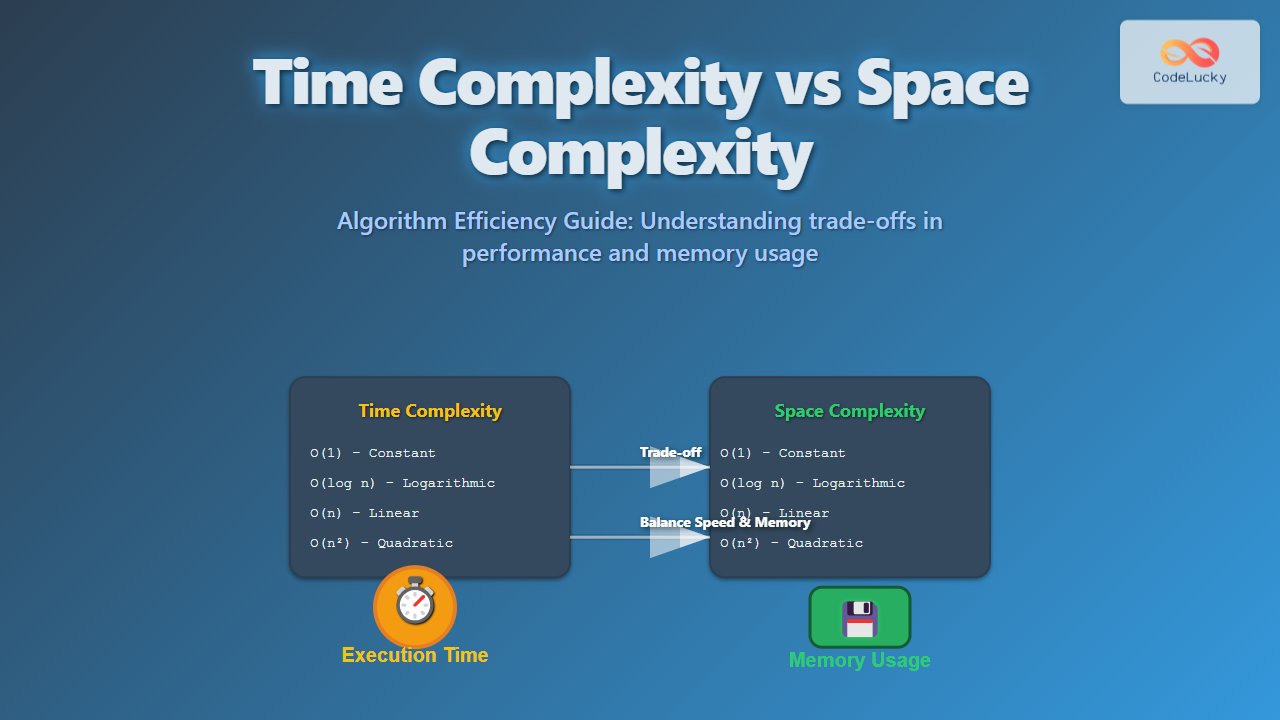
Your job as an engineer—and what interviewers are looking for—is the ability to analyze these trade-offs and choose the best approach for the given constraints.
Key Takeaways
- Purpose of Analysis: Time and space complexity provide a standardized, machine-independent way to evaluate an algorithm's efficiency, particularly how it scales with large inputs.
- Big-O Notation: This is the language we use to express complexity. It focuses on the worst-case scenario and simplifies the analysis by dropping constants and less-significant terms.
- Time Complexity: Measures the growth rate of an algorithm's runtime based on the number of operations.
- Space Complexity: Measures the growth rate of additional memory (auxiliary space) an algorithm requires.
- The Goal: In an interview, you are expected to not only solve the problem but also analyze the time and space complexity of your solution and justify your choice of algorithm.
In our next lesson, we'll move from the "why" to the "how." You'll learn how to look at iterative code (with for and while loops) and calculate its Big-O time complexity.