Introduction
Hello and welcome to the final lesson in our "Foundations" module. So far, we've focused on analyzing the performance of algorithms, calculating their time complexity with Big-O notation, and designing simple recursive solutions. Today, we'll bring these ideas together to explore one of the most fundamental concepts in algorithm design: the time-space tradeoff.
Your goal for this lesson is to learn how to analyze the time-space tradeoff in a given problem solution. This is a critical skill for coding interviews. Interviewers aren't just looking for a correct solution; they want to see that you can analyze different approaches, understand their performance implications, and articulate why one might be better than another under specific constraints.
In our last lesson, you saw how recursion works, but we also hinted that the elegance of recursion can come at a cost—namely, the memory used by the call stack. This is a perfect example of a time-space consideration. Today, we'll make this concept explicit and look at how we can deliberately use more memory to make our algorithms run much, much faster.
The Core Concept: A Balancing Act
At its heart, the time-space tradeoff is the idea that you can often decrease an algorithm's runtime by increasing its memory usage, and conversely, decrease its memory usage by increasing its runtime. It's a balancing act where you exchange one resource for the other.

To get a formal understanding of this relationship, let's watch a short video that outlines the key principles.
Time And Space Complexity of Algorithms | Time Space Trade Off in Data Structure | Intellipaat
This video from Intellipaat explains the relationship between time and space complexity and introduces the core ideas behind the tradeoff.
Watch the section from 09:27 to 12:39. Focus on understanding the following points: The definition of the time-space tradeoff. The concept of a 'spectrum' where algorithms can prioritize time or space. How techniques like dynamic programming (which uses memoization) are examples of this tradeoff.
Now that you have the high-level idea, let's make it concrete with two powerful case studies.
Case Study 1: Optimizing Recursion with Memoization
In our last lesson, you learned how to write a recursive function for the Fibonacci sequence. A naive implementation looks like this:
public int fibonacci(int n) {
    if (n <= 1) {
        return n;
    }
    return fibonacci(n - 1) + fibonacci(n - 2);
}
The time complexity of this approach is roughly , which is very slow. Why? Because we re-calculate the same values over and over again.
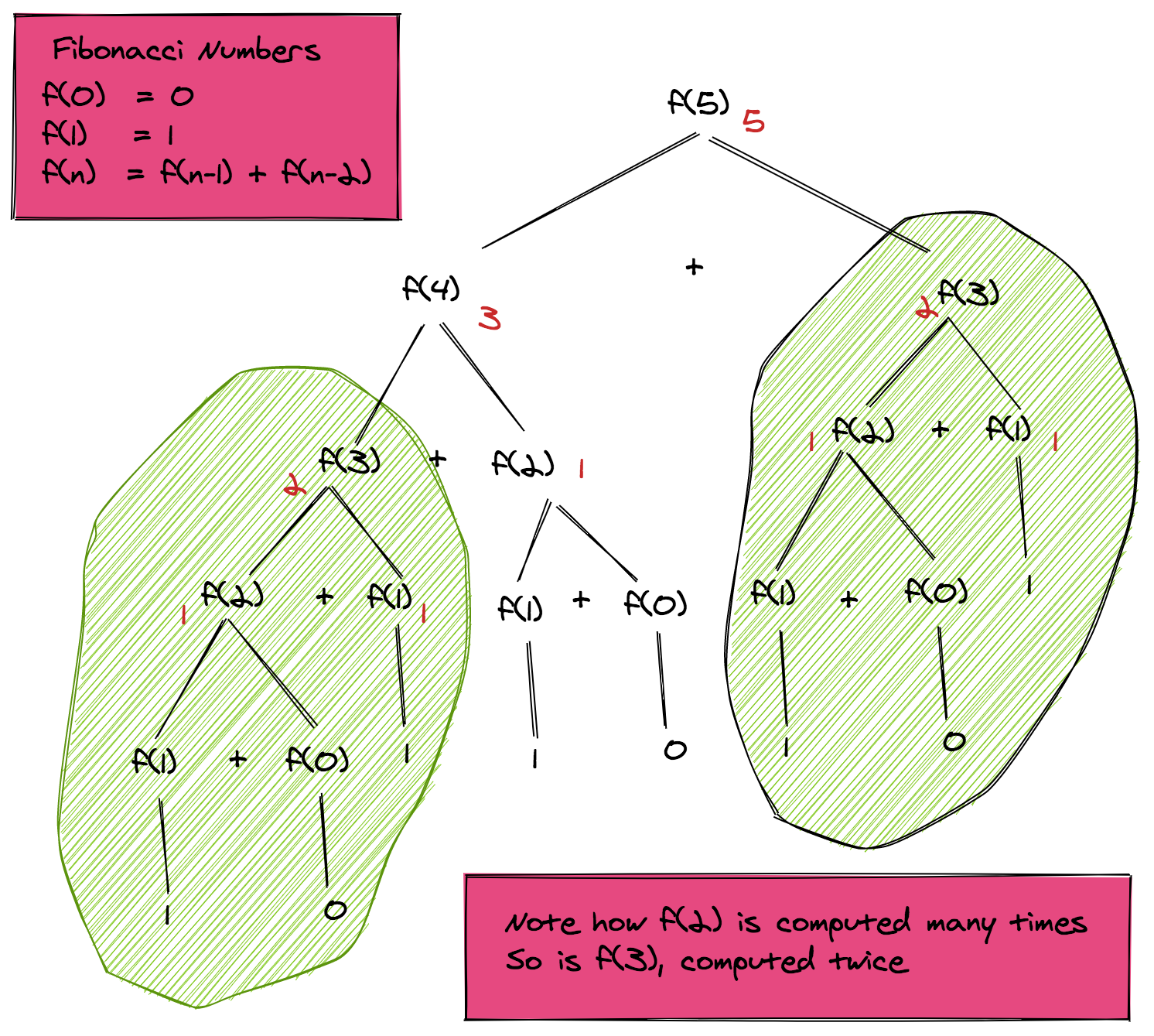
This is a classic scenario for a time-space tradeoff. We can trade space for time by storing the results of our calculations in memory (a cache) so we never have to compute them more than once. This technique is called memoization.
Analyzing Time vs. Space Trade-offs in Code: Mastering Efficient ...
The following article, 'Analyzing Time vs. Space Trade-offs in Code', provides a perfect, code-based example of this tradeoff using the Fibonacci sequence.
Read the section titled '1. Memoization and Dynamic Programming'. Compare the naive implementation with the memoized version and pay close attention to the analysis of their time and space complexities.
Let's summarize the tradeoff:
-
Naive Recursive Solution:
- Time Complexity: - Exponentially slow.
- Space Complexity: - The maximum depth of the recursion call stack.
-
Memoized Solution:
- Time Complexity: - Each Fibonacci number from 1 to
nis computed only once. A massive improvement! - Space Complexity: - We use an array or map of size
nto store results, plus for the call stack. The total is still linear.
- Time Complexity: - Each Fibonacci number from 1 to
By using extra space for the memoization table, we reduced the time complexity from exponential to linear. This is an excellent tradeoff and a very common pattern in dynamic programming.
Case Study 2: Fast Lookups with Hash Maps (The "Two Sum" Problem)
This next example is one of the most famous interview problems and a perfect illustration of the time-space tradeoff. It also serves as a direct bridge to our next module on hashing.
The Problem: Given an array of integers nums and an integer target, return the indices of the two numbers such that they add up to target.
The following blog post provides a complete, self-contained analysis of this problem in Java, walking you from a slow solution to a fast one and explicitly discussing the tradeoff.
Coding a fast O(n) solution for the TwoSum problem - Everything Dev
This article from Everything Dev provides a fantastic walkthrough of the Two Sum problem. It shows both the brute-force and optimized solutions in Java and analyzes their performance.
Please read the entire article. It's a short and highly relevant case study. As you read, focus on: The O(n^2) brute-force solution and why it's slow. The logic behind the O(n) optimized solution. How the HashMap is used to store seen numbers (the 'space' part of the tradeoff). The final comparison of the two approaches and the author's conclusion about the tradeoff.
Let's break down the tradeoff for the Two Sum problem:
-
Brute-Force Solution (Nested Loops):
- Time Complexity: - We check every possible pair of numbers.
- Space Complexity: - We only use a few variables, no extra space that grows with the input size.
-
Optimized Solution (Hash Map):
- Time Complexity: - We iterate through the array once. For each element, we do a hash map lookup and insertion, which are average-case operations.
- Space Complexity: - In the worst case, we store every number from the array in the hash map.
Here again, by investing space, we dramatically improved the time complexity from quadratic to linear. For the input sizes common in interviews and real-world applications, this is almost always the preferred solution.
Making the Decision: How to Choose?
Recognizing a tradeoff is the first step. The second, more critical step—especially in an interview—is deciding which solution to implement and being able to justify your choice. There's no single right answer; it always depends on the context.
Analyzing Time vs. Space Trade-offs in Code: Mastering Efficient ...
Let's return to the AlgoCademy article, which offers excellent guidance on how to think through this decision.
Read the sections 'Analyzing Trade-offs: When to Optimize for Time or Space' and 'Real-world Examples of Time-Space Trade-offs'. These sections provide a checklist of factors to consider.
In an interview, if you identify two possible solutions with a time-space tradeoff, a great response would be:
"I see two ways to approach this. The first is a brute-force method with time and space. The second uses a hash map to achieve time at the cost of space. Given that memory is generally plentiful and a quadratic runtime can be very slow for large inputs, the hash map approach is likely better. Do you have any specific constraints on memory usage or input size that would make the space-efficient solution preferable?"
This shows the interviewer you understand both solutions and can think critically about engineering constraints. The real-world examples mentioned in the article, such as database indexing and caching, are concepts that should be familiar from your backend development experience. They are large-scale applications of this same fundamental tradeoff.
Conclusion
This lesson concludes our foundational module. You now have the essential tools to analyze and discuss the efficiency of algorithms.
Key Takeaways:
- The time-space tradeoff is a core principle where you can often make an algorithm faster by using more memory, or more memory-efficient by making it slower.
- Memoization is a key technique that trades space (a cache) for time (avoiding re-computation), turning exponential recursive solutions into linear ones.
- Hash maps are a powerful data structure for executing time-space tradeoffs, enabling average-time lookups at the cost of space, as seen in the Two Sum problem.
- The "best" solution depends on the problem's constraints (input size, memory limits, performance requirements). In an interview, it's crucial to discuss these tradeoffs.
Preview of the Next Lesson:
The hash map solution to the Two Sum problem was a perfect preview of our next module, "Hashing & Basic Array/String Problems." In the next lesson, you will dive headfirst into this powerful pattern. You'll start by solving problems using frequency counting with hash maps, such as checking if two strings are anagrams.