Introduction
In our previous lessons, we've encountered two seemingly distinct types of "infinities" that have historically challenged physicists. First, in quantum field theory, we saw how loop diagrams lead to ultraviolet (UV) divergences, arising from integrals over arbitrarily high momentum states of virtual particles. Then, in statistical mechanics, we found that systems at a critical point exhibit a diverging correlation length, leading to fluctuations on all scales and non-analytic behavior in thermodynamic quantities—an infrared (IR) phenomenon.
Today, we will bridge these two worlds. We'll explore the profound idea that these problems are not pathologies, but rather clues pointing to a deeper truth about the nature of physical law. This lesson will articulate the concept of separation of scales and show how it necessitates the framework of effective field theories (EFTs). You will learn to see QFTs not as fundamental "theories of everything," but as descriptions that are inherently tied to a specific energy scale. This perspective, championed by Kenneth Wilson, recasts renormalization from a mathematical "trick" into a powerful conceptual tool for understanding how physics at different scales relates to one another.
The Wilsonian Revolution: From Hocus Pocus to a Theory of Theories
The initial unease with renormalization in QFT, famously described by Feynman as a "dippy process," stemmed from the feeling that it was an ad-hoc procedure to sweep infinities under the rug. The conceptual breakthrough came from realizing that these infinities were a symptom of asking a theory questions about a domain where it is not valid—the realm of arbitrarily high energies or short distances.
How Mathematical 'Hocus-Pocus' Saved Particle Physics
This article from Quanta Magazine provides a superb historical narrative of this conceptual shift. It traces the evolution of renormalization from a controversial technique in QED to the modern Wilsonian framework.
Please read the entire article. As you read, focus on how the problem of infinities in particle physics was eventually illuminated by ideas from condensed matter physics, specifically the study of critical points and universality. Pay attention to the roles of Gell-Mann, Low, Kadanoff, and finally, Wilson in uniting these ideas. The article does a great job of explaining how this led to viewing QFTs as "effective" theories.
The article you just read introduces the modern perspective: any quantum field theory we use is likely just an effective description, valid only up to a certain energy scale, or below a certain distance. The infinities are a signal of our ignorance about the "true" physics that takes over at scales beyond this cutoff. Ken Wilson's crucial insight was to take this ignorance seriously and build it directly into the theoretical framework.
This philosophy is beautifully explained by Sean Carroll.
The Biggest Ideas in the Universe | 11. Renormalization
This video segment explains Wilson's core idea: we should explicitly admit that we don't know what happens at very high energies and see what consequences this has for the physics we can observe.
Please watch the segment from this point. Carroll introduces the idea of a cutoff energy, E_*, which divides the world into high-energy (UV) modes we are ignorant of, and low-energy (IR) modes we want to describe. This simple act of introducing a cutoff renders the troublesome loop integrals finite.
The Logic of Effective Field Theory
Wilson's philosophy gives rise to the practical framework of Effective Field Theory (EFT). The central principle is that to describe physics at some low-energy scale , we don't need to know the detailed dynamics of what is going on at a much higher energy scale . The effects of the high-energy "UV physics" can be systematically incorporated into the low-energy "IR theory" without knowing the precise details of the UV completion.
Constructing an EFT involves three key steps:
- Identify the relevant degrees of freedom: What are the particles or fields that exist and interact at the energy scale of interest? For example, when studying the hydrogen atom, the relevant degrees of freedom are the electron and proton, not the quarks and gluons inside the proton.
- Identify the symmetries: What are the symmetries that govern the interactions of these degrees of freedom? This includes spacetime symmetries (like Lorentz invariance) and internal gauge symmetries (like electromagnetism).
- Establish a power counting scheme: Identify an expansion parameter, typically the ratio of the low-energy scale to the high-energy scale (). This allows you to organize your theory as a systematic expansion, where you can calculate to any desired precision by including more terms.
This leads to two main ways of using EFTs, depending on what you know about the higher-energy theory.
1. Introduction to Effective Field Theory (EFT)
This lecture by Prof. Iain Stewart from MIT OpenCourseWare provides a very clear distinction between the two main approaches to building an EFT.
Watch the segment from this point, where he explains the top-down and bottom-up approaches.
To summarize Prof. Stewart's points:
- Top-Down: We know the fundamental, high-energy theory (e.g., the Standard Model) and we want to derive a simpler effective theory at low energies. We do this by a procedure called "integrating out" the heavy particles. Their effects are not lost, but are absorbed into new interactions and corrections to the couplings in the low-energy theory.
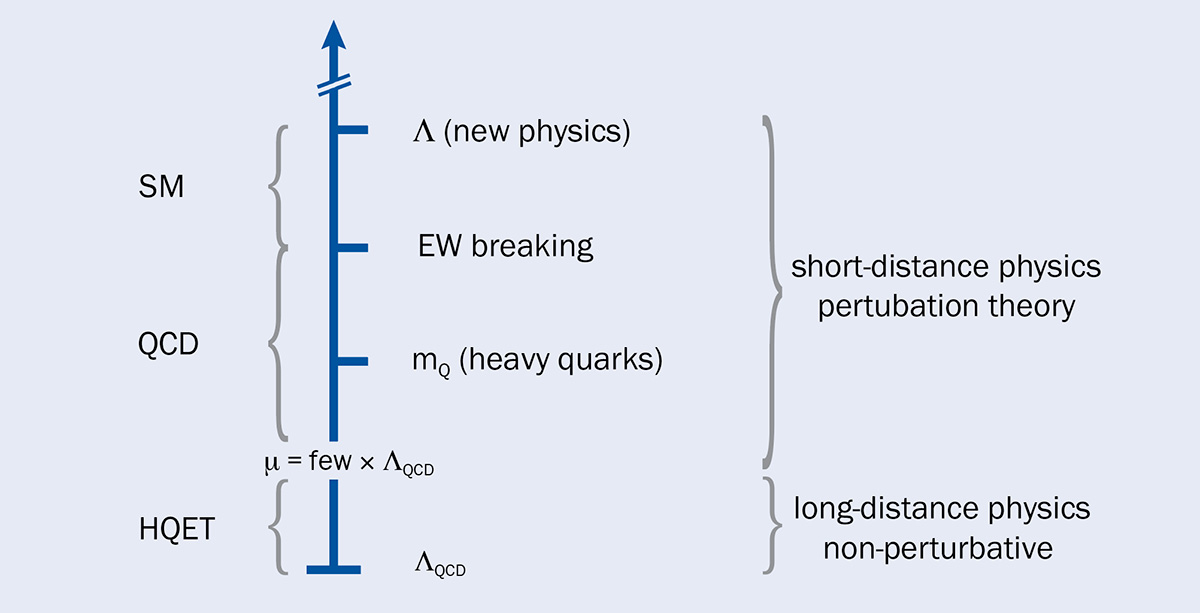
- Bottom-Up: We don't know the underlying high-energy theory. We construct the most general possible Lagrangian for our low-energy degrees of freedom that is consistent with the known symmetries. The unknown high-energy physics is parameterized by a set of coupling constants for these new interactions, which must be determined by experiment. The Standard Model itself can be viewed as a bottom-up EFT, with its interactions representing the leading terms in an expansion whose higher-order terms might be set by some unknown scale of new physics, .
This logic leads to a beautiful picture of physical law as a "tower of theories," where each theory is an effective description valid within a certain range of energies.
Why Separation of Scales Works: Relevant and Irrelevant Operators
You might wonder: if high-energy physics affects the low-energy theory, how can we ever calculate anything without knowing everything? The magic lies in the power counting. The effects of high-energy physics on low-energy observables are suppressed by powers of the high-energy scale .
This is best understood through dimensional analysis. As Sean Carroll explains, every term we can write in a Lagrangian has a certain "mass dimension." In a four-dimensional spacetime, the Lagrangian density must have a mass dimension of 4. This simple fact has profound consequences for the coupling constants of different interaction terms.
The Biggest Ideas in the Universe | 11. Renormalization
This next segment from Sean Carroll's video is a masterclass in using dimensional analysis to understand the structure of EFTs. He derives the dimensions of a scalar field and its interaction terms.
Please watch carefully from this point. Follow his argument for how the coupling constants for terms like \phi^3, \phi^4, \phi^5, etc., must have different mass dimensions to keep the Lagrangian's total dimension fixed at 4.
As Carroll demonstrates, this leads to a crucial classification of operators:
- Relevant Operators: These are terms whose coupling constants have a positive mass dimension (e.g., a mass term ). They become more important at low energies.
- Marginal Operators: These are terms whose coupling constants are dimensionless (e.g., a interaction in 4D). Their importance is roughly independent of the energy scale (at least at tree-level).
- Irrelevant Operators: These are terms whose coupling constants have a negative mass dimension (e.g., a interaction). They become less important at low energies, as their effects are suppressed by powers of the high-energy scale .
The effects of the unknown high-energy physics are encoded in an infinite series of irrelevant operators in the low-energy EFT. Because these operators are suppressed by powers of , their contributions are small as long as we are probing the theory at energies . This is the mathematical reason why the separation of scales works and why we can make precise predictions using an EFT without knowing the full theory of quantum gravity.
A Physical Consequence: Running Couplings
This framework isn't just a mathematical convenience; it has direct physical consequences. The parameters of our effective theory, which we call "coupling constants," are not truly constant. Their values depend on the energy scale at which we perform our measurement. This is known as the running of coupling constants.
A classic example is the electric charge. The vacuum of spacetime is a seething soup of virtual particle-antiparticle pairs. A "bare" electron is surrounded by a cloud of these virtual pairs. The virtual positrons are attracted to the electron, while the virtual electrons are repelled. This creates a screening effect, similar to the polarization of a dielectric material.
The Biggest Ideas in the Universe | 11. Renormalization
Carroll provides an excellent intuitive picture of this phenomenon, known as vacuum polarization.
Watch his explanation from this point. He explains how the measured or "effective" charge of the electron depends on how closely you look at it.
If you probe the electron with a low-energy (long-wavelength) photon, you see the bare charge partially shielded by this cloud of virtual pairs. If you hit it with a high-energy (short-wavelength) photon, you penetrate deeper into the cloud and see a larger effective charge. Therefore, the fine-structure constant, , is not a constant but a function of energy: . This has been precisely verified by experiments. The running of couplings is the physical manifestation of moving between different scales in an effective theory.
Conclusion
In this lesson, we have reframed our understanding of renormalization. It is no longer about "hiding infinities," but about describing how physical laws change with scale.
Here are the key takeaways:
- Separation of Scales: Physics at low energies is largely insensitive to the precise details of physics at very high energies.
- Effective Field Theories (EFTs): This separation allows us to construct EFTs, which are accurate, predictive descriptions of nature within a specific range of energies. They are built using the relevant degrees of freedom and symmetries for that scale.
- Power Counting: The effects of high-energy physics are systematically included in an EFT as a series of operators. Those with higher mass dimension ("irrelevant operators") are suppressed by powers of the high-energy scale, which is why the framework is predictive.
- The Wilsonian View: All our current theories, including the Standard Model, are best thought of as EFTs. The "infinities" of QFT are artifacts of naively extrapolating these theories to arbitrarily high energies where they are no longer valid.
We have seen that parameters like charge are not fixed constants but change with the energy scale of our measurement. This brings us to the next crucial concept. In our next lesson, we will formalize this idea by distinguishing between "bare" parameters—the hypothetical constants appearing in our Lagrangian—and "physical" parameters—the quantities we actually measure in experiments. We will see that the core procedure of renormalization is what connects the two.