Introduction
In our last lesson, you learned how to construct a persuasive proposal that secures a client's initial "yes." Now, it's time to formalize that agreement. A proposal outlines the plan; a contract provides the legal rails to keep the project on track and protect both you and your client.
Given your background in finance and audit, you'll naturally appreciate the precision and risk-management function of a strong contract. Think of it as the master service agreement that underpins the "statement of work" detailed in your proposal. It’s not a sign of mistrust, but a mark of professionalism that creates clarity and prevents costly misunderstandings down the line.
In this lesson, you will learn to identify the essential clauses for a freelance design contract, with a specific focus on four critical areas: scope, revisions, intellectual property, and payment.
1. Proposal vs. Contract: Setting the Legal Foundation
First, let's clarify the distinction. A proposal sells the work, outlining objectives and price. A contract governs the work, detailing the legal terms and conditions.
10 Design Contract Must-Haves - Everything You Need In a Design Contract
The video "10 Design Contract Must-Haves" by Philip VanDusen starts by perfectly explaining this difference.
Watch the brief introduction from proposal vs. contract. The speaker calls the contract the "cover your ass" document, which is a direct but accurate way to think about its protective function.
With that distinction clear, let's dissect the core components of a design contract.
2. The "What": Defining Scope and Managing Revisions
This is arguably the most critical section of a design contract, as it's the primary defense against "scope creep"—the slow expansion of a project beyond its original boundaries. Your analytical skills are a major asset here, allowing you to define project parameters with precision.
The key is to move from a general description to a measurable production plan.
UI/UX Designer Service Agreement: Scope Creep and Revision ...
The article from Contractable.ai is an outstanding resource written specifically for UI/UX designers. It provides a structured, logical approach to defining scope and revisions that will resonate with your background.
Please read the first two main sections: "Define ‘Scope’ like a designer (not like a lawyer)": Focus on how it recommends listing deliverables in measurable units (e.g., "5 unique screens") and explicitly stating what is not included. "The core problem: revisions without limits" and "Set revision limits that still feel fair": Pay close attention to how it defines what a "revision" is and what it is not, and the different models for limiting them (e.g., round-based).
To visualize this, here is a sample contract clearly defining the scope and deliverables.
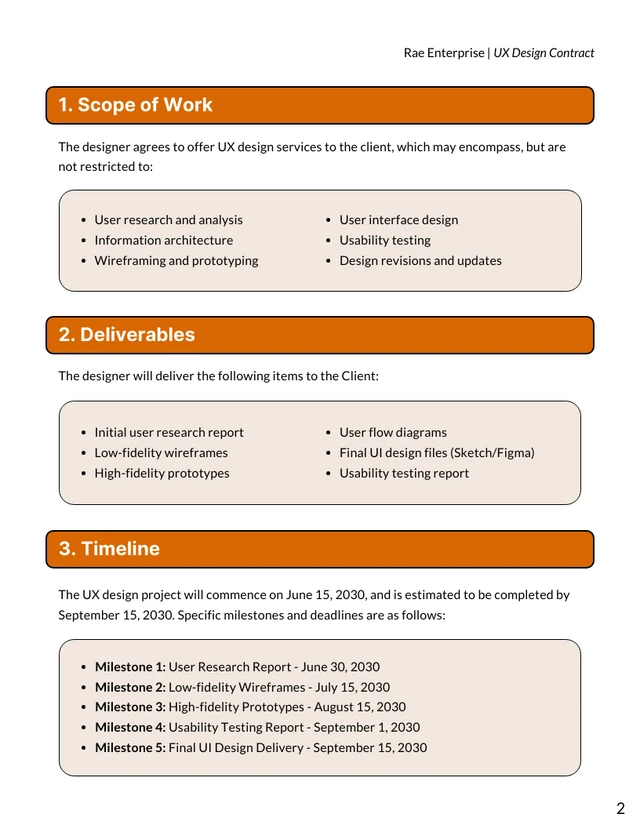
Key Takeaways on Scope & Revisions:
- Be Specific: Instead of "social media graphics," write "5 static Instagram post templates (1080x1080px) and 2 Instagram Story templates (1080x1920px)."
- Define "Revision": Clarify that a revision is for minor changes (color, typography, placement) on an approved layout, not a complete redesign or change in direction.
- Set Limits: The "two rounds of revisions per phase" model is a simple, effective industry standard. It encourages clients to provide consolidated, thoughtful feedback.
3. The "How Much": Payment Terms
This section defines your compensation and is the financial engine of your freelance business. Your commerce background makes you uniquely equipped to structure this section professionally. A strong payment clause protects your cash flow and reinforces the project's boundaries.
How to Create a Freelancer Contract (Step-by-Step Tutorial!)
The video "How to Create a Freelancer Contract" from We Are Indy gives a solid overview of standard payment and termination clauses.
Please watch these two crucial segments: The Payment Section: Note the emphasis on deposits, payment deadlines, and late fee penalties. Termination Clause: Pay attention to the concept of a "kill fee," which ensures you're compensated for work done if a client cancels the project prematurely.
Essential Payment Clauses:
- Payment Schedule: Link payments to project milestones. For UI/UX, phase-based billing is ideal. The resource "Free Freelance UI/UX Designer Contract Template" suggests a common structure:
- 25-50% non-refundable deposit upfront to begin work.
- 25% upon approval of wireframes.
- 25% upon approval of high-fidelity visual design.
- Final 25% upon handoff of final files.
- Late Fees: Specify an interest penalty for overdue invoices (e.g., 1.5% per month). This is a standard business practice that encourages timely payment.
- Kill Fee: A cancellation clause that stipulates if the project is cancelled by the client, they must pay for all work completed up to that point, plus a percentage of the remaining fee to cover your lost booking.

4. The "Who Owns What": Intellectual Property (IP) and Publication Rights
This section is vital and often misunderstood. It determines who owns the final designs, the preliminary concepts, and whether you can show the work in your portfolio.
10 Design Contract Must-Haves - Everything You Need In a Design Contract
Let's return to the "10 Design Contract Must-Haves" video, as it explains IP and publication rights for designers very clearly.
Please watch these two sections: Ownership: This explains the crucial difference between the final, chosen design (which the client owns after payment) and all the conceptual work and unused variations (which you, the designer, retain ownership of). Publication: This addresses your right to display the work in your portfolio—a right you must explicitly reserve in the contract.
Key IP and Publication Clauses:
- Ownership Transfer: State clearly that the client gains full ownership and copyright of the final, approved design only after the final payment has been made.
- Designer's Rights: Specify that you (the designer) retain ownership of all preliminary concepts, sketches, and rejected designs. This prevents a client from taking your unused ideas to another designer.
- Portfolio Rights (Publication): Include a clause that grants you the right to showcase the final work in your portfolio, on social media, and for other self-promotional purposes, sometimes after a specified date (e.g., after the client's official product launch).
5. A Practical Checklist for Your Contract
Your contract is your primary business tool. To ensure it's robust, you can use a checklist to review any template you find or create.
Free Freelance UI/UX Designer Contract Template Canada (2026)
This Canadian freelance resource contains an excellent, comprehensive checklist that summarizes everything we've discussed and more. While some legal specifics are Canadian, the checklist items are universally applicable best practices.
Review the "UI/UX Designer Contract Template Checklist" at the end of the article. Use it as a guide to ensure your future contracts are thorough.
This checklist acts as a final quality control, much like a pre-audit review, ensuring all critical components are in place before you send the contract to a client.
Conclusion
You've now dissected the legal backbone of a freelance design project. By understanding and implementing these essential clauses, you elevate your business from a creative service to a professional consultancy. Your unique background allows you to approach this not as a legal burden, but as a strategic framework for building clear, respectful, and profitable client relationships.
Key Takeaways:
- Scope is Your Shield: Define deliverables in measurable units and explicitly state what is not included to prevent scope creep.
- Revisions Need Rules: Define what a "revision" is and limit the number of rounds to keep the project moving forward efficiently.
- Get Paid on Time: Structure payments around milestones, always take a deposit, and include penalties for late payments.
- Own Your IP: Ensure the contract states that ownership of the final design transfers only upon final payment, and that you retain rights to your conceptual work.
- Reserve Portfolio Rights: Always include a clause allowing you to showcase your work. Your portfolio is your most valuable marketing asset.
Preview of the Next Lesson:
With your proposal and contract structure in place, the final step before closing a deal is often presenting your ideas. In the next lesson, we'll focus on how to build a concise pitch deck to present a design solution to a client, combining your design work with a compelling narrative that reinforces your value.