Welcome to the final lesson of our foundational module. In our last session, we deconstructed the anatomy of a habit into its four fundamental stages: cue, craving, response, and reward. You practiced mapping this Habit Loop to one of your own behaviors, which gave you a diagnostic model for understanding how your habits work.
Today, we will connect that model to a practical framework for action. This lesson introduces the Four Laws of Behavior Change and explicitly links each law to its corresponding stage in the habit loop. Your goal is to understand this connection, as it forms the core operating system for the entire Atomic Habits method. Mastering this framework will equip you with a complete set of levers for systematically building good habits and dismantling bad ones.
From Diagnosis to Prescription
Think of the process you might use in your work as a business analyst. First, you analyze a system to understand its current state and identify its core components and processes (the "as-is" analysis). Only then do you formulate a solution or a set of recommendations to achieve a desired future state.
The Atomic Habits framework operates in the same way:
- The Habit Loop (Cue, Craving, Response, Reward) is your diagnostic tool. It allows you to analyze any habit and see its underlying structure.
- The Four Laws of Behavior Change are your prescription. They provide a clear set of rules for redesigning that structure to produce better outcomes.
Let's hear James Clear himself explain how he bridges the gap between the four-stage model and this actionable framework.
How to make or break a habit with the 4 Laws of Behavior Change | Peter Attia, M.D. with James Clear
In this segment from an interview with Dr. Peter Attia, James Clear outlines his rationale for creating the Four Laws as a way to operationalize the science of habit formation.
First, watch the brief clip where he introduces the purpose of the Four Laws (his introduction). Then, continue watching as he walks through each of the Four Laws for building a good habit, explaining how each one maps directly to a stage in the habit loop.
As Clear explains, each law is a lever designed to influence a specific stage of the habit formation process. The logic is straightforward and powerful:
| Stage of the Habit Loop | Corresponding Law | Purpose |
|---|---|---|
| 1. Cue | Make It Obvious | A habit cannot begin if you don't notice the trigger. This law is about making the starting pistol unmissable. |
| 2. Craving | Make It Attractive | The craving provides the motivation to act. This law is about amplifying the anticipation of a reward. |
| 3. Response | Make It Easy | Humans are wired to follow the path of least resistance. This law is about reducing the friction for your desired action. |
| 4. Reward | Make It Satisfying | The brain learns through reinforcement. This law is about giving your brain a signal of success to close the feedback loop. |
The Complete System: Building Good Habits and Breaking Bad Ones
One of the most effective aspects of this framework is its symmetry. To break a bad habit, you don't need a new set of rules; you simply invert the Four Laws. This provides a single, unified model for all behavior change.
Let's return to the interview to hear Clear explain these inversions.
How to make or break a habit with the 4 Laws of Behavior Change | Peter Attia, M.D. with James Clear
Here, James Clear completes the framework by explaining how to reverse each law to make bad habits harder to perform.
Watch this segment from where he details the four inversions for breaking bad habits, connecting each one back to a stage in the habit loop.
This gives us a complete model. The same levers you use to build a habit can be pushed in the opposite direction to dismantle one.
To help you consolidate this entire system, this workbook excerpt provides a perfectly clear and concise table summarizing the framework.
[PDF] Workbook for James Clear's Atomic Habits
This workbook provides a clear, structured summary of the core concepts.
Read the section titled "Ch 3: How to Build Better Habits..." to review the habit loop. Then, pay close attention to the table that maps each of the Four Laws—for both forming a good habit and breaking a bad one—to its relevant step in the loop. You can find this table right after the text "These four steps...".
Visualizing the Framework
A visual summary can often make a framework like this click. The following cheatsheet provides an excellent one-page overview of the entire system we've just discussed. It shows how the four stages of the Habit Loop lead directly to the Four Laws of Behavior Change and their practical applications.
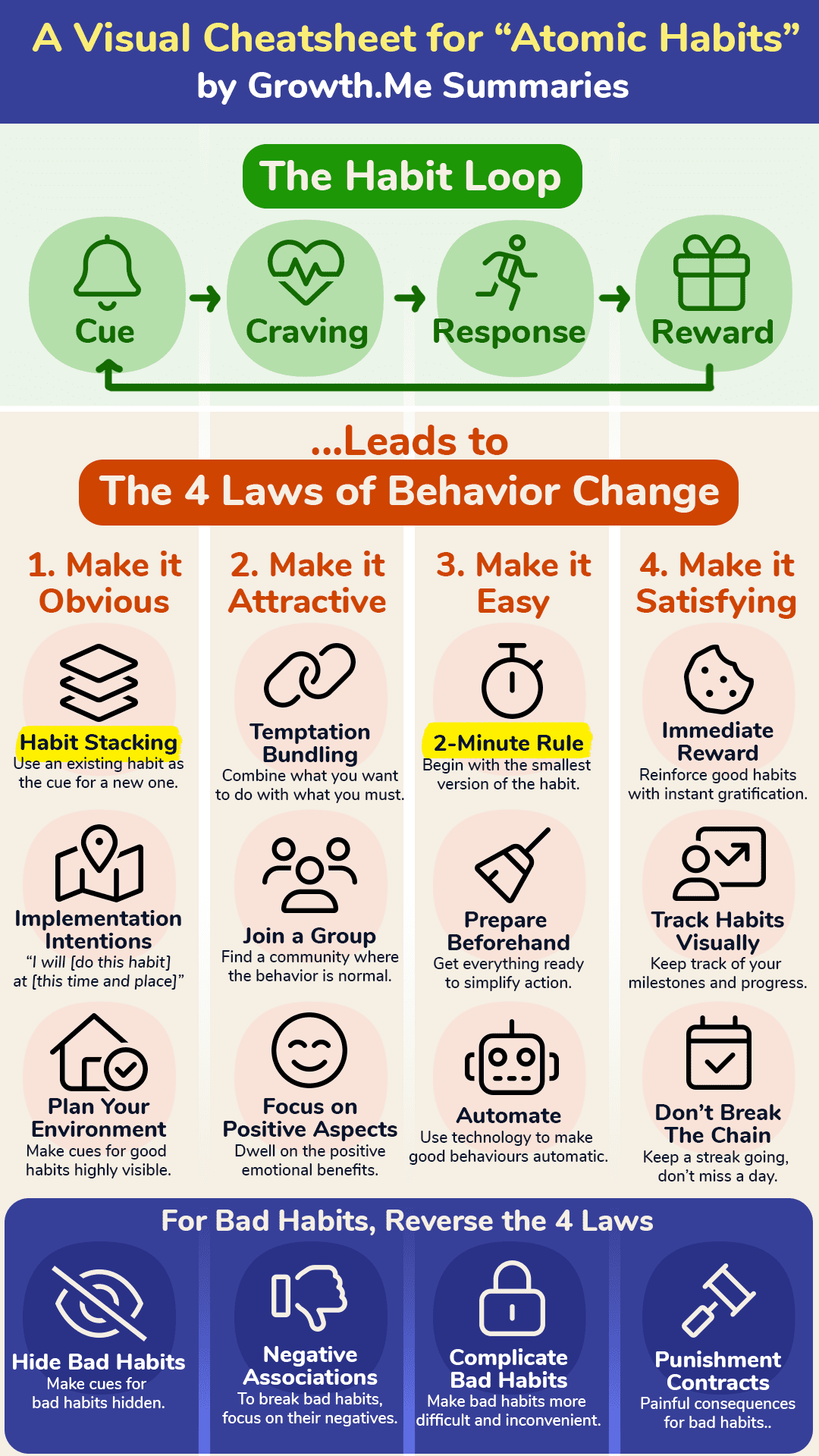
Take a moment to trace the flow in this diagram. You can see the problem phase (Cue, Craving) and the solution phase (Response, Reward). The Four Laws give you a specific strategy for intervening in each phase, either to encourage a good habit or discourage a bad one. This is the complete system in a nutshell.
Conclusion
This lesson bridges the gap between the theory of how habits work and the practical strategies for what to do about them. You have now assembled the complete foundational model of the Atomic Habits system.
Here are your key takeaways:
- From Diagnosis to Prescription: The Habit Loop is the tool for analysis, while the Four Laws of Behavior Change are the tools for action.
- A Law for Every Stage: Each of the Four Laws directly corresponds to one stage of the habit loop, giving you a specific lever to pull to influence that stage.
- Law 1 (Make It Obvious) targets the Cue.
- Law 2 (Make It Attractive) targets the Craving.
- Law 3 (Make It Easy) targets the Response.
- Law 4 (Make It Satisfying) targets the Reward.
- A Symmetrical System: To break a bad habit, you simply invert each law (Make It Invisible, Unattractive, Difficult, Unsatisfying).
You have now completed the first module, "Foundations of Habit Formation." You understand why small, compounding changes are so powerful, why identity is more important than outcomes, and the mechanical loop that drives all behavior. You are now fully equipped to move from theory to practice.
In our next lesson, we will begin Module 2 and dive deep into the 1st Law: Make It Obvious. Your first action-oriented task will be to conduct a "Habits Scorecard" to build awareness of the cues that are currently shaping your daily life.