Welcome back!
In our previous lesson, we explored the different cloud service models—IaaS, PaaS, and SaaS—by looking at how much of the technology stack you manage versus the provider. We established this is the "what" of cloud services.
Now, we shift our focus to the "where." This lesson addresses the different cloud deployment models: public, private, and hybrid. We will compare their characteristics and, most importantly, analyze business requirements to determine which model is the most appropriate choice. This skill is fundamental for the AWS Cloud Practitioner exam, which often uses scenario-based questions to test your understanding of these core concepts.
Defining the Cloud Deployment Models
At its core, the choice of a deployment model answers the question: Who owns and operates the infrastructure, and who has access to it? Is it a shared environment open to everyone, a dedicated environment for a single organization, or a combination of the two?
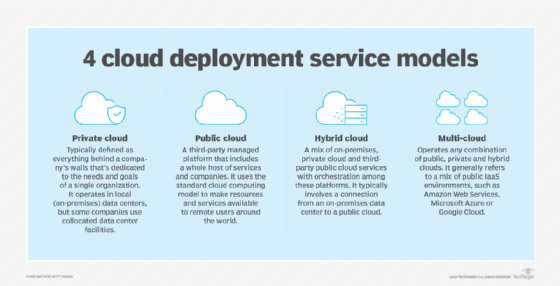
The image below illustrates the primary deployment models you need to know.
To establish a solid foundation, let's turn to AWS's own definitions and comparisons. The following article clearly explains the core concepts and key differences between the two foundational models: public and private cloud.
Public Cloud vs Private Cloud - Difference Between ...
This official AWS article provides authoritative definitions and a direct comparison of public and private cloud models, which is essential knowledge for the certification exam.
Please read the following sections to understand the fundamental concepts and differences: Start with the introduction to see how AWS defines public and private clouds. Then, jump to the section "Key differences: public vs. private cloud" and read the detailed comparisons on Infrastructure, Security, Deployment, and Ongoing costs. Finally, read the section that introduces the Hybrid Cloud model as an integration of both.
Analyzing the Models: Control, Cost, and Agility
As the AWS article highlights, the choice between deployment models involves a series of trade-offs. The "right" model depends entirely on an organization's priorities, such as security regulations, budget, scalability needs, and existing technical investments.
A great way to understand these trade-offs is through analogies and real-world examples. The following article does an excellent job of this, comparing the models to different types of housing.
Choosing the Best Cloud Deployment Model for Your Needs
This article uses intuitive analogies and provides clear, real-world examples that will help you analyze the decision-making process for choosing a deployment model.
Read the following sections, paying close attention to the use cases and the real-world examples provided for each model: Public Cloud: Read about the "Apartment Rental" model and how a company like Airbnb leverages AWS for scalability. Private Cloud: Understand the "Owning Your Own Home" model and why a financial institution like Bank of America chooses it for security and control. Hybrid Cloud: Explore the "Condo Living Experience" and how a company like Netflix uses a hybrid approach to balance security with massive-scale content delivery.
A Quick Video Reinforcement
To hear these concepts explained in a slightly different way, watch the first part of this video from ACI Learning. The speaker provides a concise overview and uses a practical startup example to illustrate the hybrid model.
Public Cloud vs Private Cloud vs Hybrid Cloud - Major Differences Explained & Examples
This video offers a conversational explanation of the deployment models and discusses why hybrid has become the most popular approach in many enterprises.
Watch the following segments: Public Cloud: The standard definition. Private Cloud: Building it yourself in your own data center. Hybrid Cloud: The most popular model, with a practical example of a fictional startup, CATPRO.TV.
Comparing the Models Side-by-Side
Now that we've explored each model, let's bring it all together in a structured comparison. The table below succinctly summarizes the key differences across the most important criteria.

As you can see, the decision hinges on balancing competing priorities:
- Public Cloud prioritizes low cost and high scalability at the expense of granular control.
- Private Cloud prioritizes high control and security at the expense of higher cost and slower scalability.
- Hybrid Cloud aims to provide a balance, offering flexibility to place workloads in the optimal environment.
Applying Your Knowledge: Scenario-Based Decisions
For the Cloud Practitioner exam, you won't just define these models; you'll apply them. Let's walk through some scenarios, similar to what you might encounter.
Scenario 1: A financial services company
- Requirement: The company needs to modernize its core banking application, which processes sensitive customer financial data. It is subject to strict regulatory compliance (like PCI-DSS) that mandates data isolation and specific security controls. The company has a large, expert IT team and significant capital budget.
- Analysis:
- Control and Security are the non-negotiable top priorities.
- The need for data isolation makes a multi-tenant public cloud unsuitable for the core application.
- The high upfront cost and management overhead are acceptable given the security requirements and available resources.
- Recommendation: A Private Cloud is the most appropriate choice. It provides the single-tenant environment and maximum control necessary to meet stringent regulatory and security demands.
Scenario 2: A mobile gaming startup
- Requirement: A small team of developers is launching a new free-to-play mobile game. They have very little upfront capital. They need to be able to scale infrastructure instantly if the game goes viral but also want to keep costs minimal during quiet periods.
- Analysis:
- Low cost and rapid scalability are the primary drivers.
- There is no budget for purchasing hardware or managing a data center.
- The pay-as-you-go model of the public cloud perfectly aligns with the unpredictable nature of their workload. Your own experience with AWS services like Lambda, S3, and API Gateway demonstrates how such scalable, low-overhead systems are built.
- Recommendation: The Public Cloud (e.g., AWS) is the clear winner. It allows the startup to launch with minimal investment and scale on demand, converting capital expenditure (CapEx) into operational expenditure (OpEx).
Scenario 3: A large manufacturing firm
- Requirement: The firm runs its factory floor operations on a legacy system hosted in its on-premises data center. This system requires extremely low latency to control machinery and cannot tolerate internet connectivity disruptions. The firm also wants to launch a new analytics platform to process production data, which requires massive, temporary compute power for quarterly reports.
- Analysis:
- The factory system requires the control and low latency of an on-premises deployment (a private cloud).
- The analytics platform is a perfect workload for the public cloud, where large amounts of compute power can be provisioned on-demand and then shut down to save costs.
- Recommendation: A Hybrid Cloud approach is ideal. The firm can keep its mission-critical, latency-sensitive factory system on its private cloud while "bursting" its data analytics workloads to the public cloud. Your experience building data pipelines with services like AWS Glue and Step Functions is relevant here, as such services are often used in hybrid scenarios to process data from on-premises sources.
Conclusion
In this lesson, we dissected the three main cloud deployment models, moving from foundational definitions to real-world application. You learned how to compare public, private, and hybrid clouds based on their core trade-offs and how to select the best model for a given business scenario.
Here are the key takeaways:
- Public Cloud: A multi-tenant environment owned by a provider like AWS. It offers immense scalability and a pay-as-you-go model, making it ideal for workloads with variable traffic and for organizations prioritizing agility and cost savings.
- Private Cloud: A single-tenant environment dedicated to one organization. It provides maximum control and security, making it suitable for organizations with sensitive data, strict regulatory requirements, and the capital to manage their own infrastructure.
- Hybrid Cloud: An integrated environment that combines private and public clouds. It offers the flexibility to keep sensitive workloads private while leveraging the public cloud's scale and cost benefits for other applications.
We have now covered the "what" (service models) and the "where" (deployment models). In our next lesson, we will tie these concepts together by exploring the six advantages of cloud computing as defined by AWS. You'll see how these models enable benefits like trading capital expense for variable expense and benefiting from massive economies of scale.